
Why 30 Days: A Sobriety Simulator chose to explore addiction recovery as a video game
Posted: 31 Aug 2026Safe In Our World spoke with Tate Pollock, Creative Director of Not Right Now Studios, about their upcoming visual novel RPG, ‘30 Days: A Sobriety Simulator,’ to discuss addiction recovery and how video games can open up more nuanced conversations about difficult real-world experiences.
Content Warning: This article discusses addiction and substance use, relapse, bereavement, and mental health challenges related to living with or supporting someone experiencing addiction.
What’s the story behind 30 Days: A Sobriety Simulator?
30 Days: A Sobriety Simulator follows you, a recovering addict returning to New Miami, a cyberpunk megacity, after a life-threatening overdose. Struggling with the recent death of your father and a growing dependence on the “good dream” drug Stardust, you are given an ultimatum by a family physician: stay sober for thirty days, or risk death.

Throughout 30 Days, players build strong relationships, explore the massive city, and work a soul-crushing office job, all in an attempt to build a life you want to live in, rather than escape from.
The goal is deceptively simple: make it to Day 30 without using Stardust. However, staying off Stardust isn’t a guaranteed outcome. It’s difficult to heal, to avoid relapse, and we want to reflect that in our gameplay.
When players relapse, it’s not simply game over. Their sobriety counter resets, but the game keeps track of all the progress they’ve made with the people and world around them, even as they face temporary setbacks.
What begins as a personal story about grief, addiction, and recovery gradually expands into a larger mystery involving powerful corporations, buried secrets, and a community of people working together to change the future of their city.
Why create a game about addiction and recovery?
My family has struggled with addiction for generations. My sibling (and assistant director) Liz and I were exposed to the harsh realities of addiction from a young age, losing our father, brother, stepmother, and uncle – most of them to opioid addiction. These experiences have shaped the story and mission behind this project.
In 2025, I obtained a PhD in Neuroscience, specializing in addiction research. While Liz finished film school, I gained experience as an educator. Our backgrounds have helped us approach 30 Days with care, not merely as an educational game or a piece of media about addiction, but something that could help people gain a deeper, contextualized understanding of recovery.
Making a game centred around addiction has been something we’ve both talked about doing for years, but there was always a reason to say “not right now.”
There came a point where we decided it was now or never, and so Not Right Now Studios was born.
Our debut title, 30 Days: A Sobriety Simulator, is about what happens after the crisis. Many stories about addiction focus on hitting rock bottom; we wanted to explore what comes next.

How does 30 Days tell an authentic story of addiction?
The game examines addiction from an intersectional perspective, portraying the many different lived experiences of its characters. Why was this important for you to include, and how has it shaped the game design process?
There is no one template for addiction, or for someone dealing with a substance use disorder, even if popular culture often treats it that way.
Many people picture addiction as something obvious: someone living on the street, someone whose life has completely fallen apart, or someone whose substance use is visible to everyone around them. In reality, it can be significantly less obvious. The friend who parties a little too hard every weekend, the boss who happily chugs a twelve-pack after work, or the acquaintance who slowly becomes dependent on opioids prescribed for an injured back.
People begin substance use for many reasons, including mental health struggles, chronic pain, loneliness, social pressure, grief, or simply because a substance was available at the wrong place or time. Inevitably, recovery journeys are equally if not more diverse.
Because of that, we wanted the player to meet a wide variety of characters. Not everyone in 30 Days agrees with one another, and no one has the exact same experience. Real recovery communities are full of people with immensely different stories who still find common ground, and we wanted to reflect that.

It was also important to avoid a narrative where every character’s struggle revolves around drugs or alcohol. In 30 Days, every major character has a Vice, that represents an unhealthy habit, a coping mechanism, or a behavior that causes problems in their day-to-day lives.
Some Vices are more direct, like substance use, overwork, chasing attention, and adrenaline-seeking behaviors. Others are quieter. A character’s Vice might manifest as isolation, dwelling on past mistakes, refusing to ask for help, or even sacrificing their own well-being to take care of everyone else.
That design choice reflects something I learned from both studying addiction and life experience: everyone struggles with something. By broadening the conversation beyond substances alone, we can tell stories that are universally relatable while still remaining true to the realities of addiction and recovery.
Why did you choose simulation over story?
30 Days doesn’t just tell a story of sobriety; it simulates one. Why did you choose to address the topic in this way, and how does it impact gameplay?
There are so many great books, films, documentaries, and personal stories about addiction and recovery. I don’t think games need to replace any of that. What games can do, though, is let the player participate in the experience rather than just watch it happen to someone else.
We didn’t want the player to just watch a character stay sober. We wanted them to feel, in a safe and fictional way, how many small choices and trade-offs can build up across a day, a week, or a month.
A big part of that is Resolve, one of the game’s main resources. Players spend Resolve on work, relationships, hobbies, self-care, and other choices throughout the day. Then, at night, they may be faced with the temptation to use Stardust. Resisting that temptation also costs Resolve.
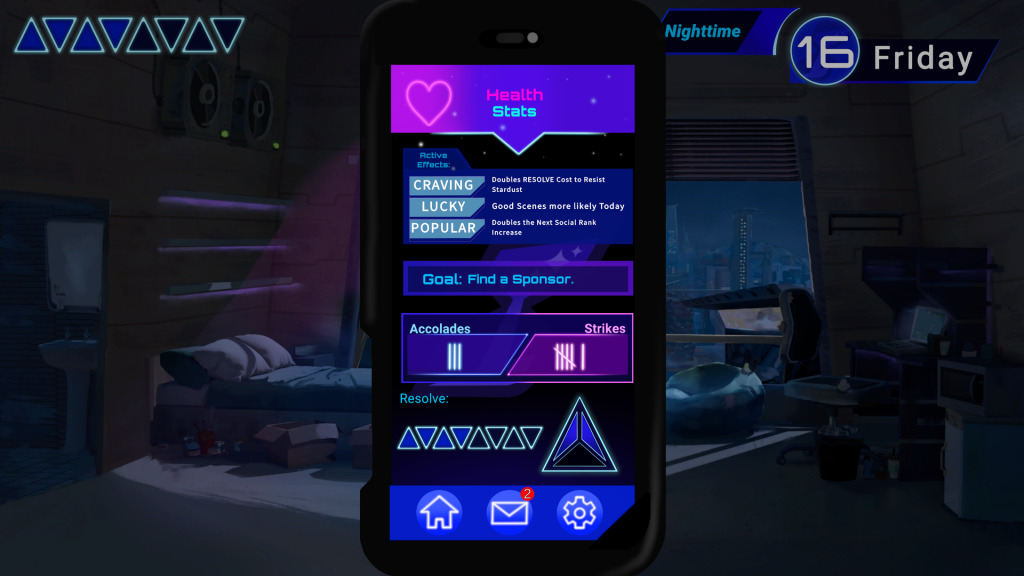
So the challenge is not really “can you say no in one dramatic moment?” It’s “what kind of life are you building that makes saying no possible?” If you are isolated, burned out, stressed, and running on empty, resisting becomes much harder. If you are building routines, friendships, support, and reasons to keep going, your capacity changes over time.
That is what Resolve represents to me. It is not just willpower. It is your mental, physical, and emotional capacity to keep going, and it’s different for everyone.
We also use randomness to reflect the messiness of real life. Players can choose where to go on the map and what kind of life they want to build, but a lot of the moment-to-moment scenes come from an evolving pool of events. Sometimes something beautiful happens when you don’t expect it. Sometimes something awful happens on a day when you were already barely holding it together. You do not control everything that happens to you, but you do often control how you respond.
We let players make bad choices. If they want to spend the night partying, ignore their responsibilities, or use Stardust, they can. The game is not there to lecture them. But choices do carry forward. They affect your relationships, your resources, your opportunities, and the version of the story you end up creating.

We also wanted to avoid presenting recovery as one clean path. Every playthrough can look different. Players might lean on different friendships, pursue different hobbies, explore different parts of New Miami, uncover different secrets, or struggle with entirely different problems depending on how they play. With at least 20 major characters and nearly 40 locations, most players will not see everything in one run, and that is intentional. Some players may not even make it to Day 30.
The main thing we keep coming back to is that recovery is incredibly hard to do alone, and setbacks do not mean failure.
Support can come from many places: friends, family, faith, therapy, education, work, hobbies, support groups, or just having people who remind you that you are still worth fighting for. The important thing is to keep moving forward and keep trying. People help you do that. We want to show that with our game.
How have you signposted to real-world support?
Much thought has been given to signposting and encouraging people to seek support in the game. Can you tell us more about why and how you approached this?
We knew from the beginning that authenticity came with responsibility. The goal was never to position the game as a form of treatment or as a replacement for professional support. Instead, we wanted it to encourage reflection, reduce stigma, and point players toward help when appropriate.
We’ve worked closely with Safe In Our World and put significant effort into ensuring players understand that support is available, even when it doesn’t feel that way.

In addition to creating in-game support resources, many of which have counterparts outside the fiction, we’re also exploring ways to incorporate real-world support resources directly into the experience. That includes crisis lines, organizations, useful websites, and other services that players can access for immediate help.
Many people struggling with addiction don’t actively search for help. We wanted support resources to feel visible, normal, and present in our worldbuilding.
Some resources may appear in traditional places like the credits, but we’re also interested in weaving them naturally into the world itself. A billboard might display a helpline. A character might text the player a legitimate website. A support group banner could include information about where to seek help.
Our hope is that players encounter these resources organically rather than only after they’ve finished the game. Ultimately, if even one player leaves knowing where to find help for themselves or others, then that extra effort will have been worth it.
Tell us about the team behind 30 Days: A Sobriety Simulator
I’ve been fortunate to assemble an incredible international team at Not Right Now Studios, including artists, veteran programmers, award-winning musicians, writers, and addiction consultants who bring New Miami to life responsibly and authentically.
Many members of the team have also been affected by addiction in some way, whether personally or through loved ones. Those experiences have shaped the world, characters, and themes of the game in ways Liz and I could never have accomplished alone.
The result is a project shaped by many different perspectives, rather than one person trying to speak for everyone. No singular person defines what the “correct” recovery story should be. Any story of recovery is “correct.”
Check out ‘30 Days: A Sobriety Simulator’ on Steam, visit the Not Right Now Studios website, and follow the Kickstarter page to be notified when the campaign goes live.
Join our Level Up Mental Health programme to gain access to a wealth of mental health resources for your workplace, including a brand new guide for supporting addiction recovery, co-authored by Tate Pollock.

