
Discovering the Root of Tribalism in the Gaming Industry
Posted: 19 Jul 2024A short while ago, I wrote an article detailing the Tribalism commonly seen among gaming communities and why this happens. You can read the article here.
For this follow-up article, I wanted to examine the emotions and thought processes that underpin Tribalism, and I did this by sending out a survey, asking the internet for their experiences of toxicity online. With this data, I plan to employ the thematic analysis method to discuss the content of these responses.
What is Thematic Analysis?
Thematic analysis is a method used to analyse qualitative data. This is data relating to thoughts, emotions and opinions. This data could be in the form of anything, such as diaries, blog posts, interview transcripts or in the case of this article, survey responses. The data is then analysed and grouped together, with the researcher attempting to discover patterns and themes within the data. While there are many forms of thematic analysis, the entire process can be generalised and broken down into six steps:
- Familiarisation – The process starts with the researcher familiarising themselves with the data, reading and re-reading it exhaustively. This may even include transcribing the data if necessary. During this time, the researcher may write a few thoughts down, which will help with the initial coding process.
- Coding – Coding in thematic analysis is the method which researchers use to identify the ideas and topics in the data, allowing them to refer to them quickly and easily. They can be assigned to small snippets of audio, writing or clips. Depending on the researcher’s need, these codes can be thorough and rigid or done more intuitively and instinctively.
- Identifying the themes – Themes are the overarching narratives or ideas within the research data. Researchers identify themes by combining the results of the coding process and generating the themes which fit the codes into the groups according to the subject.
- Reviewing the themes – The researcher will then review the themes to check how well they fit the data. They might begin to create a map of the themes at this point.
- Focusing and naming the themes – After spending more time with the themes, researchers will give them names. This is important because the themes represent the patterns in the data and can relate directly to the research question.
- Writing it all up – The final stage is writing it all up and providing a thorough, in-depth report on the themes and codes, including any extracts from the data and anything else that’s relevant.
Now, after reading all the responses from the survey, I spent a long while coding, identifying themes and narrowing them down to more focused ideas. I’ll spare you my early work, but here are the final themes I discovered from your data:
- Misogyny
- Xenophobia/Racism
- Skill
- Diversity, Equality and Inclusion (DEI)
- Gatekeeping
Misogyny is perhaps the most common form of toxicity we see in today’s gaming landscape if not one of the oldest prejudices since modern gaming.
More than likely, this is partly due to the strict social hierarchies formed millennia ago when humanity took its first steps into creating a society and a civilisation.
Misogyny and Evolutionary Theory
This theory proposes that men and women were designed by nature for different roles in life, i.e. men would go hunting while women perform domestic tasks. While this is true to a certain extent, society has shifted drastically.
Most people no longer hunt for food, danger does not necessarily lurk around every corner, and we don’t need to fear a sabre-toothed tiger jumping us from out of nowhere. Open-mindedness has permeated modern society, meaning it isn’t that simple anymore and hasn’t been for generations.
The roles that used to be pigeonholed for both sexes are now fluid, enabling women and men to engage in whatever activity floats their boat. And while many ascribe to this, there is a far more vocal minority that does not.
Why does Misogyny still exist in the Gaming Space?
Of course, there are more women playing games than ever before, so why does misogyny still exist in the gaming landscape? The answer is both simple and complicated at the same time.
The simple answer boils down to how games are built and designed. The gaming industry is still mainly dominated by men, and although this is improving, only 30% of game developers identified as women or nonbinary in 2020. This is up from 3% in 1989. Furthermore, this lack of female game developers has resulted in an absence of representation and the over-sexualisation of female characters in games.
Further complicating matters is that sexist people will often band together with others who share their views, making it harder for anyone to stand up to them, especially if they are higher management, for fear of severe repercussions. This creates a mentality of them vs us, creating a toxic work environment.
To many women, this is driving them away, as they feel uncomfortable playing as women with either exaggerated proportions or wearing skimpy clothing or both.
While many game companies state that they do not tolerate toxic behaviour within their games, there is little structural safeguarding to prevent this. Of course, progress has been made, such as The Good Game Playbook, created in collaboration with global gaming giant Ubisoft and Mental Health Charity Safe In Our World.

The Good Game Playbook – Ubisoft and Safe In Our World
The most common safeguard is preventing players from sending offensive messages in chat. However, there is little in the way of stopping players from shouting obscenities via voice chat.
In turn, this creates a vicious cycle where women and minorities are dissuaded from playing because of this behaviour, and some refuse to participate in voice chat, as seen in these excerpts here:
To this day I still can’t voice chat anyone. I get really scared and freeze up. I make up excuses to avoid speaking to anyone and I try to avoid making it known I’m a woman.
Since that day I’ve never spoken online again. It gives me anxiety just thinking about it. I was so worried it wouldn’t stop.
This can cause women to avoid fast-paced, multiplayer games due to the gameplay necessitating voice chat, further cutting them off from many different games. More women are playing games, but only 7% play Call of Duty or Valorant because of the emphasis on team-based gameplay, which encourages voice chat.
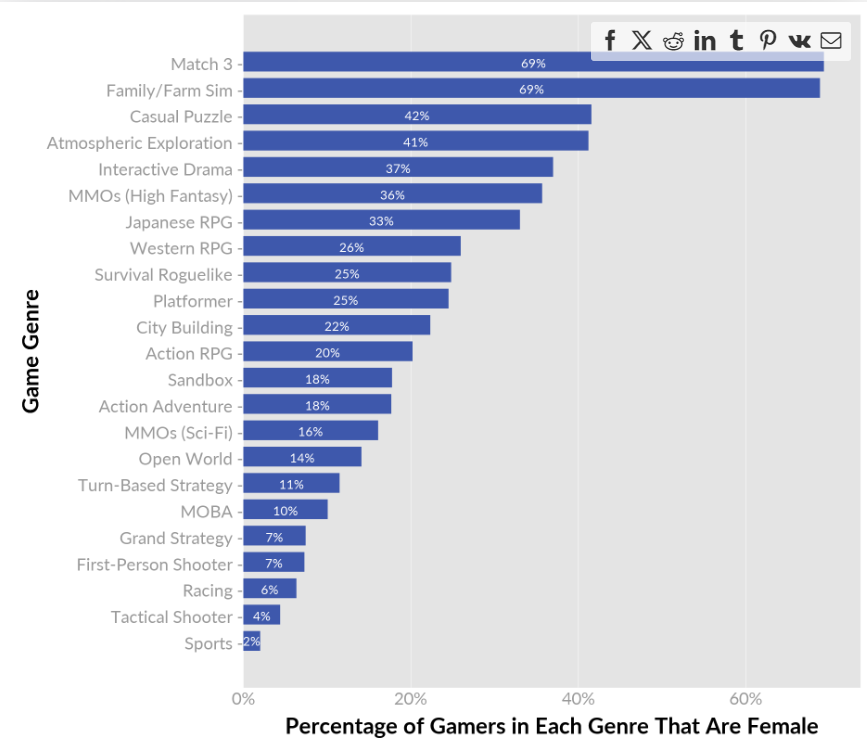
The percentage of female gamers by genre – Quantic Foundry
As you’d expect, the impact on one’s mental health can be severe. A 2010 study involving almost 2,000 students showed a correlation between being bullied online and low self-esteem.
Sexual harassment has been linked to anxiety, depression and low self-confidence. There is an ever-present struggle for women who feel they have to mask their sex to avoid being harassed.
Moreover, there is another factor that harassment tends to cause among those experiencing it. This is called Rumination. Rumination is a typical response to stressors in which a person constantly thinks about negative experiences. This makes people more vulnerable to conditions such as depression.
To protect themselves from these negative emotions, women will often shift the blame, citing themselves at fault for choosing the wrong game, for not being skilled enough or downplaying the abuse. They are also likely to withdraw themselves from any environments where this kind of abuse takes place.
I just stopped playing PvP games after that. It causes so much stress and anxiety for me now.
As I said in my previous tribalism article, these are automatic defence mechanisms honed over years of evolution and adapted to our modern world. Although, they are not quite as successful as we would want them to be. Furthermore, some women may even go above and beyond, playing games beyond a reasonable amount to surpass their male peers, which can lead to other problems.
Xenophobia/Racism
Xenophobia is not a term you hear often these days, as it has been superseded by racism. However, while similar to racism, Xenophobia is slightly different in that it deals with discrimination towards people from other countries and not just different races. In a nutshell, it is an intense fear, hence phobia in the word, of something or someone perceived as foreign or otherworldly.

The In-group, Out-group – The University of Texas at Austin
The In-group, Out-group – The University of Texas at Austin
It encompasses the threat perceived by someone in their in-group by people considered the out-group. If you would like an in-depth explanation of the in-group/out-group and the console wars, please read my previous tribalism article here.
Competition
In summary, the in-group is a group in which a person is a member. Conversely, the out-group is a person that isn’t part of the in-group. You see this type of mentality regularly seeping its way into sports, and the same can be said of gaming, often with games that are structured competitively.
It’s easy to see why this kind of toxic behaviour can manifest itself when games are constantly billed in a way that encourages antagonistic behaviour and out-group hostility. By pitting one side against the other, it isn’t hard to set up a situation in which toxic behaviour is displayed.
For example, Adachi and Willoughby (2011) suggested that competition rather than violence was the aspect of gaming that had the most influence on aggressive behaviour.
Cause my username sounds Mexican I get a lot of anti-mexican shouts.
The “Gamer”
There is also the sentiment that a hobby, in this case, gaming, ‘belongs‘ to a particular demographic. In retrospect, there was an emphasis on catering to the hardcore gamer (Braegger and Moeller, 2021). Now that companies target more demographics, there is still that image of the white heterosexual gamer that persists to this day (Paaßen, et al., 2017).
In these people’s minds, they can’t fathom their precious hobby being taken over by someone unlike them. Tying in with Misogyny, one of the more recent controversies that comes to mind is the GamerGate debacle, a targeted harassment campaign aimed at female gaming journalists.
While I won’t go into detail here, suffice it to say that it was driven by a fear of feminisation (Vanderhoef, 2013), an overriding phobia that gaming was slowly being eroded by a group of people who were not the core white masculine base. Of course, like any phobia, it is a heightened illogical fear, but this idea still persists.
Skill
Skill is obviously very relative and can be affected by many factors, such as disability and age. But still, people weaponize it and use it as a means to attack others.
For me personally, this was exacerbated by two factors: First, I play on European servers, where there are players speaking more than a dozen languages — including Russian and Ukrainian. Second, I am comparably old (40+) and as such no longer capable of the ‘no-scope 360 headshot’ shenanigans that are apparently expected from everyone.
Age is vital because it encompasses different factors that tie in toxicity. You can see from the above excerpt that this person is 40+. That is not the typical age that the image of the gamer conjures, as I mentioned above. Many people still consider gamers to be children upwards to around 30 years of age with a hard stop after 30.
According to Statista, 31% of gamers are aged 30-39, making this age group the biggest gaming audience in the UK. 20-29 year olds accounted for an additional 23% of the UK’s gaming population. While this is far from confirming anything substantially, this data shows the perception that many have of people who play games is misguided on many levels.
With age, the body starts to slow down, and gamers may not be capable of the gaming feats they were once able to achieve. This can lead to discrimination against older gamers because others believe they ‘sabotage‘ play or hold them back due to their lack of skill.
This is exacerbated by the design of particular games, chiefly competitive multiplayer ones. Many games like this, namely Call of Duty or Overwatch rely on twitch reflexes and fast-paced gameplay, something older gamers may struggle with.

Twitch Reflexes – Activision Blizzard
If we consult Statista again, as of the back half of 2023, the Shooter genre is still the most popular among all age groups. However, we see the percentage shrink as gamers age. It starts at 62.4% for 16-24-year-olds to 29.3% for gamers aged 55-64. Again, as the survey method was used here, it isn’t definitive, but it offers some insight into the links between age and gaming.
Diversity and Inclusion
But with the inclusion of more queer characters in games as of late, the toxicity has certainly spread to that as well. “Keep your politics out of games.” As though wanting to exist as a queer person in the world is inherently political.
This has always been a highly charged topic among people and has steadily become more volatile over the last few years. In my circles, I’ve seen much vitriol spat at devs and supporters of Assassin’s Creed Shadows for the inclusion and depiction of Yasuke, a real-life historical figure, as a playable character.
While I won’t go into my own views about the topic, it is clear that most of the negativity stems from racism, xenophobia and a lack of understanding of LGBTQIA+ and Neurodivergent people.
As stated before, many people fear what or who is different from them. It’s a standard human defence mechanism, but as more and more people discover themselves, the number of LGBTQIA+ and Neurodivergent gamers will continue to rise.

Diversity matters to the majority of gamers – Newzoo
Unfortunately, this will only lead to more hate in the short term, as opinions and views are as societal as they are individual; they take generations to shift. In a Global Gamer Study, 64% of gamers indicate that diversity is critical to them. This is based on the GGS’s aggregate of 36 video game markets, suggesting diversity and inclusion are important issues for the global video game community.
The Differences between Generations
As you can see from the picture above, younger gamers feel more strongly about diversity and inclusion than the older generations. This would make sense, seeing as many of the older generation grew up in a world less connected, where society was more concerned with local and national issues instead of global ones.
Furthermore, society was less tolerant of LGBTQIA+ people compared to older society. Society was far more rigid than today and had a more concrete idea of the ‘norm.’ This isn’t to say that all society was like this; there were various counter-cultures and movements associated with changing what was normal at the time. Society as a whole was less focused on embracing that which wasn’t considered the societal norm.
However, it’s important to remember that diversity means different things to different people. This research asked gamers of varying backgrounds to agree or disagree with the statement “diversity is important to me,” This is a problematic statement because it doesn’t provide a definite viewpoint of what diversity means to them. This still engenders data that is useful though.
Looking at the features gamers find most appealing, 18% selected “Diversity of characters within a game (i.e., representation of different genders, ethnicities, viewpoints etc). This varies among generations. 22% of Gen Alpha (the youngest generation) say this is important, while 6% of Baby Boomers (the oldest generation) selected this option.
One franchise that has wholeheartedly embraced diversity and inclusion is The Sims. With the release of The Sims 4, players can create trans and disabled avatars, meaning that a more diverse player base can see themselves in the game.
While more representation doesn’t necessarily guarantee success, it can open the game to more potential audiences.
Older Players feel less represented in games
Interestingly, it seems that older players feel less represented in video games than younger players. When looking at the global statistics, 62% of players experience good representation in the games they play. However, when that data is broken down, it paints a divided picture.
It was found that 72% of Gen Alpha players indicated they are well-represented in gaming, a much higher share when compared to Gen X (48%) and Baby Boomers (35%).
While it is complicated to pin this down and what it means exactly – the feeling of being represented is an element of games that can decide what games we play over others.
That Game isn’t for me
Representation in games can be a deciding factor in whether a person plays a game or not. Over half of gamers (57%) who took part in the GGS said they didn’t play a game because they felt it wasn’t made for them. This was consistent over all generations, ranging from 54% to 58% of players.

Percentage of gamers who didn’t play a game because it wasn’t made for them – Newzoo
This shows that while representation isn’t the most substantial element, it can be a deciding factor when weighed up against other aspects of a game. As always, we are more likely to engage with something if we feel attached to it somehow. This is only one of the many ways that game developers can reach new audiences.
Gatekeeping
Gatekeeping as a term has become popular in recent years, but the concept was first coined by social psychologist Kurt Lewin in 1943.
In non-toxic situations, a Gatekeeper controls the flow of information at any given time. Examples of this are editors, producers and directors in media. The Gatekeeper can establish a hierarchy of sorts, determining what info to give and when based on political and social events, etc. This is not inherently toxic and is needed for work environments to thrive.
In modern gaming, this takes on a different dimension as some fans become gatekeepers, trying to bar others from playing or even liking certain games. It’s further complicated when there is often more than one person acting as a gatekeeper for different franchises/games.
Alienation or Protection?
For instance, in the Assassin’s Creed community, fans of the older, more action adventure-focused games essentially become toxic to fans of the recent RPG games. They will also refuse to acknowledge the newer games because of their RPG leanings.
People who gatekeep often see their actions as a way to preserve the integrity and legacy of a franchise. Continuing with the Assassin’s Creed example, some older fans believe that recognising the new AC games and their fans will lessen the impact of the older games in the franchise.

Assassin’s Creed – Ubisoft
In their opinion, they have seen the downfall of the franchise with the RPG games and are protecting what they consider to be the peak of the franchise. This is not one-sided either – although less common, RPG Assassin’s Creed fans will also resort to this behaviour.
By engaging in gatekeeping, each side can validate their opinions, taking it upon themselves to ensure that the fanbase is not ‘polluted,’ if you will.
On the other hand, those who see gatekeeping as nonsense argue that it creates barriers to entry, fostering a toxic community. By their nature, gatekeepers limit diversity and inclusivity, which tend to give way to insular communities, resistant to change or innovation, ultimately limiting the growth of the gaming industry itself.
Conclusion
The gaming industry has come a long way from the early days of Pong and Asteroids, and the issues plaguing gaming as a whole have only become more complicated as our understanding of human psychology has increased.
Much progress has been made in researching the effects gaming has on our minds, but this still pales in comparison to other topics.
I’d like to thank everyone who completed my survey; this article wouldn’t have happened without you. I’d also like to thank Safe In Our World for promoting this article! Please visit their website for more information on their mission and how you could get involved.
I hope you enjoyed reading this article and be sure to follow Brain_Quest65 for the latest on the psychology of gaming!
