
Games for Good: Sibel’s Journey & Exploring Our Identities
Posted: 5 Jan 2024This month we chatted with Serenad from Berlin-based collective Food for Thought Media about their game Sibel’s Journey and overall ethos around educating and raising awareness for important topics.
Tell us a bit about Food for Thought Media…
We are a Berlin-based small indie studio and collective, founded in 2019 and since then we are developing computer games, media and cultural projects about LGBTQIA+, gender, identity, sexuality, public sphere, cultural heritage, accessibility, climate and environment using creative technologies. Our team comprises women, trans people, queers, migrants and mothers of teenagers, so we see diversity not as ornamental, but as a core part of their identities. We incorporate not only our professional know-how in our specialist areas, but also our personal experiences and different perspectives into every experience we create.
Sibel’s Journey is a narrative adventure game and a self-learning experience about gender, sexuality, bodies, and personal boundaries. What went into the decision to structure the game like this, and what are the benefits of self-learning in this context?
Initially, as a group of five women within the game industry, we united with the goal of using our expertise in different fields to create an inclusive educational game focused on gender, sexuality, identities, and healthy relationships. Our motivation stemmed from a shared belief in the inadequacy of education on these critical issues within digital media. Personally, I had a longstanding interest in gender, gender identities, and their intersection with computer games. And the others had experience in educational games for children. It appeared evident that we could play a role in addressing this gap by offering meaningful solutions.
As our team evolved, we welcomed additional members, including activists advocating these causes, academics deeply engaged in relevant studies and other passionate individuals who resonated with our project.
Utilising a video game as a platform for this educational tool brought several advantages. Firstly, the computer game, which is already a part of children’s and young people’s lives, was an advantageous and interesting medium because the content is communicated in a fun way throughout the game. Secondly, these topics are sensitive and new for many young people at that age. In early adolescence, especially learning about sexuality can be scary, and overwhelming and can often be perceived as something embarrassing. The fact that computer games can be played alone gave the possibility of privacy to the young people while exploring the topics and it left enough space to evaluate one’s own thoughts and feelings without shame or embarrassment.
The concepts of gender and sexuality are explored in Sibel’s Journey in a very fluid way (for example using sliders and scales to describe someone’s gender identity and expression): was this a conscious choice from the outset or did this method evolve as you developed the game?
The Gender Unicorn is a concept that already existed outside of the game. It is a visual tool designed to help individuals understand and explore the concepts of gender identity, gender expression, biological sex, and attraction. From the beginning, we knew we would like to somehow incorporate this into the game. Initially, we thought of using it in the form of a mini-game where players are asked to make guesses about the characters they encountered through the gameplay however after a little bit of thought we changed our minds about it and decided that our characters should be able to speak for themselves. As players proceed in the game and meet new characters, from the gender unicorn section they can see the characters’ choices and how they filled this information for themselves. Players can also choose to fill this section for themselves. As they fill the gender unicorn, affirmative comments on their decisions are taking place. But it is not mandatory to play this part to be able to finish the game. Using sliders and scales was a very conscious choice, we wanted to visually show that certain categories addressed on the gender unicorn such as gender identity, gender expression, or attraction are indeed categories of the spectrum and cannot be defined by multiple choice decisions.
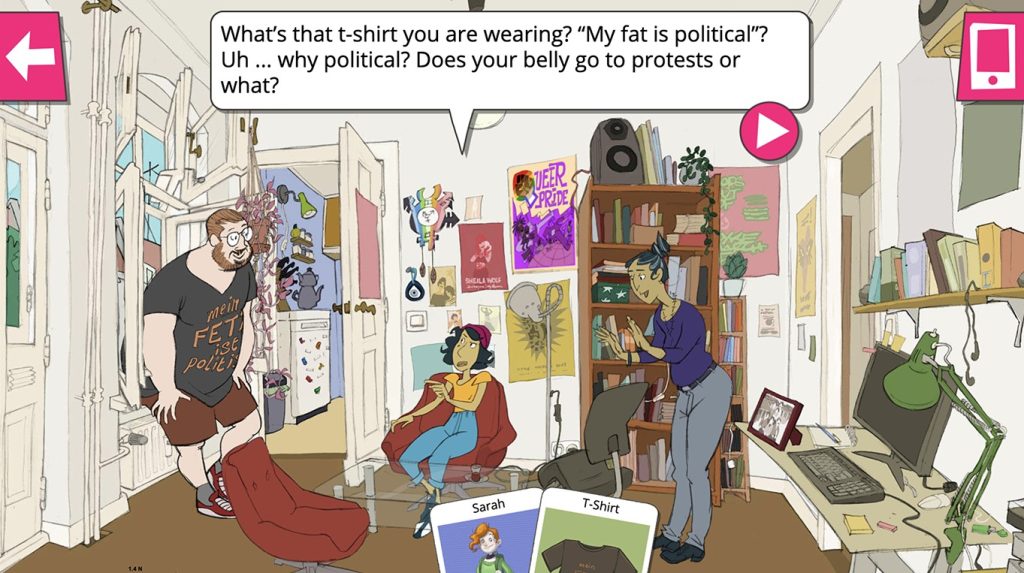
Image from ‘https://sibelsjourney.com’
As well as LGBTQIA+ issues, Sibel’s Journey talks a lot about different facets of identity: body image, history, politics, language and culture. Why was this important for you to cover in the game?
From the very beginning, we wanted to follow an intersectional and comprehensive approach. We wanted to show that those topics are intertwined and do not exist in a bubble in society. The more we thought about it the more we wanted to add to the topics but eventually, we had to stop ourselves a little bit from not overwhelming children with a lot of information at once. Also, it would not be as effective as we wanted if we just briefly mentioned every topic but did not have time to properly dive into the discussions. That would create a danger of tokenism which we are all against. On the other hand, topics around body image, politics, language and culture are so closely connected that it is almost impossible to make a good quality game without addressing those issues in an inclusive gender and sexuality education game. Our character Sibel is already deeply affected by each of the mentioned issues in her everyday life, and it is the reality of human experience. Considering that we live in Berlin and the Turkish population here (well, I am Turkish as well), we thought that having the German daughter of a Turkish immigrant family as the main character would be remarkable in many ways, and it would raise awareness. Especially to fight stereotypes about migrant populations or Muslim populations’ attitudes about queer and feminist politics, we find it valuable for a character like Sibel to ask questions about intersectionality, immigration, guest labour, being Muslim and queer, and to analyse and understand the answers.
What’s next for Food for Thought Media?
We will continue what we do best, creating games and workshops for young people on diverse topics around inclusion and diversity. It is our job to give food for thought, you know 🙂 We previously did that on the topics of gender, sexuality, sexual orientations, bodies, boundaries and healthy communications with Sibel’s Journey. This time within the general framework of diversity and inclusion, we are moving our focus a little bit to other topics. Especially the ones that we wanted to address in depth in Sibel’s Journey and left out to not overcrowd the game. Our new game Leila’s Play (working title) is going to focus on the issues around disabilities, neuro- and physical diversities, accessibility, ableism, and diverse backgrounds of people while telling a coming-of-age story. Players are going to find themselves in a remote club in the suburb where a theatre festival is about to take place, and they will need to solve a series of puzzles and mysterious events while learning about the diversity of human experience. We aim for an entertaining game play by embedding the topics we cover into the puzzle and mystery elements to be solved by the player, using metaphors in places and giving the player even more freedom of movement. We are expecting to release it in mid-2024, so stay tuned!
Sibel’s journal can be played on iOS and Android. Learn more and find additional resources at https://sibelsjourney.com.
Check out Food for Thought Media and their other projects at https://foodforthoughtmedia.com.
