The Story Behind Pine Hearts: An Interview with Rob Madden
Posted: 9 Apr 2024On Wednesday 27 March, our 2024 Ambassadors Phoebe and Pengy, attended a press event for Hyper Luminal Games’ new title, Pine Hearts.
The pair sat down with Rob Madden, Creative Director at HLG, to discuss the game’s themes of love, loss, life, memories, and family.
The general theme of the game is this journey where Tyke is revisiting his childhood and learning through memories of his father.
“The game was very much inspired by my own personal experiences. I lost my dad very suddenly to cancer in 2019 and that was obviously a very big change in my life, and my family’s life. I’m an only child, so it was just me and my mum having lost my dad. It was quite a big ripple that my family felt at that point in time. There was quite a while where I was just trying to figure out what that means, and how you cope with something like that, and how you deal with something like that.”
“I’ve always loved building things and making stuff. I’m a games developer and I just love making things and being in little worlds and kind of figuring out what they are. I kind of just turned immediately to the thing I knew best, and was comforting I suppose, which is just sitting in front of my computer and making something.”
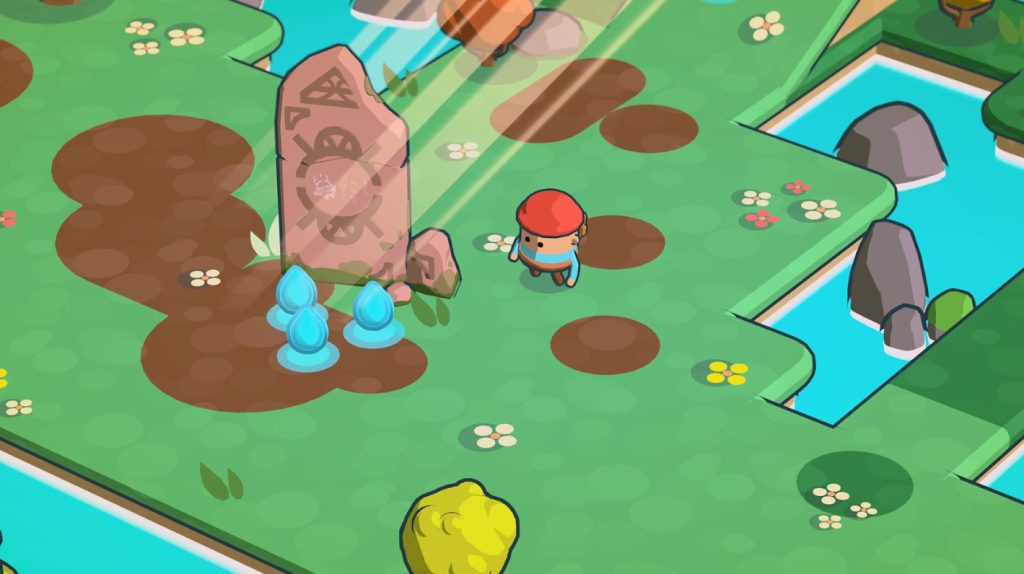
“So Pine Hearts initially started out as this cute little diorama: it was just a house with a white picket fence and some trees, and it just felt like this really cute, cosy, comfortable little place where I was like “Yeah, I’d like to be there, in that little world, for a bit.” And then, from that, it grew into a little character that runs about the space, and now you have things you can interact with, and different characters you can speak to…it really just came very organically from that, but it was all very much born out of this need to create something that felt safe and cosy.”
“It was all very much born out of this need to create something that felt safe and cosy.”
And so when it first started to come together I realised that actually there’s something here where maybe we could use the game as a vehicle to express a very literal story about someone’s experiences – maybe my own experiences. We kind of dabbled with that in the past with certain games where they have a sort of theme or undertone where you could read between the lines a little bit and get a sense of that theme, but we’d never made a game where the story was really quite explicitly about, you know, “this is what happened: this character has lost this person, and is learning how to cope with it.” I felt like it was a really interesting opportunity to do that, and so we just sort of figured out as a team how we could tell that story and how we could make it feel as applicable to a broader range of people as possible, which we thought was really important.
Although it’s my story, it’s not a story that’s unique to me, unfortunately…it was important that, while we were developing it, the team was able to kind of latch onto it and bring their own sense of personal experience to it, and have it relate to them in various ways. If you’ve lost someone else – friends, family, whoever it might be – you can still get a sense of belonging and understanding.
“Although it’s my story, it’s not a story that’s unique to me, unfortunately.”
With the team contributions to the story: was it planned out from the start or did it happen quite organically? What was the process of collaboration?
It was fairly organic – that’s how we like to operate our teams. I like to work in a way where you give people enough space where they can be really talented and clever, and make their own decisions. I provide just enough direction to sort of say “these are the boundaries, so we just need to be really clever within this space.” I think a really important part of that is trusting the team to bring their ‘A game’ and get involved. If you’ve spoken to some of the other members of the team today, hopefully you’ve recognised that they feel like they have a really strong sense of ownership of certain parts of the game. They’ve been able to impart little stories or little things that they’ve dealt with in their lives, and they can kind of put that in the game.
I think that sort of collaboration at the beginning was really important. I think what I’d do differently is that I probably wasn’t as open about the themes of the game initially as I should have been, and that’s been a learning point. We started the game three years ago, and it was still pretty soon, relatively speaking, after [my father’s death] had happened, and I think I was still at a point where I didn’t know if I was confident about talking about it. Sometimes it felt like I’d bitten off more than I could chew; I’d think, “You know, I could get on stage and talk about this,” and then you actually get on stage and you’re like “Oh, no, this is too much.” I think maybe in hindsight I should have been a bit more open with the team about it, and just been more vulnerable I guess. Being like “this is how I’m feeling about it, and this is what I’d like to do.” It’s kind of scary – right? – to do that, even with people you trust.
Do you find that – with the game being so personal to you – it has given you the opportunity to open up a bit more in that way?
Yeah, I think so. I think there’s one thing I can’t quite wrap my head around, but that I really appreciate people doing, is when we take [Pine Hearts] to shows and demo the game, and people ask the team “What’s the game about?” because they get the sense that maybe it’s a bit sadder, and so the team explain the concept…I’ve had people come up to me – complete strangers – who say they spoke to the team about how the game was made, and say “I’ve lost a sister,” or “I’ve lost a mum,” or “I’ve lost someone,” and wanting to just be open about that.
I met a guy at EGX who had lost his dad 8 weeks prior to the event…and he didn’t actually play the game – we were kind of laughing about it, that he should maybe just leave it, and that it might be a bit too much right now. But for someone to just come up to you and be so open like that was quite emotional. I felt very fortunate that people were willing to share that, you know?
It’s obviously something that has a lot of emotion: it’s very powerful and can feel very raw. What are the ways you felt you, and/or the team, have helped to support each other or practice self care? What are the things that have helped you, as a team and as individuals, work with these kinds of very difficult emotions?
First of all, trust is such a big word that we speak about in the studio, irrespective of Pine Hearts. Building games in general is this really complicated and stressful endeavour, where there are lots of competing agendas, or ideas, and timelines, and budgets, and all these different things need to come together. So we talk an awful lot about trust, and building trust with your team, and how you do that, and how you earn trust over time. I think the team for Pine Hearts is really galvanised around this idea in a really lovely way: they’re very talented people, and very trusting people. I think building that as a baseline is important before you do anything. Because then you can be more open if there’s something that you feel isn’t the best, you can approach it in a really productive way. You don’t feel like you’re personalising it in any way, and it becomes a really focused conversation about how you can make the game better.
“I think building [trust] as a baseline is important before you do anything.”
Trust is just so important for the team in everything we do: we really try to get people to talk to one another and just be open, and just be good teammates, I guess.
Do you find that working on such a personal project that’s used not only your own experiences but also the team’s experiences, has brought in that trust and better communication?
Yeah, I certainly think so. We’re already thinking about the team we have now, and how we can deploy them on other stuff together. You don’t want to create this great band, and they have a single, and then they go their separate ways – that would be nonsense. We’re thinking about how this team can work on something cool together, because they’ve really bonded over their experience [of making Pine Hearts.] They’ve gone through the fire of game development with the added twist of something that’s really personal.
One thing I’ve taken from Pine Hearts is that it’s about something very serious, but there’s a lot of levity and joyfulness…When you were starting the project, what was the reasoning to go toward that, rather than something heavier?
It’s interesting. I’d like to speak to more people who have gone through something like this. They say there are all these stages of grief, right? I don’t know whether that’s true – maybe it is for some people – but definitely the stage that I was at, when I wanted to start making the game, I didn’t want to create an experience that – for me or for anyone – would pull me back down that road. It’s like, “I want to keep going this way. Towards recovery.” I didn’t want to make a game where I imagined people playing it and being upset. The game will cause upset in some respects because parts of it are going to be close to home, but I didn’t want people to come away feeling worse from the experience, you know? Feeling like they’d taken a back step or anything like that – that’s just not the sort of game I want to make.

I felt it was important that the game – no matter what it was doing – was still always working towards a hopeful place. And you take little dips every now and then, but ultimately you feel like when you get back, you realise how far you’ve come. I think that was important: to make it feel like you were still moving forward.
I think one of the things you do as well, with grief, is try to look back on those fond memories: the good times, as a celebration of them. From what we’ve seen of the game, it does that very well with these little snapshots.
Yeah, you go back into Tyke’s memories, and it’s meant to be nostalgic, I suppose. Or glad, at least, of all things, that at least you’ve still got all that stuff that you can remember. You might not get any more of those things, but no one can take them away from you.
Are there any key things you hope that people will take away from Pine Hearts?
I think people just taking away an appreciation for the time that you’ve spent with people…it’s kind of a cliché, but you don’t know what you’ve got until it’s gone. But it’s true. You spend so much time worrying about day-to-day stuff, and then something changes – irrevocably, that you can never get back – and you really feel it. You really feel that big gap. I think, if anything, just having people recognise and appreciate some of the things they have, and acknowledging that, and using that in a way that can enrich your life. And if you’re going through something like that, I hope playing the game might help you feel a bit better – even marginally – about the position that they’re in.
