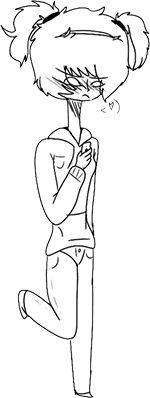
You Are Not Alone: Stories of Love, Loss & Healing
Posted: 13 Jun 2025This Pride Month, hear from our Class of 2025 Ambassador, Wendi Ndaki Mutisya, as she explores the concepts of love, loss and healing through games, art and storytelling.
What is love without respect? Without trust? When it leaves behind nothing but a shell of who I used to be, my humanity stolen, my heart torn? I sit in hazy vision, tears blurring the lines between where your heart ends and mine begins. Desperately, scissors in hand, I carefully try to cut the chords of connection. I succeed, but now the red and itchy windows to my soul, reveal that I have holes through my heart. Like holes through a curtain, I patch them up, but now they won’t let the light in. I wonder, will I ever be enough, not for anyone else, but for me?
These are the words of Wanza, a fictional character who wrestles with the weight of loneliness amplified by heartbreak and self-doubt. A great storyteller once told me that every fictional character carries a piece of their creator. Perhaps Wanza reflects parts of me, and the poets and musicians who inspired these words. But isn’t this a universal question? I implore you to reflect on what it means to embrace ‘enoughness’, to find peace in who you are without conditions. Loneliness often stems from a belief that we’re not enough, and thus unworthy of connection.
Psychologist Carl Jung once noted, “Loneliness does not come from having no people, but from being unable to communicate the things that seem important to oneself.” This means that a person can still feel lonely even when surrounded by others if they cannot share their deepest thoughts and feelings with anyone.
Psychologist John T. Cacioppo studied loneliness and found that feeling lonely, rather than simply being alone, has the greatest impact on our well-being. He explained, “When we are lonely we not only react more intensely to the negatives; we also experience less of a soothing uplift from the positives.” This shows how loneliness can make bad experiences feel worse and good moments less enjoyable.
In essence, both Carl and John emphasize that the root cause of loneliness lies in the quality and depth of our social connections, rather than the mere presence or absence of others.
For many, loneliness is about a lack of deep connection. But for queer individuals, it often carries an added layer of isolation, one shaped by societal rejection, internal battles, and the fear of truly being seen. Love often means jumping through hoops of self-love and trust, all while hate, sometimes masked as religion, surrounds your very existence.
And for those who do find love, the pain can be even greater when that love turns into betrayal, when the person you trust most becomes a source of harm.
This is the loneliness that Saidia (which means “help” in Swahili), a 2D role-playing game launched in December 2023, addresses through the story of Kaya, a trans woman navigating the ups and downs of life and love in Kenya.
It’s the loneliness that Creatives Garage’s July 2024 play, Blooms in the Dark, adapted from a podcast of the same name, explores. The play reveals the raw emotions of unrequited love and the burden of marrying straight to appease the family. These and other stories showcase the deep, painful loneliness that comes with such compromises.
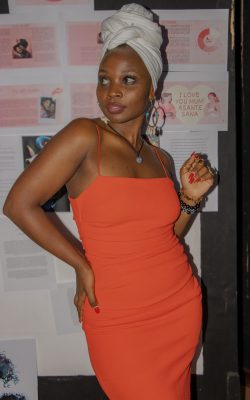
It’s the heartbreak at the center of Njeri Wangari’s January 2025 production, Holes in My Heart, where she, as Msani Riann, uses performed art pieces to reveal the silent wounds of intimate partner violence (IPV) and offer pathways to help.
Msani Riann
Through the efforts of Creatives Garage, founded by Thayù Kilili, and Mirror Arts, founded by Njeri Wangari, art becomes a lifeline, tackling the loneliness that often comes with queerness. They remind us that while you can get yourself out of a hopeless situation, having a support system, through stories, art, and community, can help you stitch your heart back together and still let the light back in. They offer us a chance to heal, in healthy ways.
It was comforting to learn that even during the production of these projects, the well-being of the cast was a priority. According to this Blooms in The Dark review by LaMusicJunkie, Joseph Obel, a cast member in the play, shared that Mental 360 Kenya was present during rehearsals, providing mental health support when needed. “They acted as first aid for mental health,” he explained. Playing Henrietta, a trans woman, also deepened his understanding of trans experiences and what he could do to be a better ally.
As the writer and director, Thayù Kilili acknowledged that some scenes were deeply personal and triggering for the cast, bringing up painful memories from their own lives. Because of this, rehearsals often paused to give actors space to breathe or speak with a therapist.

Thayù Kilili
Unfortunately, this kind of support isn’t as common as it should be. Msani Riann shared that in 2023, Mirror Arts conducted desk research on intimate partner violence (IPV) within the lesbian, bisexual, and queer (LBQ) community and found almost no data. In 2024, Leha Kenya reported that 8 out of 10 LBQ survivors in Kenya do not report violence, and 50% miss out on trauma support. This hesitation largely stems from a deep distrust in government institutions like the police and hospitals due to widespread homophobia.
“This forces most victims of IPV to stay in toxic relationships, giving perpetrators the confidence to continue with these heinous acts,” Riann explained.
Here’s a short performed art piece by Msani Riann on how IPV can manifest in relationships through financial control:
She goes on to emphasize, “To our queer siblings, queerness does not take away our human rights. As humans, what we need from each other is a guiding hand to help us navigate the difficult path toward justice, trust, and confidence in the law and humanity.”
She encourages members of the LBQ community to familiarize themselves with institutions that offer support, especially when their rights are violated. “As for the police service, remember that Utumishi kwa Wote (service to all) is your motto.” She says, emphasizing the need to map out these institutions and ensure that everyone in the community has access to the necessary information.
But there is hope amidst the challenges. The stories in the play and podcast, reflect the realities of many people, and some offer uplifting endings. One such story is about a bisexual woman who wasn’t ready to marry a man but gave in to family pressure and their constant questions about marriage. On top of that, she was struggling with a deep sense of loneliness. She eventually married her best friend, hoping it would help, but the loneliness remained. It was only when she fully embraced her bisexuality, and her husband unexpectedly opened up their marriage, that she finally felt a sense of relief. In many ways, self-acceptance saved their marriage, allowing her to stay with someone she had initially shared a deep connection with while also living fully as her authentic self.
This brings us back to Wanza’s question: Will I ever be enough, not for anyone else, but for me? I believe we are all on a journey of becoming enough, and one day, we will fully embrace these words by Walt Whitman:
I exist as I am, that is enough. If no other in the world be aware, I sit content. And if each and all be aware, I sit content. One world is aware, and by far the largest to me, and that is myself. And whether I come to my own today or in ten thousand or ten million years, I can cheerfully take it now, or with equal cheerfulness, I can wait.
As we grow in self-love and learn to embrace our enoughness, you are invited to join Kaya and her friends on an epic role-playing journey through life, love, and the challenges of being queer in Kenya. Download Saidia on the Google Play Store and immerse yourself in a story that reminds us: you are not alone, we are in this together.
Wendi Ndaki Mutisya
Wendi is a Safe In Our World Ambassador from the class of 2025. She runs WAI Network in Kenya, hosts the animated podcast Creative Tech Convos, and is a fierce advocate for mental health and inclusion.