
Intersectionality and Mental Health: Understanding your Social Identity
Posted: 1 Aug 2025Why do people shun labels? And what do we gain from them? Let’s explore the theory of social identity and why it’s an important factor in our mental health.
What is social identity?
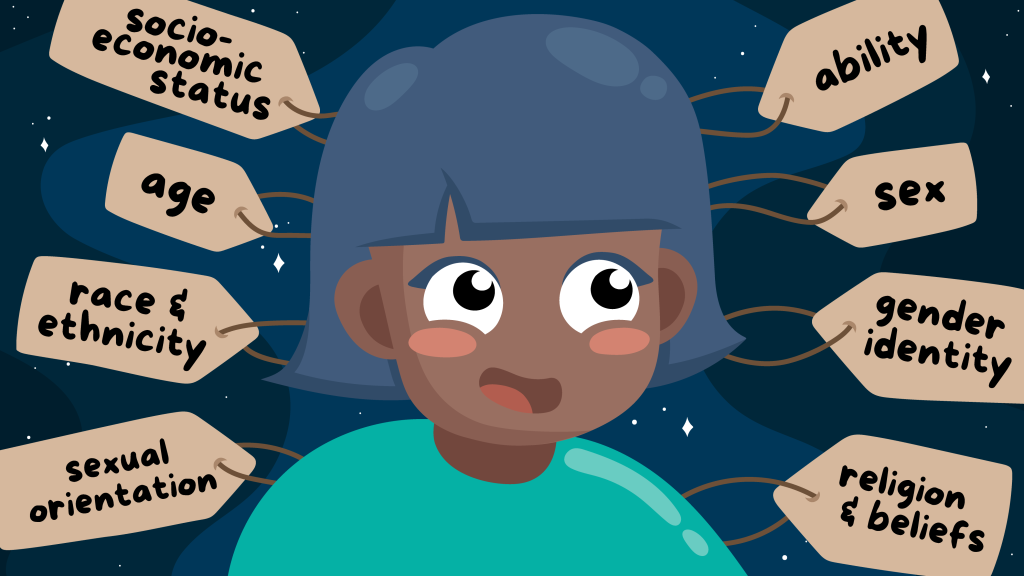
Social identity refers to a person’s sense of who they are, based on their ability, age, ethnicity, gender, race, religion, sexual orientation, and socioeconomic status (to name a few). Simply put, your social identity has helped shape who you are as a human being.
For example, you might be a woman from a working-class family. That’s two elements of your social identity: gender and socio-economic status. Your behaviours, attitudes and beliefs will likely be influenced by your experiences as a woman and your upbringing in a working-class family.
Everyone’s social identity is a unique tapestry of their lives and experiences. It tells a story – it is part of who we are, but it doesn’t define who we’ll be.
Social Identity Theory
Developed by Henri Tajfel and John Turner in 1979, Social Identity Theory sought to explain how individuals define themselves based on group memberships (e.g. religion or social class). It explored how people categorise themselves (and others) into social groups, and how this could provide a sense of belonging, purpose, self-worth and identity.
Social Identity Theory also explored how this social practice could isolate groups of people, creating issues of favouritism, stereotyping and prejudice.
A clear example of the negative implications can be found in our musical preferences, where fans of one type of music choose to mock fans of a very different type of music. But these implications can be much more severe – especially when discussing race, ethnicity, politics, or sexuality.
How is the impact of social identity felt?
Our social identities can influence how we view the world and how we behave within it. Social identity can play a big role in our mental health and sense of self. It can shape how we perceive others, how we connect with them or how we judge them.
Take for example, the working-class woman. Let’s call her Jane. Jane may have had to work really hard to get to where she is, facing down obstacle after obstacle. As a result, she might be a fiercely determined and resourceful person, with a knack for problem-solving.
At the same time, Jane might struggle with self-esteem, or anxiety that stems from a fear of making mistakes – fearing to fail and to see all her hard work unravel.
Jane is just one example of how someone can be shaped by their social identity. While these experiences can shape who we are, they do not define us. We’re not discussing the concept of fate – and it’s important to remember this.
The Rejection of Labels
Why do some people dislike labels? Many people feel comfortable with their social identity and the language used to describe themselves – while others shun labels, calling them harmful and unnecessary. This can lead to conflict, and a reduction in empathy for those who disagree.
“Labels fail to capture the complexity, diversity and wholeness of our humanity, and have the potential to reinforce stereotypes, which contribute to discrimination and oppression.” Foundation for Change
Some people choose not to label themselves because they don’t like how that label may be perceived by others. Take for example, disability – choosing to call yourself disabled. A lot of effort has been put in by people who do describe themselves as disabled, to challenge the negative perception around it.
“Disability is not a dirty word.” And while great progress has been made to shift perceptions, many people still battle internalised ableism, or worry about how others who maintain their prejudice will perceive them if they adopt that label.
Some people who don’t like labels simply don’t feel like it’s anyone else’s business how they identify – so choose not to adopt labels to help define who they are. And some simply don’t feel there are words that properly capture the complexity of their identity.
Your social identity (and the labels used to communicate it) is a very personal thing. We should never apply labels to others. And we should not allow others to dictate how we ourselves can identify.
Intersectionality and Mental Health
We, as a species, love to simplify. We love bite-sized information, neat categorisation, putting things in boxes – but it’s rarely that easy, and mental health is no exception.
Our mental health is directly influenced by our social identity. That tapestry of who we are runs through the very core of our personal experiences, influencing our emotions and the choices we make.
Understanding how our lived experiences can impact our mental health is a vital step in achieving good mental health. By considering our ability, age, ethnicity, gender, race, religion, sexual orientation, and socioeconomic status, we’re making space to explore the nuances of our experiences and personal challenges.
For instance, marginalised communities (e.g. LGBTQIA+, disabled people, Black and Minority Ethnic communities) experience disproportionate levels of hardship. LGBTQIA+ people are at higher risk of hate crimes. Black people are at higher risk of being killed by police. Disabled people have to spend considerably more money to achieve the same standard of living as non-disabled people.
These inequalities (and many more) can significantly influence the mental health of those groups, and to effectively support these groups with their mental health, we must consider these inequalities. To achieve culturally competent care that considers the nuances of our social identities, we must ensure an awareness of societal biases and risks.
Exploring your Social Identity and Mental Health
What can you do now? Well, ask yourself what you know about your social identity first. Perhaps you’re very familiar with how you’ve chosen to categorise yourself in the past. Maybe you’re comfortable with the labels you use to identify yourself.
In that case, consider this: have you ever denied yourself something because of a box you’ve put yourself in? (For example: “I can’t wear that because that’s not for my gender.”)
On the other hand, maybe you’re new to the concept of social identity. You might be one of the people we’ve mentioned who doesn’t use labels! That’s okay, and we’re not telling you to start applying labels to yourself if that’s not your thing.
But if that is you, we invite you to consider this: have you ever used the rejection of a label to justify not learning something about yourself? (For example: “This video isn’t for me because it’s about racism and I’m not Black.”)
Knowledge is power, and even if you choose not to adopt a label and build out your social identity, you can learn a lot from a little self-reflection. It can make you aware of privileges you may enjoy, or show you the challenges you’ve faced in a whole new light.
Inside or outside the box, your mental health matters – and gaining a better understanding of who you are and how you experience the world can help safeguard your wellbeing for the future.
