What We Learned at GDC Festival of Gaming 2026
Posted: 17 Apr 2026Safe In Our World were back in San Francisco this year for GDC Festival of Gaming, and we wanted to share some of our key takeaways from talks at the event.
What’s holding us back?
Sarah and I kicked off the week with Cecile Hemery’s workshop From Reliable to Respected: Breaking free of the ‘good job trap.’
This workshop centred on the feeling that you’re doing everything right, but something still feels off. The feeling that doing a really good job isn’t enough anymore, identifying which “trap” you may have fallen into, and how to move forward.
It was a very well-attended session with some great insights from the other attendees, who were at all stages of their careers. We looked at the archetypes of Reliable, Impulsive, Overlooked and Respected, understanding the different dynamics that these types of people may form within a team, and how it impacts you on a personal level.
Something that stuck with me from this session was how the cycle of validation we experience from a very early age, often starting in school, can impact us well into adulthood and lead us to doing things for approval, rather than doing them for impact.
What’s it like to navigate the industry after reaching 50?
Later in the week, we attended Tülay McNally’s roundtable, Level 50 & Above: Navigating Games Careers Beyond Mid-Life. This was a great opportunity for individuals to come together and share their experiences, frustrations, and recommendations, as people over 50 in games. A huge number of topics were covered, but the ones that stood out the most to Sarah and me were:
Ageism in the Industry
People mentioned “hiding” their experience on their CV, due to fears that having job history going too far back would mean they were less likely to be selected for interviews. We also touched on experiences around an ‘assumption’ being made that if older professionals were not applying for management-level roles, they must be “uninspired” or “lacklustre” employees.
Grief and Dealing with Change
We touched on how many individuals in attendance felt grief at the loss of how making games used to be, and the importance of being able to keep up with a changing landscape. Many attendees highlighted different ways they had embraced change and learnt new skills to ensure their expertise stayed relevant.
This roundtable could have gone on for hours longer, but it was a great start to open up some vital conversations around mental health and wellbeing that can often go overlooked.
How can we ensure respect and accuracy when portraying other cultures in games?
And finally, we caught Kate Edwards’ talk on Building the Cultural World of Indiana Jones & The Great Circle. This was a fascinating look into how ‘culturalisation’ goes beyond localisation, and seeks to truly understand and respect the location and subject matter being portrayed in-game.
Kate highlighted how the world of Indiana Jones & The Great Circle had to strike a balance between the Real World (providing an authentic experience) and the Fantasy World (with an emphasis on imagination and uniqueness), and how in a world steeped in real-life geography and politics like Indiana Jones, the Fantasy World must not override the Real World.
The talk covered heaps of examples from symbols and writing to gestures and dance, and really seemed to inspire attendees to consider culturalisation more in their own work, which was wonderful to see.
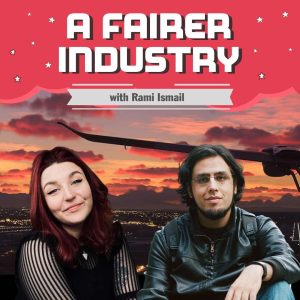
We covered ways we can achieve fairer games industry in a chat with Rami Ismail on an episode of our podcast, Safe Space: The Video Games Mental Health Podcast.
Listen now >
What can we do to recognise and mitigate signs of stress within ourselves?
This one might be cheating a little, but we hosted our own workshop at the end of the week on Understanding and Managing Stress. We wanted to share some of the awesome insights our attendees shared.
Firstly, we looked at identifying our personal stress signatures: really having a moment of introspection to think about the small – and not-so-small – signs that we’re struggling.
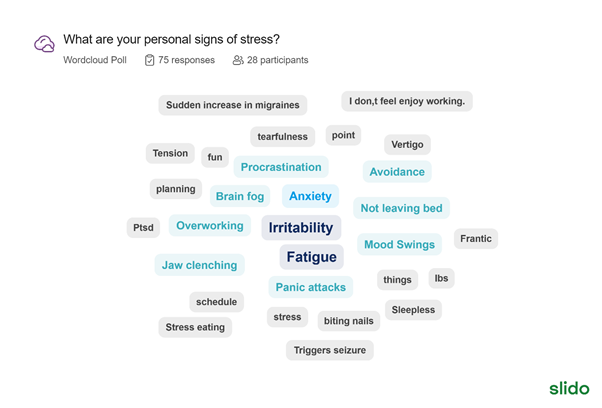
We noticed some common signs like irritability and fatigue, but also a wide range of sometimes contrasting symptoms. This demonstrates how differently stress can present from person to person.
We then moved onto discussing coping strategies for managing stress, and our participants once again highlighted some fantastic recommendations.
- Creative outlets such as singing, listening to music, playing guitar, painting, or cooking.
- Reach out to support systems: talking to friends, going for coffee, chatting to people online, or speaking to your partner.
- Practice mindfulness through writing about your feelings, acknowledging your emotions, changing your physical environment by taking a shower, or practicing breathing.
- Make time for exercise and movement by going to the gym, taking a walk in nature or even a walk around the house, or stretching.
There were loads of other suggestions, too, which proves that self-care doesn’t have to look a certain way. It’s up to you to determine how you want to decompress, while focusing on positive, helpful activities rather than unhelpful coping mechanisms.
—
There was heaps to learn at GDC this year, not to mention all the wonderful conversations we had with other attendees. We hope you found our recap helpful and we’re looking forward to sharing even more insights from future events!
If you would like to collaborate with us, just fill in our contact form or email us directly at hello@safeinourworld.com.
