
Failure-Free Games and Switching Off
Posted: 25 Mar 2024Playing games that challenge us and reward us for achievements are fantastic paths to escapism. They can allow us to put aside our troubles for a moment and focus on a vibrant alternate reality. But how can games that don’t feature failure and are free of consequence affect our mindset?
What is a failure-free game? For this context, we’re describing failure-free games as games you don’t win or lose at – you just play. A fantastic recent example of this is ‘SUMMERHOUSE‘, a tiny building game focused around creating lived-in houses. There are no rules, time limits, or end goals; just creativity in a casual city-builder.
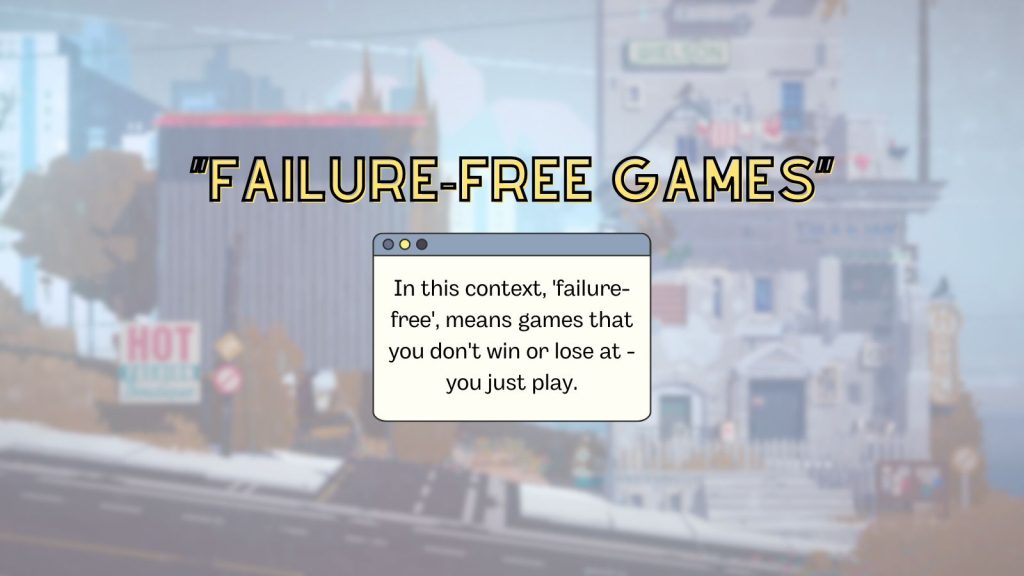
Whilst spending some time with SUMMERHOUSE on my lunch break, it got me thinking about our relationship with games that you tend to just ‘exist’ in. These games that don’t elicit competition, but are often used to inspire new ways of play. I’ve discovered two things recently in a world of seemingly constant bad news: I find peace playing games that don’t really require me to think, and I find peace playing games that don’t make me feel like I’ve failed.
This month at Safe In Our World we’ve focused on looking into rejection and failure, so it seems fitting to discuss how failure in-game can change our mood. If I recognise I’m in a bad mood and decide I want to play games, I often opt for titles that don’t punish me or make me feel like I’ve failed. Consistently seeing the words ‘you’ve failed’ or ‘you’ve died’ can be enough to exacerbate my bad mood.
Failure Free Games
We asked our community what titles they consider to be ‘failure-free’ as well as how they’ve made them feel. A similar game to SUMMERHOUSE, called Townscaper, was a popular choice! Stephen Hey from Radical Forge colourfully describes it as a beautiful ‘waste of time’, mentioning that they own it on every platform it’s available for. “I don’t think there is enough of this type of game. They hark back to the 90’s where we had ‘desktop toys’ – little widgets that let you destroy your Windows desktop. But this game is so elegant and beautiful, I love it.”
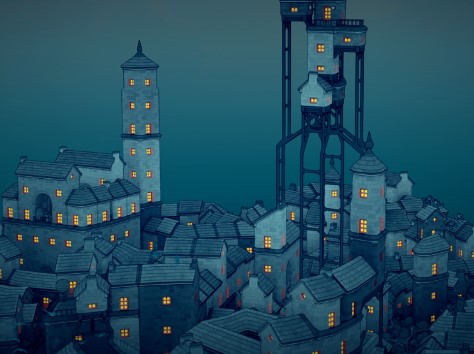
“For me, Townscaper is very therapeutic. There’s no pressure, no judgement, and these fantastical and lovingly detailed towns just spring out of nowhere.” – Stephen Hey
“You can get lost in a game like this for a few minutes, an hour, or two. They don’t take-over your life, I don’t feel like I have to be playing it all of the time like you do with some more conventional games sometimes. There is less of an obligation but more of a desire just to play to while away some time. Yet at the same time you feel creative, satisfied and even proud of what you have achieved.” Stephen elaborates.
Matt, from Land and Sea Games, explains his perspective: “I worked on Townscaper, a beautiful townbuilding “toy”. There was no main goal, no scoring or reward system, outside the satisfying sounds and creativity that came from placing down little blocks and buildings.”
Matt also worked on Alto’s Adventure, which whilst not a failure-free game itself, has ‘Zen Mode’.
“Zen Mode [is] where game-overs are disabled, and players can keep playing and exploring the game without worrying about having to master the mechanics and scoring. We’ve had tons of players reach out and comment on using this mode for meditation, to explore the terrain and environments peacefully and to wind down at the end of a day,” he explains.
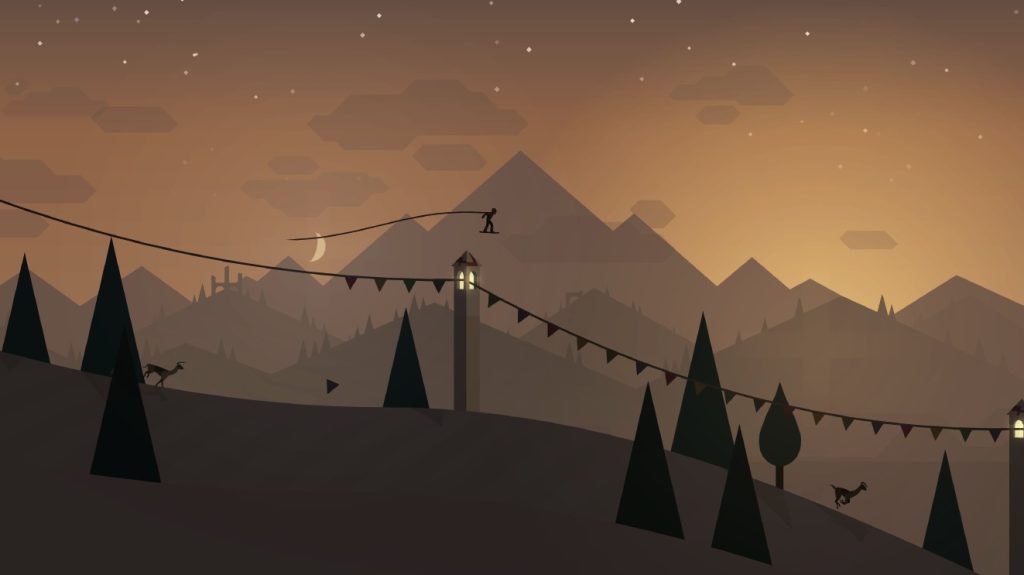
Matt continues, “Both these titles bring a calm, entertaining approach to games that steps away from the high-intensity dopamine mining games we see flooding feeds, and instead lets you just enjoy an environment and system for what it is.”
Other examples given by our contributors included Power Wash Simulator, as players can manage the tasks at their own pace with no consequences, and Palia for its gameplay allowing players to explore all the available content without missing out. JaneDash discusses this: “the team has previously made note that they allow you to romance all the characters because they didn’t want to limit you to only getting to know one villager that way (which also allows those that love lore to explore those parts too).”
Playing Styles
I also wanted to explore how failure-free games make our community feel when playing them.
“Failure-free games give me a mental reprieve from the scope of my day-job. The type of work I do, its success is measured by client satisfaction, and in my personal projects I can have a tendency to put too much pressure on being perfect.” Emily shares, “Gaming in a manner where you are not measured by your success rate is a welcome break for my anxiety and stress levels, and it’s refreshing to just be.”
Melody Geiger from Merge Conflict explained how they personally enjoy failure-free games but don’t play them too often. “I prefer games with challenge usually (but nothing rage inducing). I want to feel engaged and rewarded for completing a quest or a difficult task you know? That being said, I think there’s absolutely a space for failure-free or chill games!” Melody also shares how they intentionally designed their game Re:Fresh to have little to no consequences, allowing players to explore this cozy adventure with more freedom.
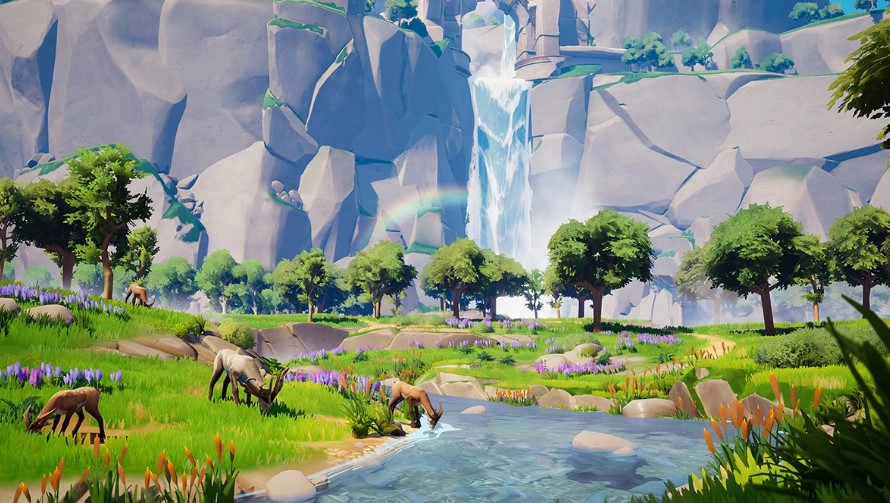
‘Palia’ – from https://palia.com
It’s interesting to also see how failure-free games have enabled some people in our community to have a space in which they can just switch off. Matt talks about this notion, too: “We’re surrounded by so many pieces of media that always fight for our attention, to give us sparks of excitement or engagement to keep us scrolling or clicking, and games do this to some degree, but with failure-free games there is often a sense of quiet that is rare. It’s like curling up with a good book, your mind is put at ease and you feel like you can let things slow down for once.”
“Failure free games are a way for people to regulate any polarizing emotions they might have and give the player space to just breathe. They’re games you don’t have to think to hard about which is nice when so much of the rest of the world can be so noisy.” – Melody
JaneDash brings up that we are still seeing some folks not considering these types of games as ‘real games’, but games like Harvest Moon and Animal Crossing are continuously proving how popular these games are. “Allowing gamers to simply enjoy their time without any stress has also allowed us to play more together, to introduce a new (and old!) generation of players to be introduced into the world of gaming.”
Personally, I love the idea that new styles of play within video games can inspire a new group of players to join in the fun, and experience all the good that gaming has to offer. Perhaps failure-free games can be a great start in exploring or rediscovering a new genre for everyone.
Written by Rosie Taylor
