
How ‘Recesses’ tells a poignant tale about childhood struggles
Posted: 22 Jan 2025We spoke to Sanjuny, creator of Recesses’ – their brand new card game meets visual novel roguelite.
With Recesses, players take up the role of elementary school child looking for their best friend. The only way to do that? By playing an alien-themed card game called Battaliens, of course..!
What is Recesses?
Recesses is a card game adventure where you’re a fifth grader whose best friend has gone missing. In order to find out what happened to her, you have to battle all the “weirdo” kids that she played the popular Battaliens card game with during elementary school recess, getting nudges in the right direction after each victory.
Working your way from battling the sandbox-obsessed snotty-nosed kid on Monday to the boss of the playground on Friday isn’t easy. But along the way you collect new cards, learn more about your classmates, the truth about what happened to your missing friend, and maybe even make some new friends too.
I spent about a year solo-developing Recesses, doing all of the design, coding, writing and art. For the music, I commissioned CoZyro and Kasey Ozymy, the developer behind the indie RPG Jimmy and the Pulsating Mass.
What were your inspirations behind the concept of Recesses?
The Pokemon TCG first came out when I was in middle school, and that was a huge inspiration for the gameplay of Recesses. I wanted to hit that nostalgic feeling of cracking open booster packs, having no idea what you were going to get inside, and just jamming whatever cards you happened to own against other kids doing the same.
For the story, I feel like adults have an unfortunate tendency to dismiss anything children say as them “just being silly kids.” But when I worked with young students as a tutor for several years, I was always impressed by how smart they were. Anyone not listening to kids is doing a huge disservice both to those children’s future, and their own future too.
So to counteract that as best I could, I had the fifth graders in Recesses wax philosophical on as many complicated societal and existential topics as I could! Aliens, capitalism, the nature of crime, climate change, and more. Every time I thought I went too far, I tried to push it a little further.
What did you want the game to accomplish or make people feel? Why did you choose 5th graders to be the ones to tell this story?
Pragmatically, I chose fifth graders because that was the highest grade level I could go while still letting the characters have recess every day. For sixth grade and above, recess is a rarity, and for fourth grade and below, the philosophical conversations would be even more absurd than they already are.
More than anything, I’d love for players to laugh while playing Recesses. If they can have fun with the characters that they encounter on the playground, and bond with them over their passions, fears, and hot takes, then that’s mission accomplished. Because yeah, those fifth graders are definitely saying some weird stuff… but they also kind of have a point!
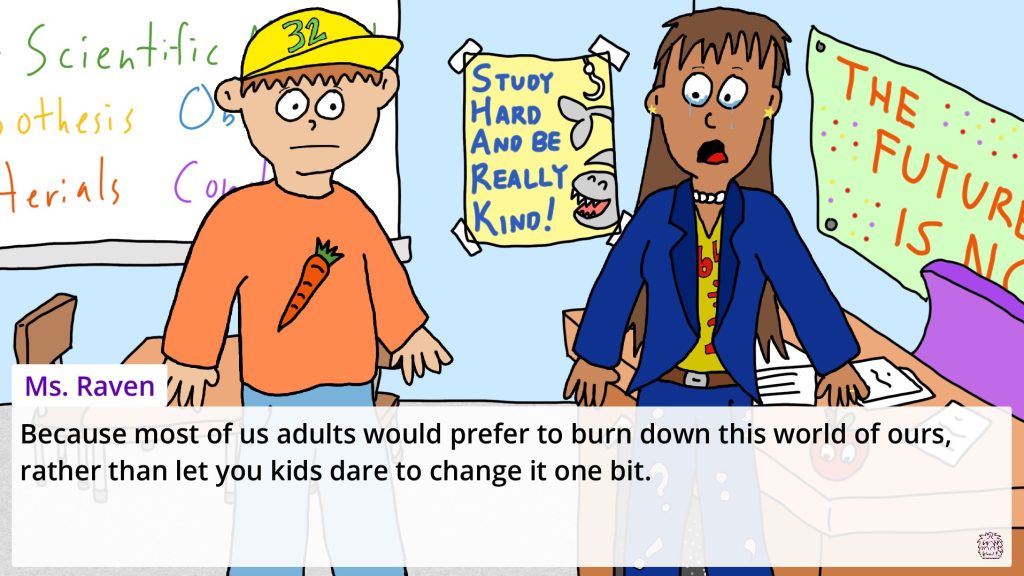
Can you tell me more about the key characters that feature in Recesses, and how their characters represent struggles in our real lives?
In the game, there are 13 characters each with unique conversations based on your win/loss record against them. It would be impossible to go over all of them, but a few early on are:
● Emily, who talks about how people are naturally good and want to help each other, but societal tools like religion and money are used to keep powerful people in power.
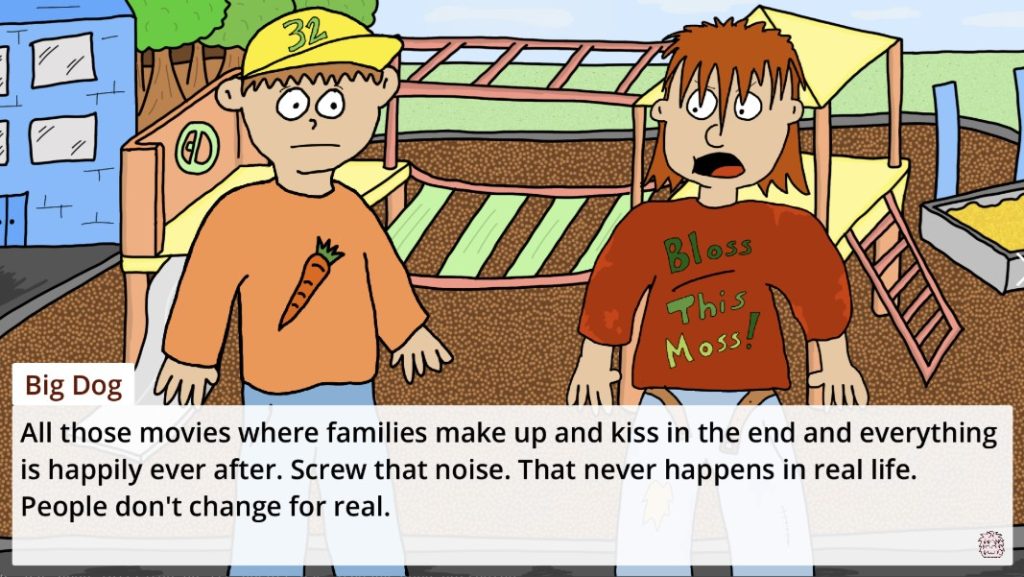
● Big Dog, who confesses to the player that he plays Battaliens as an escape from his abusive household.
● Mika, who doesn’t see her hyperactivity as a personal problem, and instead shines a light on society’s failure to accommodate those who are different.
● Wires, who tells you about their inability to make friends due to their neurodivergence.
● Syryna, who has a breakdown after talking about her mentally abusive household.
Fifth grade is a tough, pivotal year, right on the edge of childhood. For me personally, it was the year I first learned about “the greenhouse effect,” and all I could do was agonize over why adults weren’t doing anything to stop it. It’s a disillusioning period of life, but like the characters in the game, if we open up to others about our problems, then we may find out we’re not alone.
What would you like players to take away from playing Recesses?
I think most people’s first impression of the game would be something like: “Wow, this game’s art looks awful. Like it was made in MS Paint!” And while they’re certainly not wrong (although I will die on the hill that my limited artistic prowess matches the fifth-grade aesthetic), I hope they’d give it a chance and not judge it by its cover.
The same thing goes for the characters in the game. At first, fifth graders talking about politics and the economy is wild. Just like the silly graphics, I hope that you laugh when they say bombastic things, but I also hope that some of what they say sticks with you too.
Most of my favorite games had “jaw-dropping moments” in them that stuck with me. Games like Pokemon Gold/Silver, Super Mario World, and The Witness each had moments where I thought I’d reached the end of the game, but then realized that my journey had actually just begun. When I made Recesses, I wanted to make sure that it had some of those moments in it too, like after you first beat the playground boss on Friday.
That starts to get into spoiler territory though.
Can you tell me more about the Unbearable Truths – the origins and the meanings behind each one?
Spoiler warning! If you’re at all interested in Recesses, I’d recommend playing through the full week before reading any further. Even if it takes a while, I tried to make it so that losing is *good* since when you lose you get dialogue that you wouldn’t ever otherwise be able to see. In fact, if you breeze through the game and don’t ever lose, you’ll only see about a quarter of the dialogue!
Anyway, spoilers abound below.
.
.
After you’ve defeated Alan on Friday, he tells you the real purpose behind Battaliens: it’s a way to protect knowledge about the “true meaning of life.” He is one of the three guardians, and by defeating a guardian you get access to part of that hidden knowledge: one of the three “Unbearable Truths.”
Personally, I’ve always loved the trope of forbidden knowledge that you have to go on a long journey to obtain. The Unbearable Truths themselves are inspired by my own long journey, when I worked as an English translator for the Japanese government. I was fortunate to meet with some incredible people from all over the world, most often engineers from developing countries who were participating in courses in the city I worked at.
For a quick rundown of each Unbearable Truth:
● First Truth: Life is not special. This Truth is all about how “life” is fundamentally no different than any other matter in the universe, despite our desperate attempts to reassure ourselves that we’re special throughout history.
This one was inspired by a casual conversation I had with one of the guest engineers I was translating for. I’d often accompany them on their first day in the city to help with what they needed. Most of the time it was how to buy groceries or do laundry, but one time one of them dropped that “life is not special” existential crisis right on me out of nowhere.
I didn’t think much of it at the time besides a polite smile… until I later spent the whole night lying awake, unable to think about anything else besides it.
● Second Truth: Free will is an illusion. This Truth builds on the First one, talking about how the laws of cause and effect apply to us just as much as they apply to everything else in the universe.
This one was also inspired by an interaction with another guest engineer. Japan loves drinking parties, and sometimes I would accompany the guests to restaurants where they would drink alcohol with my coworkers and I would translate. I’ll never forget when I had to translate into Japanese one of their slightly-drunk takedowns of free will, and it stuck with me ever since.
● Third Truth: The meaning of organic life is to create technological consciousness. This Truth builds on the Second one, showing how the confines of a deterministic universe can be escaped. We can create a consciousness not limited by meat and hormones, one that is capable of things we can’t even conceive of.
I’m certainly not the first person to suggest that we are just the bootup bios for the universe, part of the startup “code” to eventually turn on its *actual* functions. But I do like how this idea fits as a hopeful progression from the Second Truth, and how it gives a greater meaning to all of our lives. No matter how small, every single organism would in some way contribute to the eventual creation of a technological consciousness.
Of course I know the Truths are not for everyone. They’ve got “Unbearable” in the name! But I’ve personally struggled with depression/nihilism for as long as I can remember, and I didn’t know how to escape it until I happened to have those random conversations. So if learning about them by playing Recesses could help anyone else out there the same way they helped me, then that would be worth it.
