World Parkinson’s Day
Posted: 10 Apr 2026World Parkinson’s Day is celebrated on April 11th each year.
As the second most common neurodegenerative disease in the world, Parkinson’s disease (also called Parkinson disease) affects roughly 2-3% of adults over age 65 (Zafar et al., 2025). People with Parkinson’s experience challenges with motor function (i.e., muscle movements/coordination), cognition, and communication (e.g., quieter-sounding voice, less enunciated speech) (Mammen et al., 2025) that often make it difficult to participate in conversations and other daily activities (Duncan & Earhart, 2011).
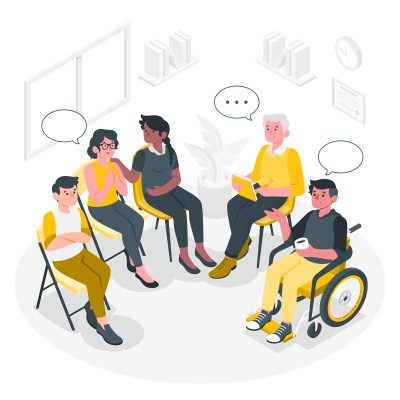
(Group Therapy Isometric Illustrations from Illustrations by Storyset, n.d.)
Combined with the neurological (i.e., brain-based) changes that happen, these challenges often contribute to depression and reduced well-being in people with Parkinson’s disease (Fresan et al., 2026) and their primary caregivers (Fresan et al., 2026; Henry et al., 2021).
What is Parkinson’s disease?
Parkinson’s disease is a progressive neurodegenerative disease, meaning that symptoms tend to become more severe over time. While we’re still learning more about what exactly causes Parkinson’s disease, we know that symptoms happen due to a progressive loss of dopamine-producing cells in the brain over time (Zafar et al., 2025; Kouli et al., 2018).
With less dopamine available, we tend to see the hallmark symptoms of
- tremor (i.e., shaking due to changes in brain-to-muscle messaging systems)
- slowed movements (i.e., bradykinesia), and
stiffened muscle movements (i.e., rigidity; Zafar et al., 2025; Kouli et al., 2018).

(Image from Parkinson’s Care and Support UK, n.d.)
How does it impact mental health and well-being?
Research indicates that social isolation becomes increasingly more common as adults age. At the risk of offending some of our readers, we’ll gently note that “older adults” are generally defined as adults age 65 or older (National Institutes of Health, 2025).
Even in “healthy adults” (i.e., those who do not have a chronic or ongoing condition requiring medical care; Menassa et al., 2023), we typically see more loneliness and social isolation in older adults than in younger age groups (Ohiokpehai et al., 2025). When you add in motor (i.e., muscle movement), cognitive, and/or communication challenges (e.g., voice/speech changes), older adults with Parkinson’s disease can experience even more social isolation, which can further worsen depression and diminish well-being.
Using Games to Cultivate Social Connectedness
Games can be a valuable tool for building relationships and enhancing social connectedness, particularly among older adults (Alweis & Alweis, 2025; Ballard & Spencer, 2023). As our mission indicates, we at Safe in Our World maintain that intentional game design, development, and gameplay practices can create positive change by promoting and supporting mental health and well-being. Here are some suggestions to try:
For Players with Parkinson’s Disease and their Gameplay Partners (Friends, Family Members/Caregivers, etc.)
Since Parkinson’s disease can create motor, cognition, and communication challenges, consider these steps to create a more inclusive gameplay environment:
Take your time
- People with Parkinson’s disease: Let yourself take the amount of time you need (e.g., opt for turns without time limits, take breaks as needed)
- Gameplay partners: Give people the time they need to play the game, allowing for rests and breaks as needed.
Prioritize Clear Communication and Understanding
- People with Parkinson’s disease:
- Supporting cognition: Ask for clarification of game instructions, game information, etc., as needed. Better yet, consider keeping a written copy of the rules/information you want to remember nearby as you play!
- Supporting communication: If you’re speaking during gameplay, consider asking your gameplay partners to let you know when they need you to say something louder/clearer, or when they need you to share your thoughts another way (e.g., via chat/writing).
- Gameplay partners:
- Supporting cognition: Give people time to decide on their in-game turns and actions. Provide clarification on game instructions or information as needed, and consider keeping the rules/target information handy to help you!
- Supporting communication: Discuss communication strategies beforehand. If you need someone to repeat what they said to help you understand them, politely ask them to repeat themself (e.g., “I didn’t quite hear you there. Could you please say that again louder / clearer?”).
Create Supportive Environments for Gameplay
Optimize the environment by…
- Reducing or limiting background noise (e.g., turning background music down or off during gameplay)
- Adjusting lighting or brightness for greater visibility
- Considering how the number of game players (e.g., 1-3 vs. 5+) may impact the gameplay experience
- For people with greater cognitive/communication challenges, smaller gameplay groups may reduce the stimuli they need to attend to (Thilakaratne et al., 2026), making it easier to focus on gameplay activities.

If you’d like to find out more about good practices in playing together, we teamed up with Ubisoft to create the Good Game Playbook, a resource designed to provide players with knowledge and support with regards to experiencing in-game toxicity.
For Game Designers/Developers
Ben-Sadoun and colleagues (2018) devised a set of serious game design considerations for people with neurodegenerative diseases (Ben-Sadoun et al., 2018). Consider these recommendations* to create more inclusive games and gameplay spaces for people with Parkinson’s disease:
- Compatibility: Address Parkinson’s disease symptoms (speech, motor challenges, fatigue) in game design for older adults.
- Guidance: Include clear instructions and built-in breaks to manage cognition/communication challenges and fatigue.
- Workload: Minimize cognitive/physical strain by simplifying actions and communication tasks.
- Adaptability: Ensure that your game can accommodate different communication approaches (e.g., voice amplification/personal microphones, Augmentative and Alternative Communication [AAC] devices or approaches) to support varying needs.
- Consistency: Ensure uniformity in instructions, prompts, and feedback to avoid confusion.
- Significance of Codes: Use intuitive, clear symbols and commands to enhance understanding.
- Explicit Control: Ensure that your game/system can respond to the controls and inputs of people with Parkinson’s disease (e.g., tremor, quiet or less enunciated speech).
- Error Management: Provide tools for navigating communication breakdowns (e.g., visual aids).
- Game Rules: Tailor rules to focus on social engagement and manageable cognitive challenges.
* Recommendations are adapted from a presentation by Philippone (2024) at the 2024 Meaningful Play Conference (Pittsburgh, PA, USA). Framework is derived from Ben-Sadoun and colleagues, (2018).
Let Gameplay Be Playful
Games are opportunities to connect and experience community. Lean into that, and feel free to create gameplay experiences that center fun and connection!
Want to Learn More?
For more information, check out these resources:
- Able to Play
- Parkinson’s Foundation – Global Care Network
- World Parkinson Coalition
- Parkinson’s Europe
- ParkinsonNet
- International Parkinson and Movement Disorder Society
Maura Philippone

References
- Alweis, E., & Alweis, R. (2025). A Narrative Review of the Benefits of Board Games in Health. Cureus, 17(9), e92484. https://doi.org/10.7759/cureus.92484
- Ballard, M. E., & Spencer, M. T. (2023). Importance of Social Videogaming for Connection with Others During the COVID-19 Pandemic. Games and culture, 18(2), 251–264. https://doi.org/10.1177/15554120221090982
- Ben-Sadoun, G., Manera, V., Alvarez, J., Sacco, G., & Robert, P. (2018). Recommendations for the Design of Serious Games in Neurodegenerative Diseases. Frontiers in aging neuroscience, 10, 13. https://doi.org/10.3389/fnagi.2018.00013
- Duncan, R. P., & Earhart, G. M. (2011). Measuring participation in individuals with Parkinson disease: relationships with disease severity, quality of life, and mobility. Disability and rehabilitation, 33(15-16), 1440–1446. https://doi.org/10.3109/09638288.2010.533245
- Fresan, A., Ochoa-Morales, A., Ramírez-García, M. Á., Chávez-Oliveros, M., Jara-Prado, A., Guerrero-Camacho, J. L., & Dávila-Ortiz de Montellano, D. J. (2026). Predictors of Quality of Life in Parkinson’s Disease: The Role of Mental Health and Internalized Stigma. Actas espanolas de psiquiatria, 54(1), 212–222. https://doi.org/10.62641/aep.v54i1.2130
- Henry, R. S., Lageman, S. K., & Perrin, P. B. (2020). The relationship between Parkinson’s disease symptoms and caregiver quality of life. Rehabilitation psychology, 65(2), 137–144. https://doi.org/10.1037/rep0000313
- Kouli, A., Torsney, K. M., & Kuan, W. L. (2018). Parkinson’s disease: Etiology, neuropathology, and pathogenesis. In T. B. Stoker & J. C. Greenland (Eds.), Parkinson’s disease: Pathogenesis and clinical aspects. Codon Publications. https://doi.org/10.15586/codonpublications.parkinsonsdisease.2018.ch1
- Mammen, J. R., Adams, J. L., Mangrum, R., Xiao, Y., Barbosa, W., Tyo, M., Redmond, C., Carter, C., Cifelli, K., Cifelli, R., Maruzo, H., Meeker, J., Shultz, G., Thomas, C., Bale, C., Davies, E., Kopil, C. M., Marras, C., Mestre, T., Morel, T., … Stephenson, D. (2025). Systematic review and consensus conceptual model of meaningful symptoms and functional impacts in early Parkinson’s Disease. NPJ Parkinson’s disease, 11(1), 65. https://doi.org/10.1038/s41531-025-00907-2
- Menassa, M., Stronks, K., Khatami, F., et al. (2023). Concepts and definitions of healthy ageing: A systematic review and synthesis of theoretical models. eClinicalMedicine, 56, 101810. https://doi.org/10.1016/j.eclinm.2022.101821
- National Institutes of Health. (2025, June 12). Age. https://www.nih.gov/nih-style-guide/age
- Ohiokpehai, J., Gammack, J. K., Siddiqui, M., & Nyahoda, T. (2025). Loneliness and Social Isolation in Older Adults. Missouri medicine, 122(2), 118–123. https://pmc.ncbi.nlm.nih.gov/articles/PMC12021383/
- Parkinson’s Care and Support UK. (n.d.). Symptoms of Parkinson’s Disease [Infographic]. https://parkinsonscare.org.uk/symptoms-and-diagnosis/
- Philippone, M. (2024, October 16-18). Tabletop game design considerations for voice and speech symptoms of Parkinson’s disease [Microtalk]. International Conference on Meaningful Play. Carnegie Mellon University, Pittsburgh, PA, USA.
- Follow this link to access the slides: https://drive.google.com/file/d/1lnrgLGi3O-j7CetlgxLkgnkOpQel9-1h/view?usp=sharing
- Storyset. (n.d.). Group Therapy Isometric Illustrations [Illustration]. https://storyset.com/illustration/group-therapy/amico
- Thilakaratne, R., Wylie, K., Loftus, A. M., & Cocks, N. (2026). Conversation Barriers and Strategies Used by People With Parkinson’s and Their Partners to Support Conversation. International journal of language & communication disorders, 61(2), e70202. https://doi.org/10.1111/1460-6984.70202
- Zafar, S., Lui, F., & Yaddanapudi, S. S. (2025). Parkinson disease. In StatPearls. StatPearls Publishing. https://www.ncbi.nlm.nih.gov/books/NBK470193/
