Self-care VS Sabotage: Protecting your mental health during the holidays
Is Christmas stressing you out? If you’re not feeling festive, you’re not alone. While some make merry, others struggle with their mental health.
‘Tis the season of feeling entirely overwhelmed and stressed out. Or at least, that’s the experience of many people during the festive period.
- One in three people surveyed reported they struggle with Seasonal Affective Disorder during the winter*
- 31% of people reported that they struggle with sleepless nights attributed to worrying about the festive period*
- 1 in 5 people surveyed reported that they will feel more irritable (and even struggle with headaches) around this time of year*
*Source: Mental Health UK
What turns festivities into frustrations?
The reasons behind finding this time of year so challenging can vary from person to person. It might be that you’re worried about your financial situation – something very relevant to many struggling with job insecurity in the games industry right now. Christmas is expensive, and having to stick to a tight budget might make you feel like you’re missing out!
Some people struggle with the changes to their routine. This can be especially true for neurodivergent folk – and that’s a lot of people in the games industry! When the structure of your day disappears, you might feel a little lost (not to mention potentially being inundated with relatives or social events, throwing your schedule into chaos).
Loneliness is another big factor in poor mental health during the holidays. Surrounded by festive sentiments of love, connection, and family, it’s understandable to feel lonely if:
- You live by yourself
- You’ve lost a loved one
- You’re going through a separation
- You’re estranged from your family
- You don’t currently have a support network
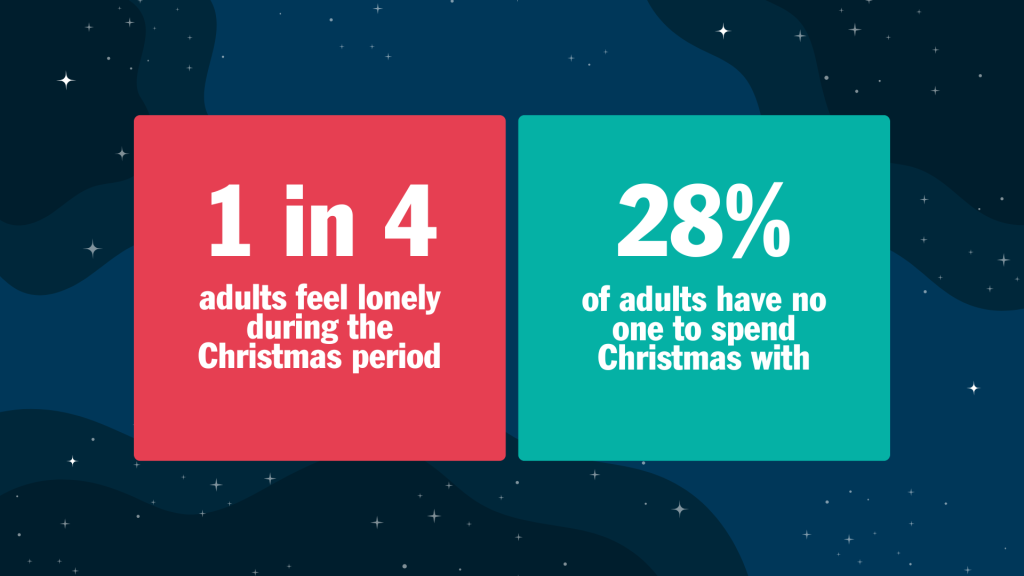
Source: Loneliness at Christmas
The pressure of participation
It can feel like you’re letting people down if you’re not feeling all that festive, but the truth is, you should never be pressured into celebrating. It’s wild that we’ve even got to say that – doesn’t it just sound so bizarre? Being forced to have fun?
And what is fun, anyway? It seems like a pretty subjective concept to us. If your idea of a Christmas Eve well spent is one with a warm drink, some of your favourite snacks, and a quiet, cosy gaming session, then party hats off to you!
If you want to spend Christmas Day walking through a cold, crispy forest, wearing your best woolly hat and throwing a ball for your dog, we support you fully. Getting out into nature can be amazingly beneficial for your mental health.

Don’t sabotage your wellbeing this season
However you choose to spend your time during the holidays is up to you. But make sure you’re mindful of two things:
- Look past the feelings you currently have on the surface, to understand what you want (and need) to get out of this festive period.
- Be careful not to further isolate yourself if what you need right now is connection.
Unfortunately, our emotions can be complex and confusing. We might feel miserable and thoroughly un-festive on the surface, but be craving connection underneath.
We might decline an invitation not because we’re feeling too tired, but because we’re worried about the “vibes” we’re bringing to the party. It’s just too easy to further isolate ourselves by letting those negative thoughts get in the way of opportunities.
If you’re confident that what you need is a quiet holiday period with games and snacks, then go for it. Just be sure to check in with yourself and the motivations behind the decisions you’re making.
Mental health resources for the holidays
Returning to that list of reasons you might feel lonely or sad this festive season, we’d like to point you in the direction of some mental health resources that might help.
If you’re struggling with a bereavement, you might benefit from our grief awareness series, written by charity ambassador Bethany Rainbird. It explores the benefits of video games during periods of grief and recommends a number of games that you could try during the holidays.
- An Introduction to Grief Awareness Week
- Using Cosy Games to Support Routine, Grounding, and Regulation
- Reconnecting With The World Through Games
- Digital Ways to Remember The Ones We’ve Lost
- Safely Engaging With Mortality Through Video Games
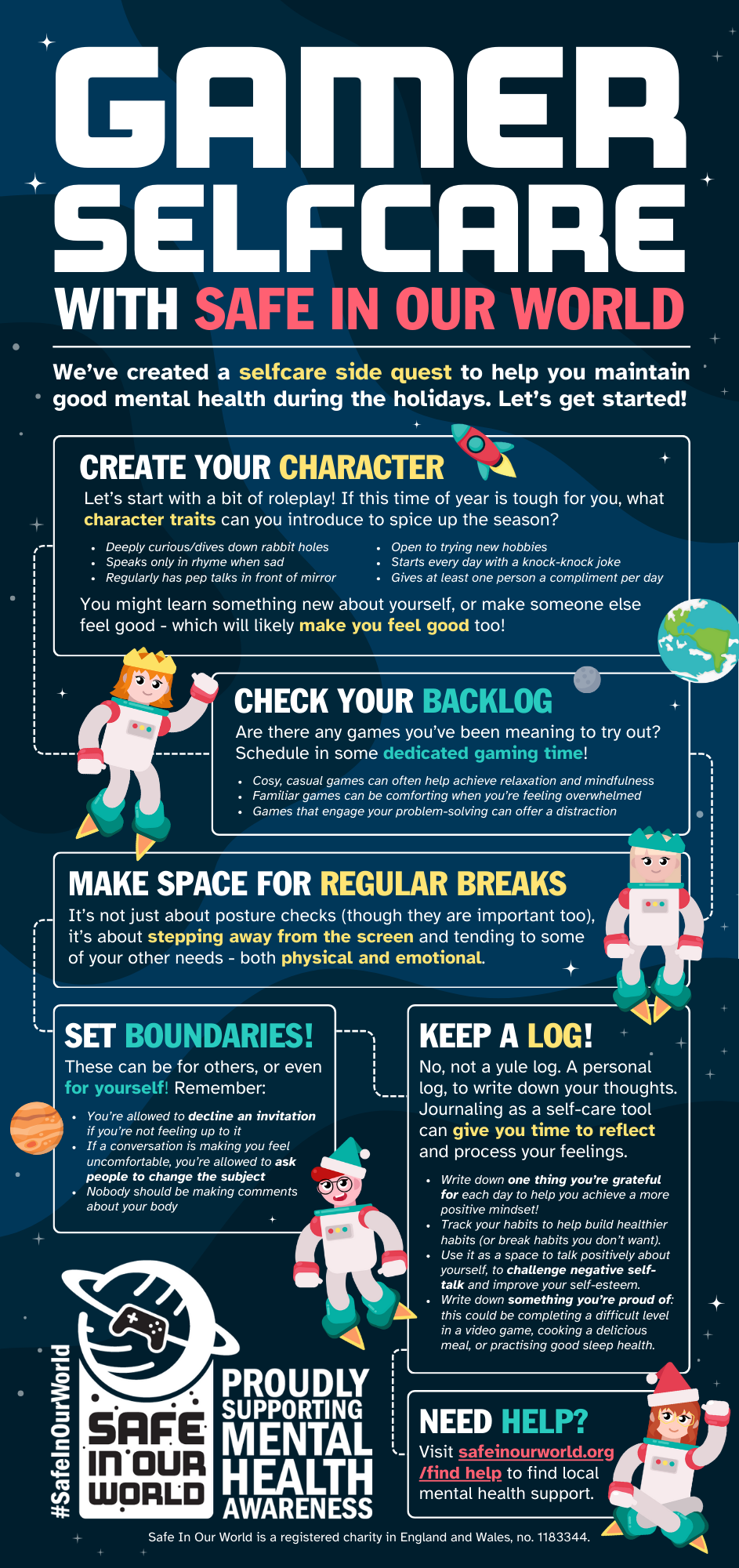
If you’re looking for ways to practice self-care during the holidays, check out our recent infographic for a side-quest to help boost your emotional wellbeing and set healthy boundaries during the festive season.
If you’re worried about your finances and you have access to an Employee Assistance Program, you may be able to access financial advice for free. People on the EAP provided through Safe In Our World (e.g. Level Up partners) can access one-to-one financial coaching with MUNNY.
If you’re struggling to switch off and find yourself endlessly scrolling through upsetting content, you might benefit from our article for protecting your mental health online. This can also help you support others impacted by the negative effects of doom-scrolling.
If you’re seeing a friend or relative this festive season who’s gone through a change (e.g. is using different pronouns, or a new name) and you’d like to build empathy and understanding around the importance of social identity, you can read our article exploring intersectionality and mental health.
And if you (or someone you know) needs support with their mental health during the festive period, please look to our Find Help page, to search for mental health services in your local area.
Safe In Our World will be back in 2026
Allow us to take this opportunity to thank you all for the enthusiasm and endless support you’ve given to our mental health charity over the last year. You can read a recap of what we’ve been up to in our birthday blog.
Our team is about to take a much-needed break! Our last work day of this year is Monday, 22nd December, and we’ll be returning to work in the new year on Monday, 5th January. We wish you all a safe, restful and relaxing break. Thank you!
Skills utilised:
News
Safe In Our World Announces New Ambassador Class of 2026
Safe In Our World is thrilled to announce our newest cohort of mental health ambassadors in our Class of 2026.
With 80 impressive applications this year, selecting Safe In Our World’s Ambassador Class of 2026 was a real challenge. We’ve seen such passion and creativity in every submission, and we’d like to thank everyone who applied for caring so deeply about improving mental health in games. But the final decision has been made, and our new ambassadors are locked in.
What do our newest ambassadors bring to the Safe In Our World mission – other than their boundless enthusiasm? We’re excited for this year’s cohort, which represents the diversity of backgrounds and experiences within our community. We’ve been joined by individuals with direct experience supporting loved ones with their mental health, educators, writers, healthcare providers, grief specialists, creators, and games industry professionals.
2026 is fast approaching, but with our new ambassadors by our side (and our ambassador alumni having our back), we’re excited for it to arrive. 2026 will bring with it fresh content, mental health initiatives, resources for the industry and global gaming communities.
Safe In Our World’s Ambassador Programme is sponsored by The Indie Stone this year, and by doing so, they power an initiative that connects mental health advocates on a global scale, allowing our charity to reach further and bring mental health resources and signposting to more people in need.
Alexander Mellström
[He/Him]
Alexander has worked in the video game industry for 7 years and is currently serving as Partner Account Manager at Paradox Interactive. With experience in digital distribution and partner relations, he’s passionate about fostering inclusive, respectful environments where everyone feels seen, heard, and supported both professionally and personally.
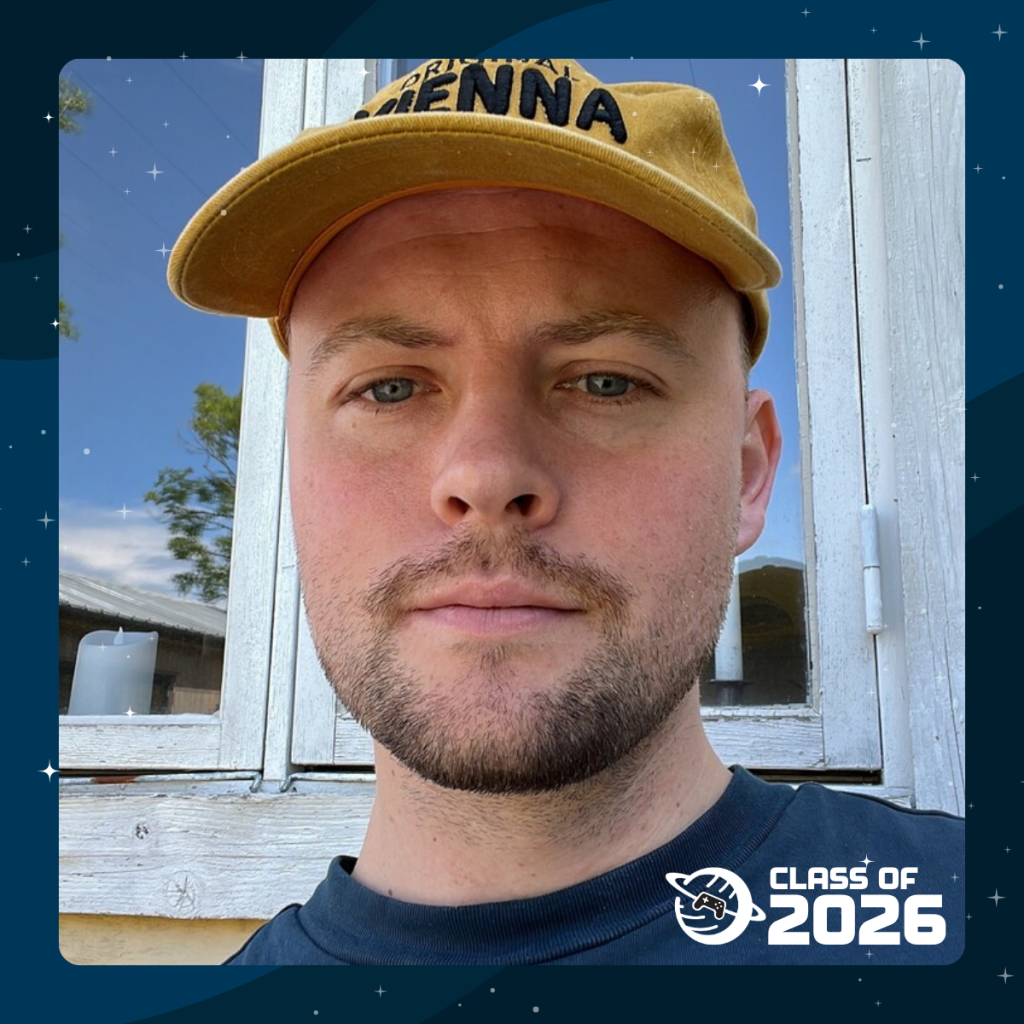
Alexander is super energetic and loves talking about, well, anything! Mostly, he enjoys talking about football, video games, Demon Slayer and Star Wars – or whatever has piqued his interest that week.
JadedPhoenix (Amber)
[She/Her]
Amber (JP) is a coordinator, creator, and entrepreneur whose work spans higher education, gaming, and community building. She fell into the world of gaming a year ago after being inspired to change careers and enter the creative industry. Since then she has worked on her own content creations, an indie studio and supports the Liverpool Game Development Network.

At the heart of everything Amber does is a passion for supporting and uplifting others, as well as working with creatives who are ready to make a difference!
Annabelle Afful
[She/Her]
Annabelle is a games developer and designer who founded Lost Wanderer Games, creating a rhythm narrative game. She’s interested in how games bring people together through shared experiences and enjoys supporting emerging developers and creative communities within the games industry.

Bethany Rainbird
[She/Her]
Beth is a game developer and one of the writers at Patch Magazine! She is passionate about how games can be used to support our mental health, particularly through loss and bereavement. While she admits to talking a lot about death, she promises that she’s still fun at parties!

Beth has already been hard at work, developing a content series for Safe In Our World exploring grief and video games.
Caitlin Doleman
[She/They]
Caitlin has been a solo indie developer for a year, and wants to have as positive an impact on the industry as possible. She has been working on publishing her first game while creating a community on social media to showcase what it’s like to work solo and help create a support network for new indie devs.

Codie Sheldon
[She/Her]
Codie is a Player Support specialist and Community Manager in passionate about creating welcoming, safe spaces for players of all ages. With years of experience in large online communities, she focuses on empathy, accessibility, and positive player experiences.

Outside work, Codie loves gaming, thrifting and nurturing cosy online spaces.
Conway Sutton
[He/Him]
Conway Sutton is a freelance indie games writer and narrative designer living in Guildford, UK, with a particular interest in telling queer and disabled stories. He strongly believes in the importance of intersectionality and supporting everyone’s mental health in the way that works best for them.
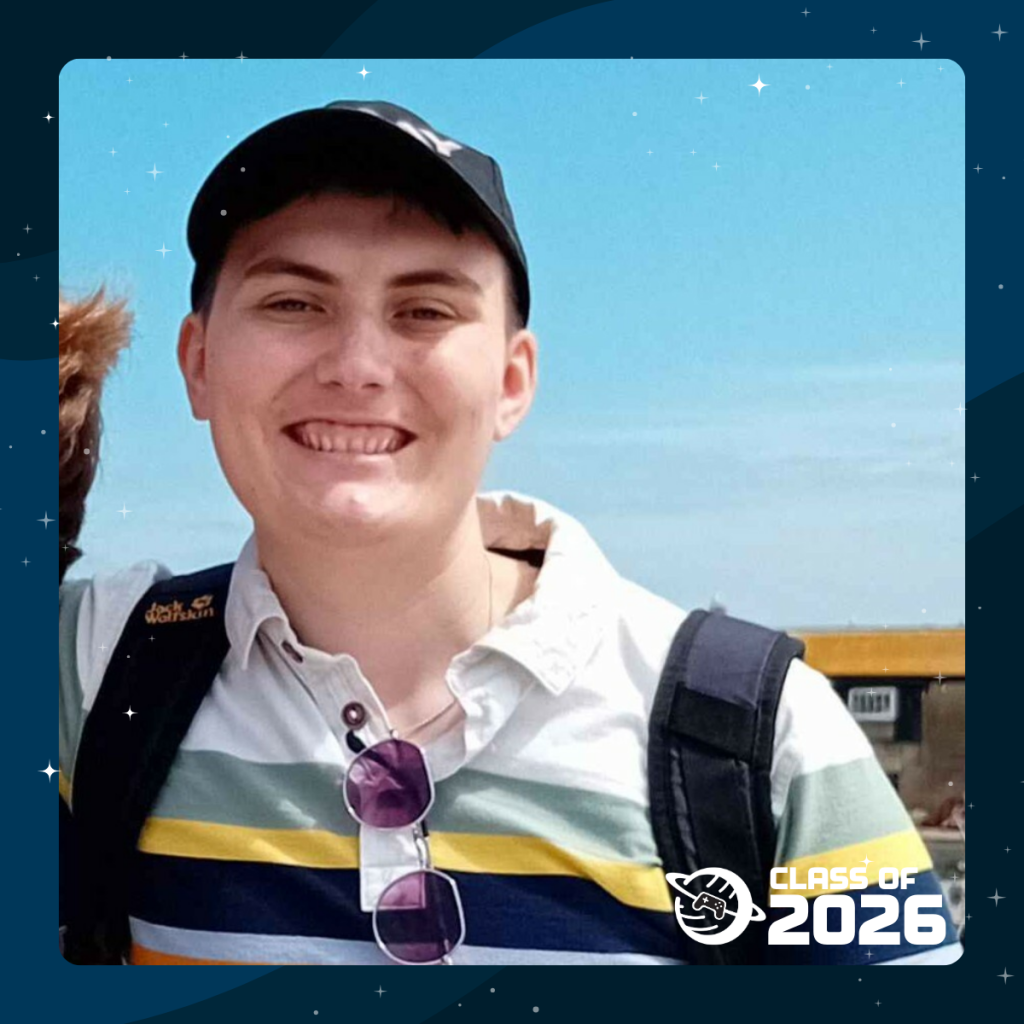
Dasha Barsky
[She/Her]
Dasha is a QA Analyst in a small studio, having taken a leap of faith 2 years ago to leave her data analytics career and pursue a life in games development. She is passionate about video games (obviously!), inclusivity, being nice to people, collecting niche hobbies like a dragon with a hoard, and her two cats.
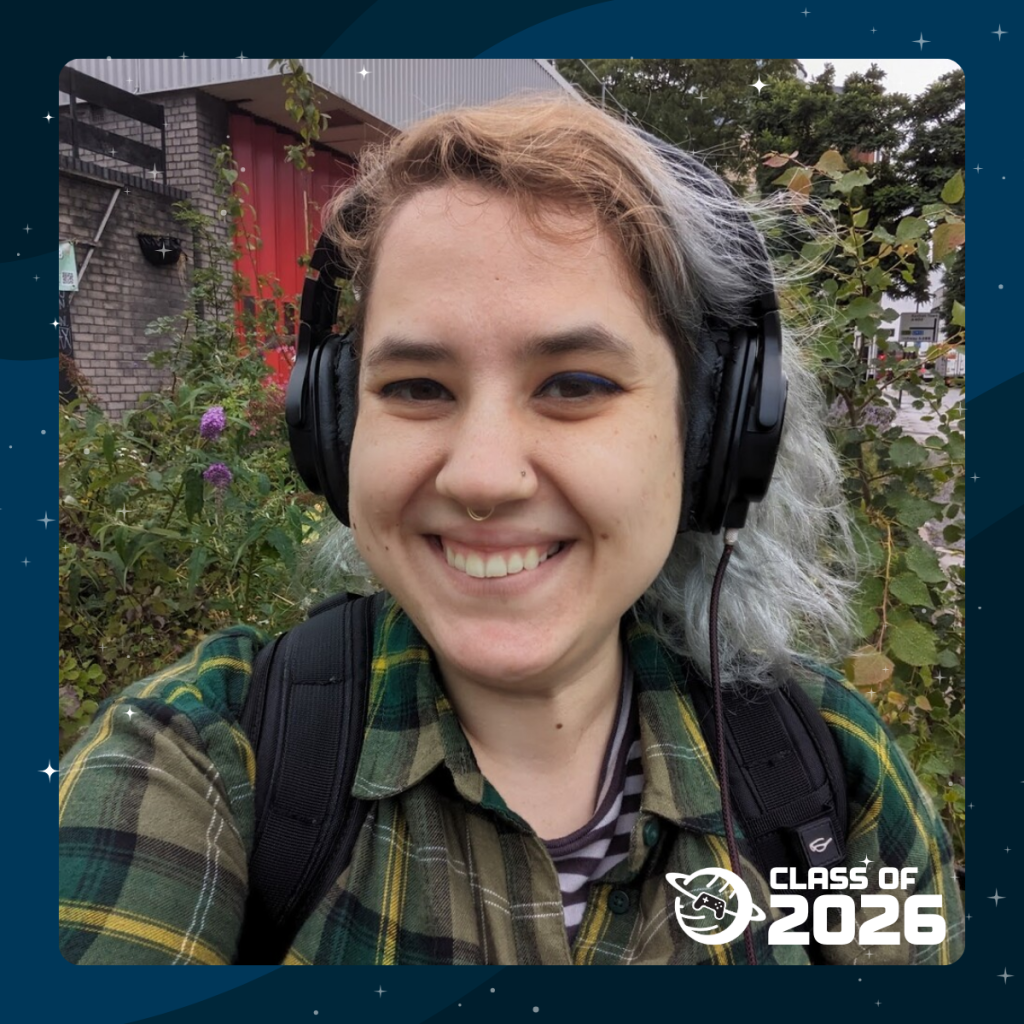
Mod Q
[He/Him]
Mod Q is a video and livestream producer at Jagex, helping bring life to announcements across Old School RuneScape, RuneScape 3, and Dragonwilds to players. As a proud dad of two, he’s driven by a deep belief that gaming should be an inclusive and welcoming space where his children, as well as players of all backgrounds can feel safe, supported, and able to belong.

Outside of Jagex, Mod Q is a lover of great stories, whether playing adventure-driven games on Nintendo consoles, watching Critical Role while learning to play Daggerheart, or diving into the magic of Disney and Star Wars.
He also loves stepping into storytelling himself, taking the occasional side quest into managing wrestling villains on the UK indie wrestling scene. He has a deep affection for New Orleans culture and cooking, as well as a love for the sounds of jazz and soul. And if that wasn’t enough, he’s a regular at the cinema, a dedicated concert-goer, a keen LEGO builder, and a guitarist at heart.
George Coates
[He/Him]
With time spent at several studios (currently at Team17 and everplay), charities, schools, and theatres; George has experience with the arts, education, and vulnerable people across the UK. He has spent a huge amount of time and effort dedicated towards learning about and bettering mental health in himself and others.

Havva Solhan
[She/Her]
Havva Solhan is the Co-Founder of Nonereal Games and has been working in the game industry for 5+ years, focusing on both mobile and PC game development. The games she has contributed to have reached millions of downloads. Currently working on a PC title called Problem Solved under the Nonereal Games label.
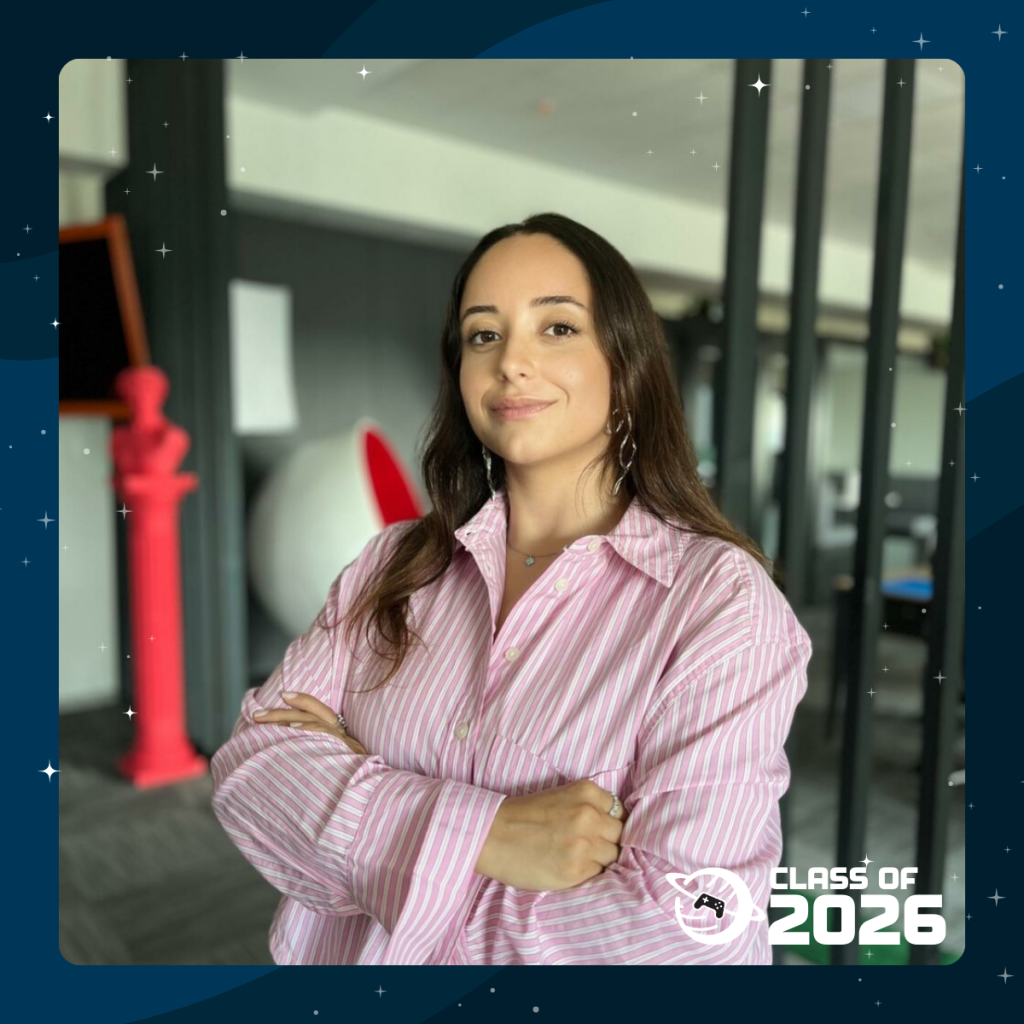
In addition to game development and publishing processes, she also leads projects on “Education in the Game Industry” and “The Role of Women in the Gaming Industry,” aiming to build more inclusive and informed communities within the industry.
Havva actively advocates for mental well-being, accessibility, and safe creative spaces in game communities – values that align strongly with Safe In Our World’s mission! Her ongoing efforts to support diverse, healthy, and supportive environments make her a strong fit as an ambassador.
Jarvs Tasker
[She/Her]
Jarvs Tasker is an award-winning Accessibility Advocate and Head of Communications at Happy Volcano, creators of the upcoming factory builder game, Modulus. With experience across community marketing, accessibility consulting, and content creation, she has worked on acclaimed indie titles and champions inclusive game communities through industry-wide accessibility initiatives.
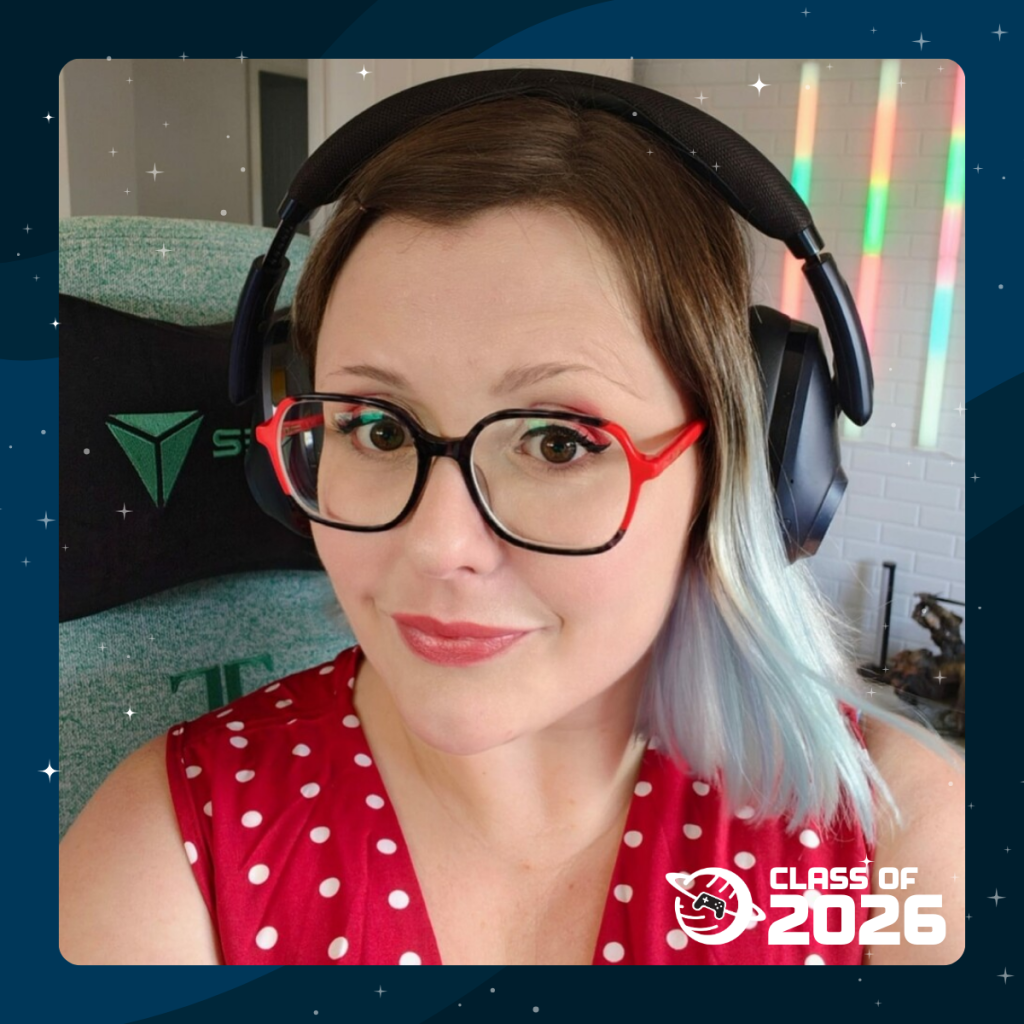
Jodie Swepson
[She/Her]
Jodie is a digital artist living in Lincolnshire. Jodie recently received First Class Honours in BA (Hons) Fine Art from the University of Lincoln and is at the start of her career in games.
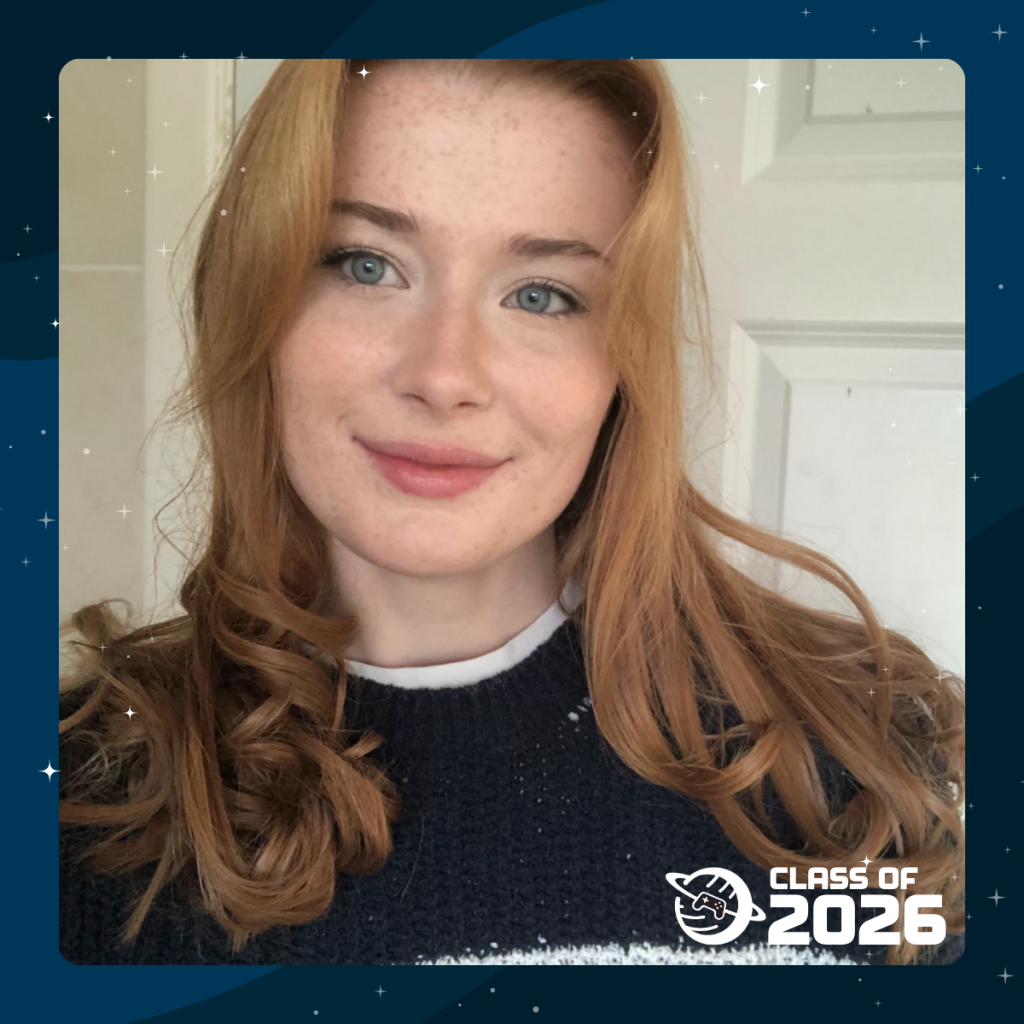
Through Safe In Our World, Jodie hopes to support fellow graduates with their mental health, knowing from personal experience how turbulent graduate life can be.
Jordan “AmazinglyOreos” Stephens
[He/Him]
Jordan is an experienced Social Media and Community Manager who started as a Sales Assistant at GAME, building his way up to work with major brands like Red Bull and Riot Games. Currently at Get In as a Social Media Manager, he supports diverse clients and studios in the games industry.
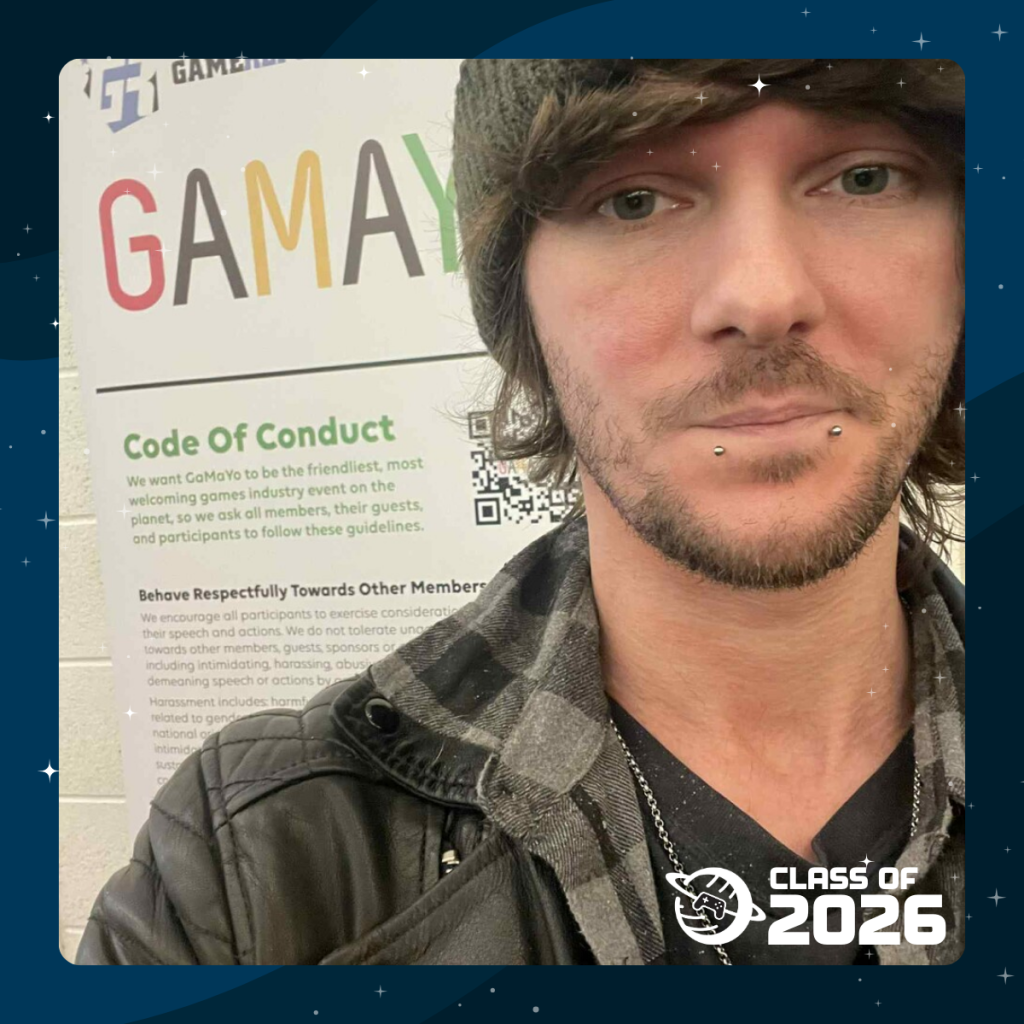
Jordan is a passionate AuDHD and neurodivergent advocate, championing truly safe and inclusive online spaces. You’ll often see him with his cat, Sebastian. Be warned though, he may ask you to dab in a photo with him for socials.
Katie Squires
[She/Her]
Katie is the Business Manager at South Westerly Games. They are a micro indie studio based on the south coast of England developing and producing their first game, NINE ROUNDS RAPID. It’s her first job in the games industry, having recently moved from a 20+ year career in the education sector.
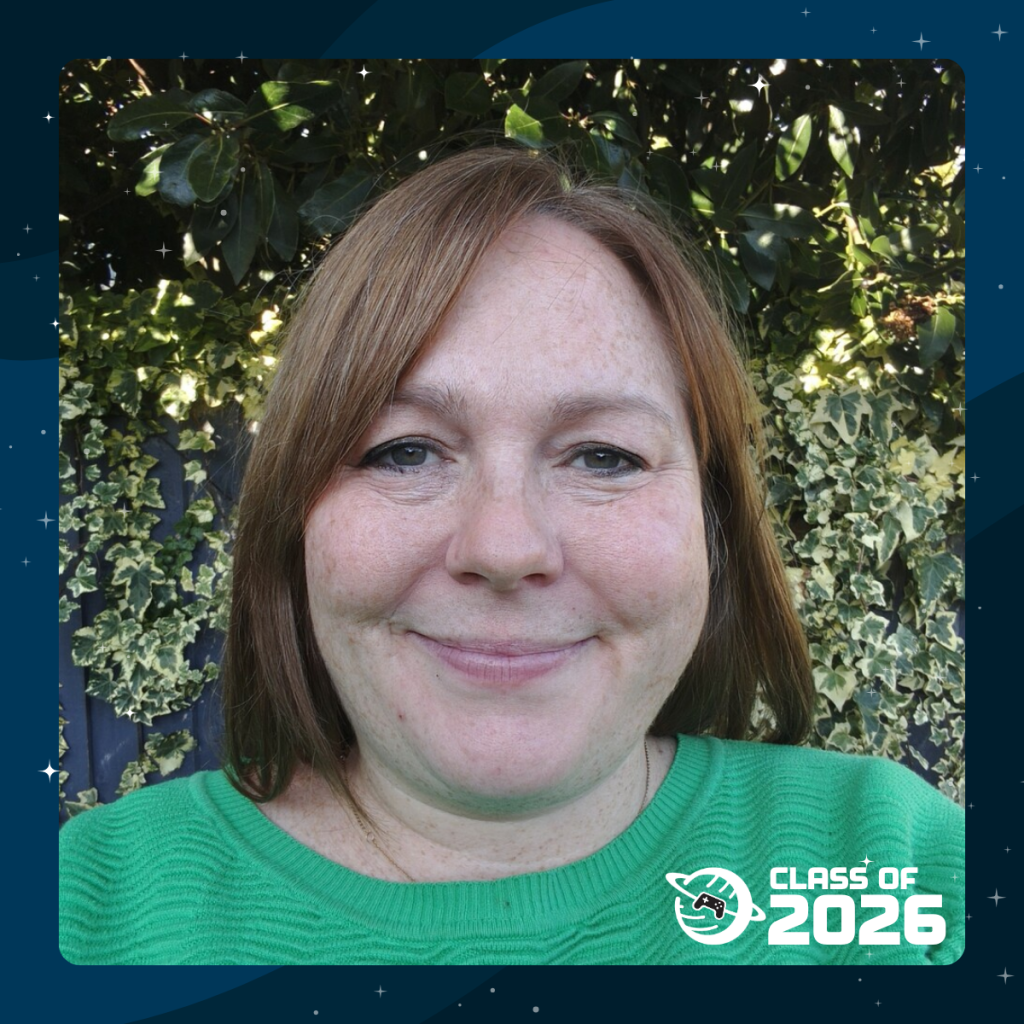
Katie held various roles over this time, with a particular interest in the pastoral care and wellbeing of the children in her care. Coupled with this pastoral experience, she has very personal reasons for knowing that talking about, raising the profile of and reducing stigma surrounding mental health is of the utmost importance. Katie is delighted to be given an opportunity to help do so in relation to the games industry. She’s happiest when she is either in her garden or swimming in the sea – the colder the better!
Eri Cheng
[She/Her]
Eri is an Account Executive at Bastion, working on the Riot, FFXIV and WotC accounts. Her favourite game is Outer Wilds. She loves connecting with people, and wants to foster that attitude in the gaming industry and encourage the building of stronger relationships regardless of backgrounds. She also has a British Longhair called Lemony!

Paul Rennie (Ren)
[He/Him]
Ren is a gamer by day, and by night? A gamer with funky neon lighting! He has over 16 years of experience in and around the video game industry – from QA to community management! He’s a content creator, and hosts a semi-regular live podcast on video game news and mental health topics.

Outside of games, Ren enjoys the usual nerdy things, as well as yoga, hiking, coffee, and is a reliable source of bad jokes.
Roshelle P.
[She/Her]
Roshelle P. is a Games UX Researcher, writer, and Death Doula with 4 years of AAA and indie experience, including shipped work on the World of Warcraft franchise at Blizzard. She holds an M.A. in UX Design and is the founder of Playfully Mortal, a 2x award-winning initiative focused on advancing grief literacy and death positivity through games.
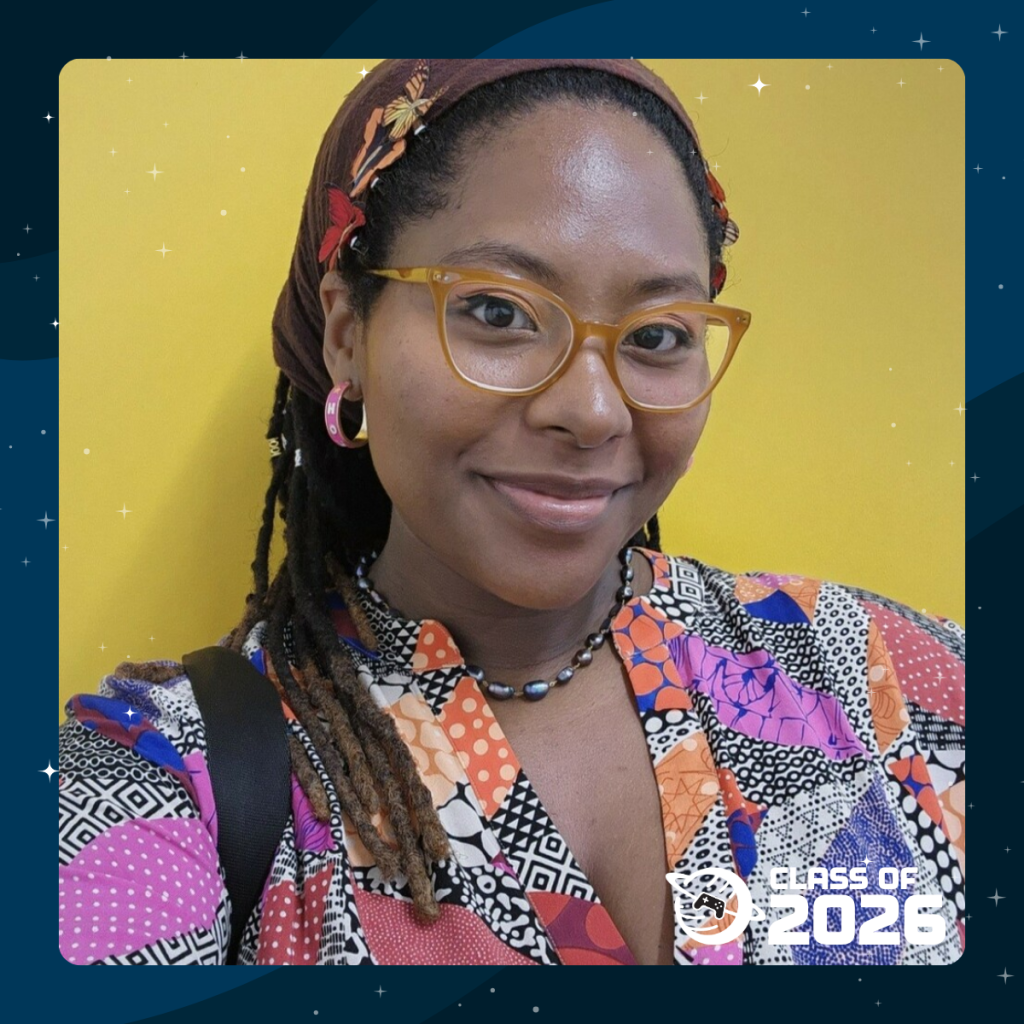
Sally Sheppard
[She/Her]
Sally is a game developer, educator, and researcher focused on inclusive game design and storytelling. A Lecturer in Game Design, Art, and Animation at the University of West London, she is also the founder of Wyrdren Games and an advocate for diversity and representation in the games industry.
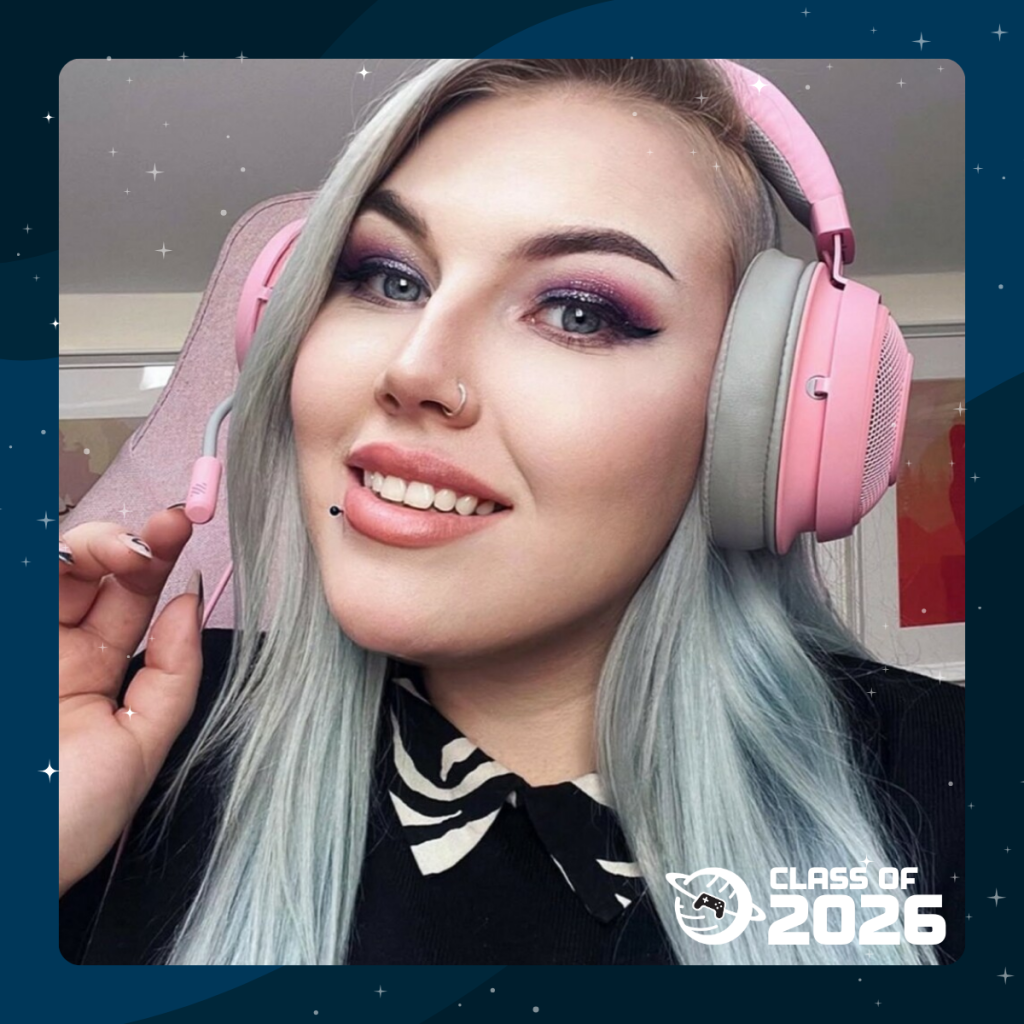
selcouthmind
[She/Her]
Sel is a Canadian V-tuber and speed-runner with a focus on indie games and cosy chaos. With an educational background in psychology and lived experience with trauma disorders, Sel loves to discuss mental health, stigma, and psychological assessment especially in the context of games and media.
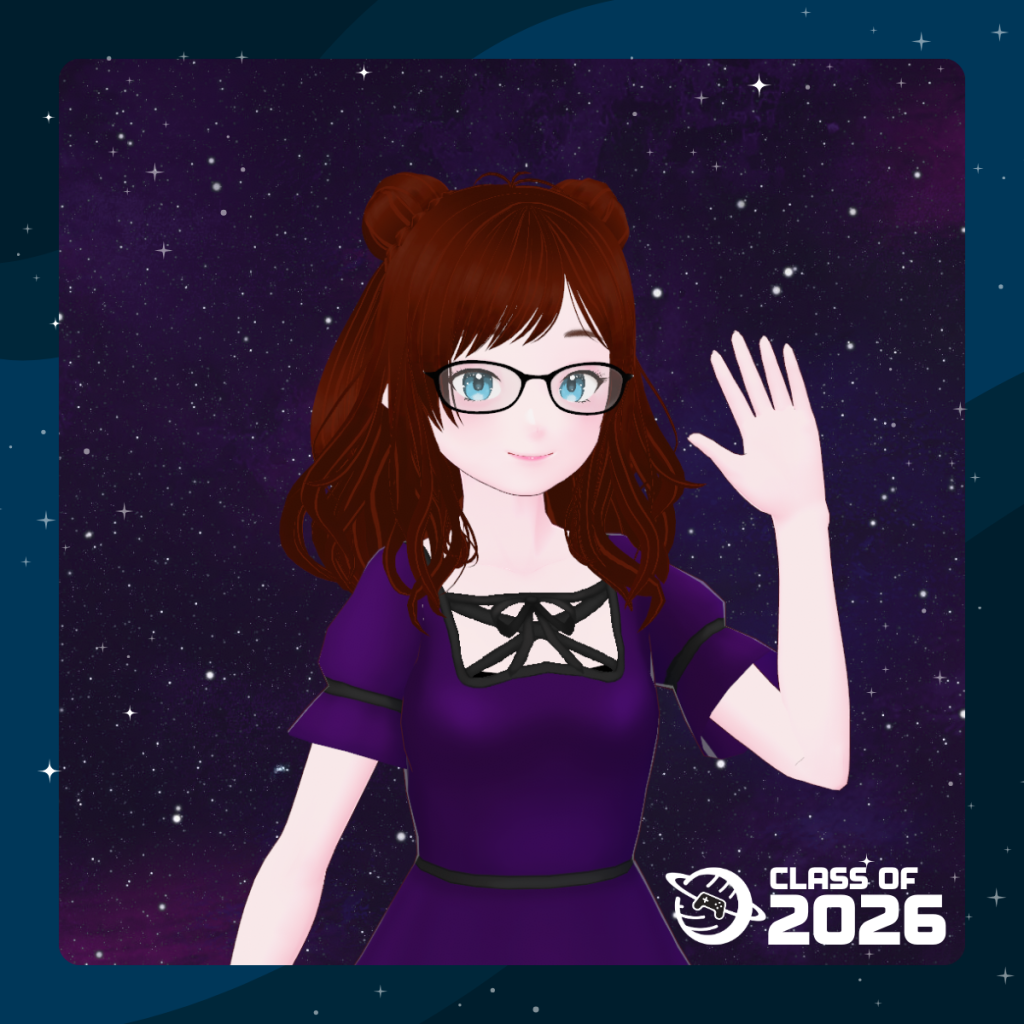
Susmita Aryal
[She/Her]
Susmita Aryal is a Kathmandu-based published author and an independent journalist. As a graduate in journalism, she brings years of writing and publishing experience. Susmita has a genuine love for storytelling, and is a person in progress as a communication professional. With a curiosity about International Affairs, she is currently pursuing her interest in International Relations and Diplomacy.

Sybil Collas
[They/Them]
Sybil Collas is a creative director, narrative designer and published author. They work with clients ranging from video game developers to interactive television and tourism companies (Ubisoft, Warner Bros., Canal+, We Are Social and more) and have navigated the ever-changing landscape of interactive narration for the past 15 years.

In this lapse of time, Sybil has sailed through several burnouts and started operating as a DEI consultant and advisor with a focus on fostering mental health awareness among both teams and projects, especially for queer and neurodivergent developers. They are one of the founders of the French collective Radi (Radical Collective for the Actors of Diversity and Inclusion) and a fervent advocate of political action through community making.
Thomas Müller
[He/Him]
Thomas ‘SpeedyBrain’ Müller is an indie game developer, community manager and co-founder of Fire Sword Studios with over a decade of experience. He purr-sues community-driven development and advocates for mental health and accessibility in games. Thomas is a proud cat dad, shameless pun enjoyer and can always be found on Discord.

Spencer Stachi
[He/Him]
Spencer is a Montréal-based Brazilian-born Canadian. He’s a former video game journalist turned PR, marketing and social media pro, working with brands like Sony Music, Atari, Focus Entertainment, and WB Games. Spencer is a board member for AbleGamers Brasil and a Certified APX Practitioner, and is passionate about making games accessible for everyone.

Tara Williams
[She/Her]
Tara is a non-profit professional who advocates for cancer patients and survivors. Video games brought levity to her own cancer diagnosis, treatment, and survivorship. She tries to balance a love of the outdoors with a love for indoor pursuits and lives in the United States with her husband and their retro video game collection.
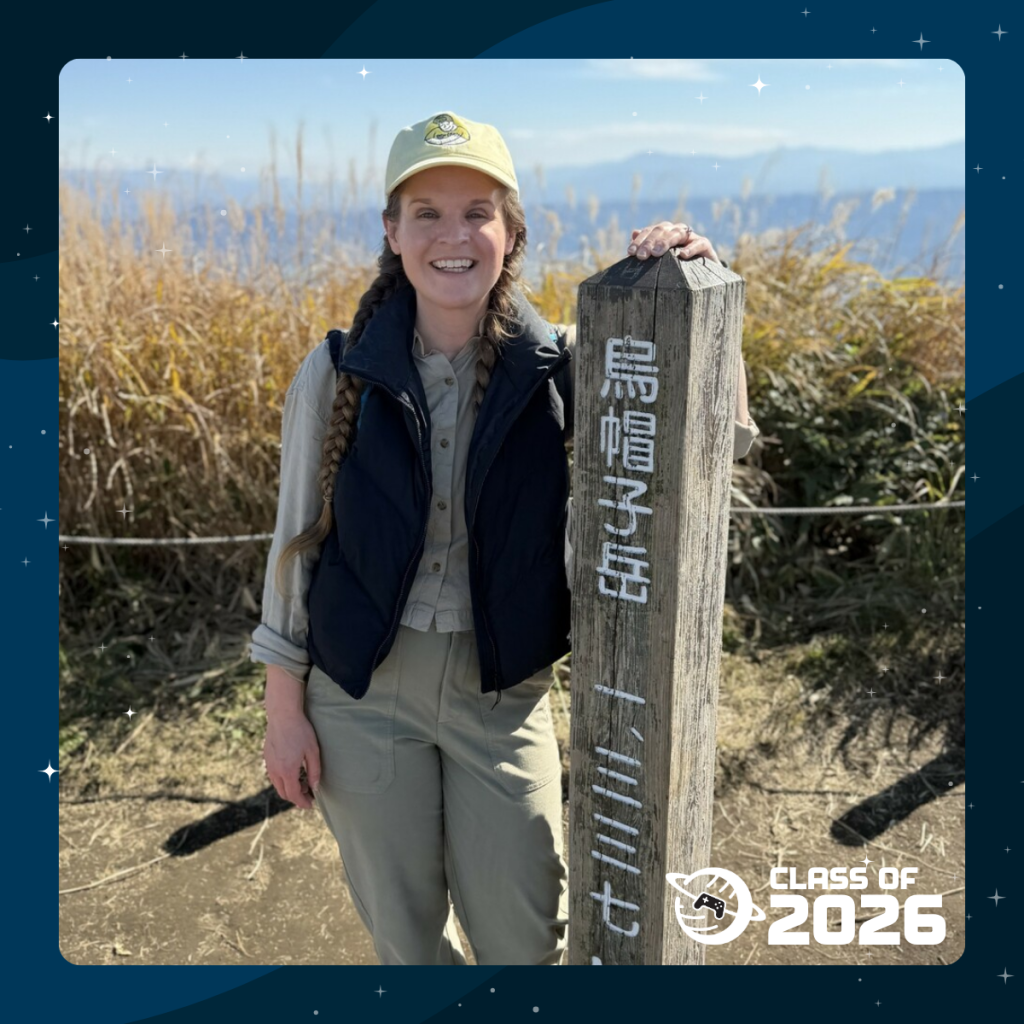
Aiden Sealey
[He/Him]
Aiden Sealey is an Assistant Producer at Electronic Arts with a background in indie production and studio operations. As a neurodivergent, transgender man, he’s passionate about inclusive, wellbeing-focused game-dev cultures. Outside of work, Aiden freelances as a graphic, web and UI/UX designer, drinks too much caffeine, and spends his free time playing games.

Elise
[She/Her]
Elise is a people-focused, detail-loving producer who thrives where creativity meets structure. From Zynga Mobile and Cloud Imperium Games to her own indie studio, she’s led teams, shipped features and worn many hats. Mental health matters deeply to Elise, inspiring her support for Safe In Our World and inclusive gaming spaces.
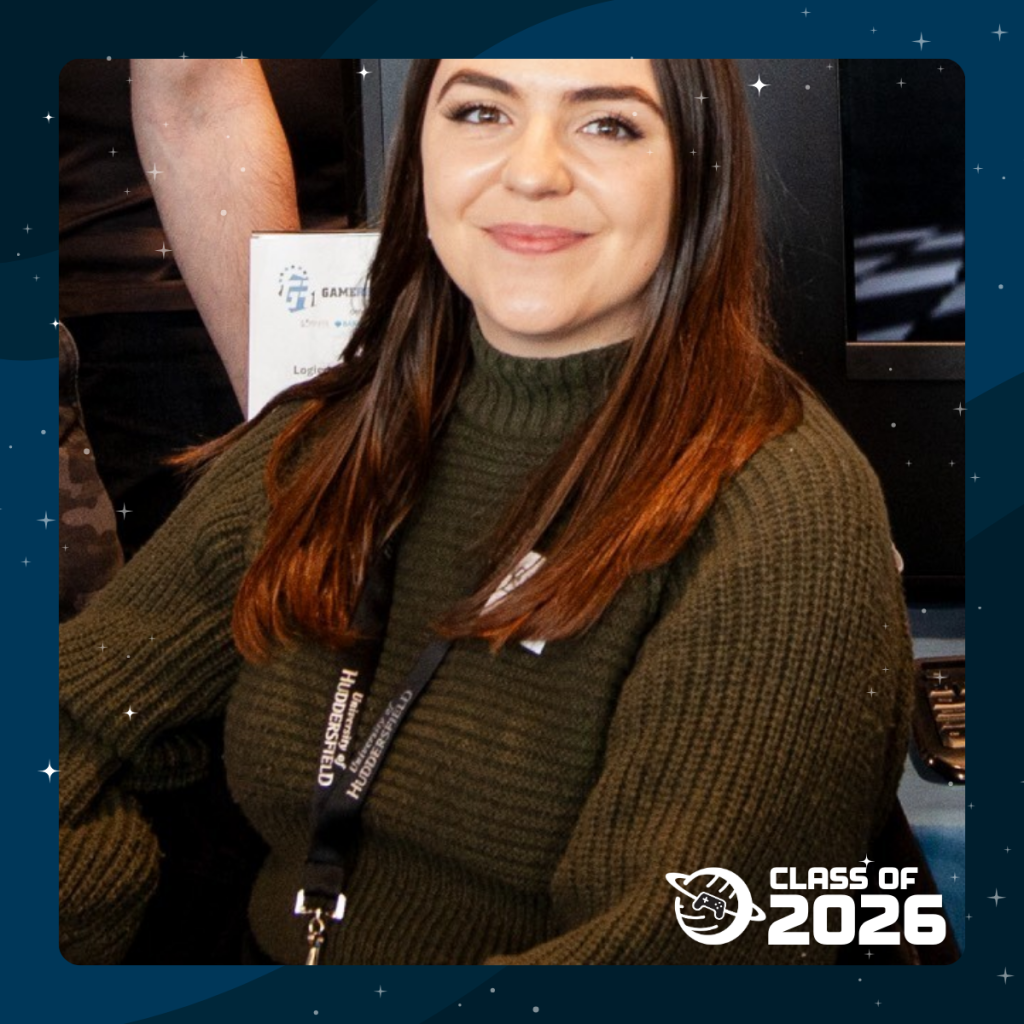
Ricardo Lozano Ham
[He/Him]
Ricardo has over 10 years of marketing experience and is currently the Head of Operations at Infernozilla, a marketing agency in the gaming space.
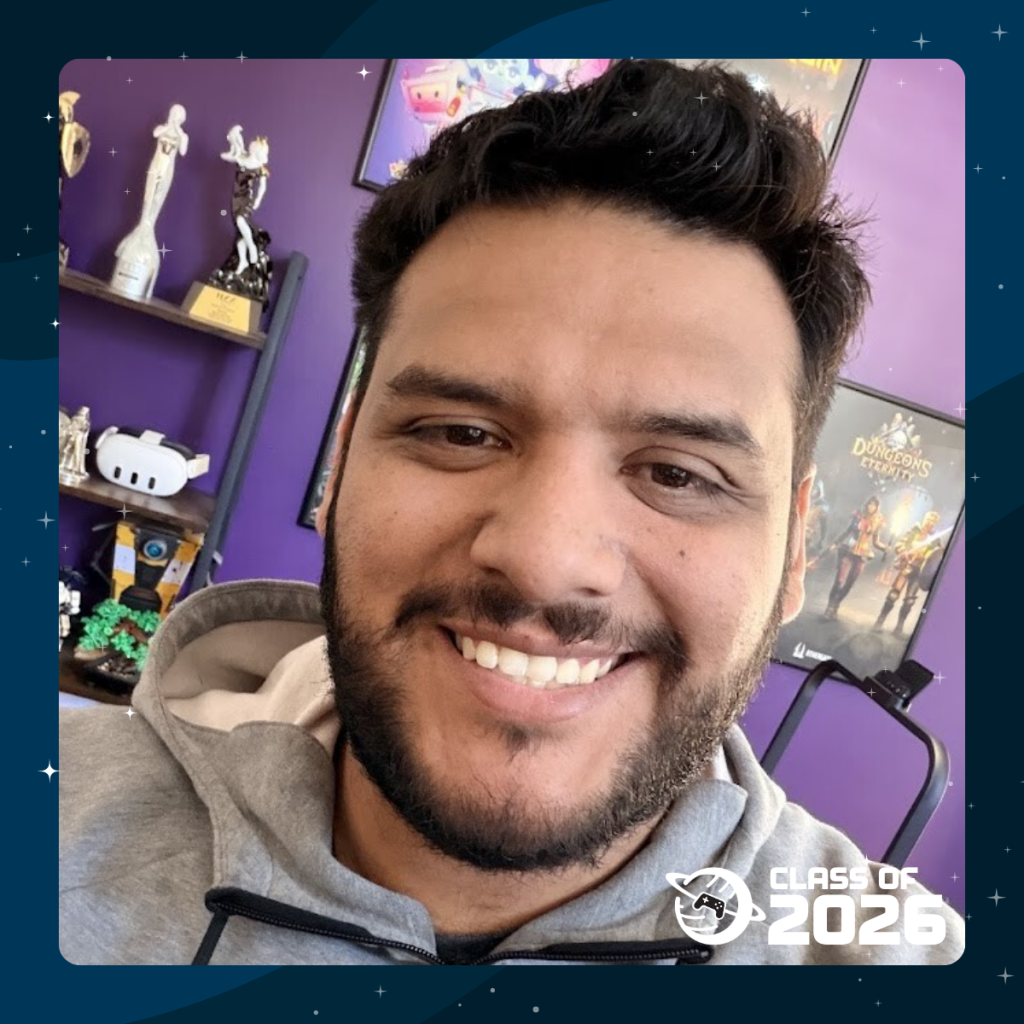
He is deeply passionate about working with indie games and helping them succeed. He is looking to raise mental health awareness across the hundreds of gaming communities he is responsible for and to be the helping hand he once wished he had. Outside of his professional work, he is dedicated to animal welfare, serving as a volunteer godfather for multiple shelters.
Nat (MurderVeggie)
[She/They]
As Community Manager by trade and content creator for fun, Nat (@MurderVeggie) has a penchant for creating welcoming and safer spaces for gamers that fit more than one type of person. Despite recent online harassment as a direct consequence of her job, they continue to speak publicly and refuse to leave the industry out of equal amounts of passion and spite.
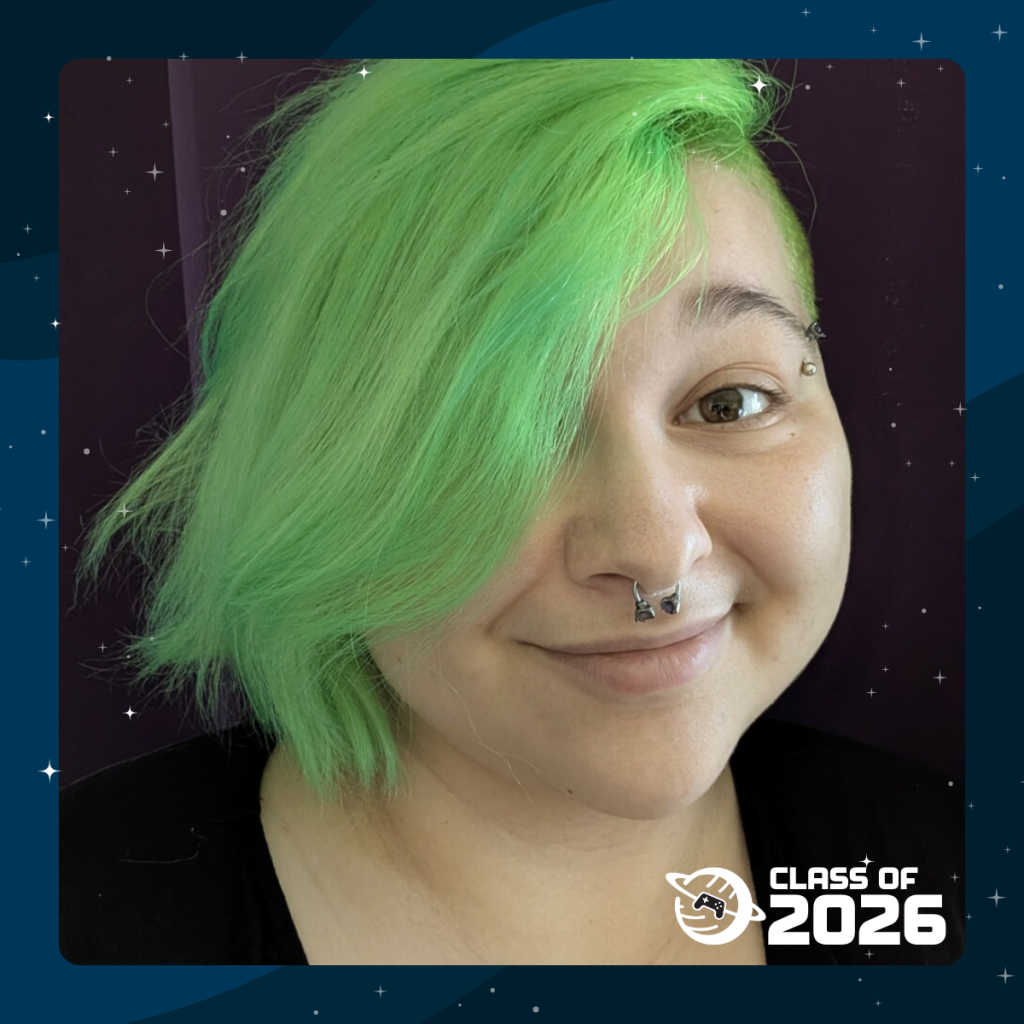
Thank you to all our new ambassadors for their passionate applications, and to everyone who applied. We’re so excited for our Class of 2026! Remember, applications open every year in October, so if you want to apply (or reapply if you weren’t selected this time), add a reminder to your diary, follow us on social media, or join our Discord to hear when we’re looking for a new cohort.
Skills utilised:
News
Ubisoft and Safe In Our World team up to deliver new Good Game Playbooks for kids, teens, and parents
Safe In Our World and Ubisoft have united again to deliver three Good Game Playbooks for kids, teens, and parents – challenging toxicity in video games.
Safe In Our World and Ubisoft co-developed the very first Good Game Playbook back in 2023, designed to provide players with the tools to navigate and help reduce in-game toxicity. Now, two years later, we’re back to collaborate on a brand new set of tools – this time for the whole family!

The History of the Good Game Playbook
When Ubisoft and Safe In Our World came together back in 2023, the goal was simple: create a tool to help players experiencing online toxicity. That included those perpetrating unhealthy behaviours, as well as those on the receiving end of in-game negativity.
The original Good Game Playbook gave players the tools to recognise warning signs, cope with anger and negativity, and practice self-care. Over the last two years, it’s been delivered to any Ubisoft player reporting others for toxicity, as well as to players who are reported.
Expanding the Good Game Playbook
Ubisoft and Safe In Our World got together again this year to explore a new series of Good Game Playbooks. We recognised the need to adapt to the different ages of young gamers and provide parents with the tools to support their children engaging safely with online games.
“Expanding the Good Game Playbook to parents, teens, and kids marks a new step in our mission to make online gaming a safer and more positive space for everyone. By empowering families with the right tools and insights, and through our continued partnership with Safe In Our World, we want to help the next generation of players build empathy, respect, and healthier gaming habits,” – Jérémy Marchadier, Player Safety Director at Ubisoft
A playbook in three parts
So, what does this look like? Well, players and parents can now download three Good Game Playbooks: for kids, teens, and parents. Each has been adapted to consider the kinds of challenges faced by that age group.
While all the toolkits focus on the same core objective (helping gamers be positive online community members), each playbook approaches this in a way that resonates with the audience it’s intended for.
- The Good Game Playbook for Kids caters to a 5th grade reading age and focuses on how to stay safe online and understand appropriate and inappropriate behaviour in online gaming.
- The Good Game Playbook for Teens supports an 8th grade reading age, and helps young people make informed, safe decisions about what games they play, how, and with whom. It also supports teens in identifying signs of tilt, and gives guidance on how to remain a positive member of their online communities.
- The Parents’ Guide is designed to support parents and guardians in understanding the risks and nuances of online gaming and communication, so that they can facilitate open and productive conversations with their children.
“It’s part of Safe In Our World’s mission to support gamers and ensure they can play the games they love while maintaining their wellbeing: addressing this with children and young people is crucial for building skills that will see them well into adulthood.” – Sky Tunley-Stainton, Partnerships & Training Manager at Safe In Our World
The Good Game Playbooks are available in English, French, Portuguese, Spanish, and German, and you can download them for free from the Ubisoft website.
Skills utilised:
News
Which would you choose in a mental health crisis? ChatGPT or human connection?
If you were experiencing mania, psychosis, or suicidal thoughts, would you turn to an AI chatbot, or would you seek support from a friend?
Content Warning: This article mentions suicidal thoughts and one case of suicide in a young person.
You might think the answer is simple – talk to a friend! Or, you might be wondering whether chatbots could actually help people in crisis reach out. Either way, we’ve seen a rise in people turning to AI tools for mental health support.
OpenAI has announced that 0.07% of users in a given week have shown possible signs of mental health emergencies related to psychosis or mania. On the surface, that might not sound like a lot – but OpenAI claims to have 800 million weekly users.
That leaves us with 560,000 weekly users engaging with ChatGPT while seemingly showing signs of experiencing a mental health crisis.
Are AI therapy chatbots safe?
ChatGPT hasn’t been designed to support people experiencing mental health problems. It’s described by OpenAI as an “AI chatbot for everyday use”, with the ability to answer questions, summarise information, and so on. But there are AI therapy chatbots, designed specifically to provide mental health support.
These AI therapy chatbots tend to sell themselves on the promise of providing a supportive, non-judgmental space. It might feel like a good option to those struggling to access therapy due to long wait times, expensive fees, or having to travel to appointments.
But a Stanford study from this year revealed that AI therapy chatbots may not only lack effectiveness compared to human therapists, but could also contribute to harmful stigma and provide dangerous responses.
“Therapy is not only about solving clinical problems, but also about solving problems with other people and building human relationships. If we have a [therapeutic] relationship with AI systems, it’s not clear to me that we’re moving toward the same end goal of mending human relationships.” – Jared Moore (Leading Author of Stanford Study: Exploring the Dangers of AI in Mental Health Care)
The limitations of AI in mental health care
An article from the National Centre for Biotechnology Information explored whether AI can replace psychotherapists, and envisioned a future where AI could offer scalable, cost-effective solutions that reduce barriers to mental health care – such as affordability, stigma, and logistical challenges.
But they also recognised the dangers of the limitations as AI becomes more integrated into mental health care, including algorithmic bias, a lack of genuine empathy, and the ability to interpret non-verbal cues – qualities that are intrinsic to human therapists.
Devastating consequences for vulnerable people
We’re already seeing the dangers of using chatbots for mental health support. This year, a 16-year-old boy from California died by suicide. The parents of Adam Raine are suing OpenAI for wrongful death, stating the AI programme’s design “foster[s] psychological dependency in users”.
Adam spent months confiding in the chatbot, discussing his interests, his future, and his experience of anxiety and mental distress. The final chat logs showed that Adam discussed his plans to end his life.
Sadly, this isn’t the only story like this, and it speaks to the ongoing challenges we face as AI becomes more commonplace.
Build your mental health crisis strategy
Navigating the introduction of AI to mental health care feels like a huge challenge, because it is. But it’s not your responsibility to find one big catch-all solution.
Instead, we’d encourage you to focus on building out your knowledge and confidence in supporting people in your life who might struggle with their mental health.
We still have spaces on our upcoming FREE Mental Health Awareness training (Nov 6, 2025), to help increase your knowledge of mental ill health and feel confident in signposting to resources. You’ll learn to identify and manage stress, and establish healthy boundaries.
Skills utilised:
News
Mental Health Charity Safe In Our World Turns Six & Press Pause 2025 Begins
Can you believe Safe In Our World just turned 6 years old? Our mental health charity has grown so much, and we’re on a trajectory of positive change.
We’ll spare you the comprehensive recap of the last year (saving that for our next Impact Report) and jump straight into the celebrations. 🥳 What a wonderful year we’ve had at Safe In Our World! We’ve seen growth within our team, our Board of Trustees, our Clinical Advisory Board, and we’ve welcomed new Level Up partners.
But most importantly, for us at least, we’ve been able to directly engage with so many of you in our community. Our team has been able to meet and talk with hundreds of games industry professionals, consultants, and graduates – at events across the globe.
We’ve brought you talks, roundtables, and resources. We’ve been able to listen to your stories, your lived experiences, and your hopes for the future. The opportunity to connect with you has fuelled our motivation and filled us with inspiration. We’re rocketing into another year of Safe In Our World with fresh ideas and boundless enthusiasm.
🚀 Our Continued Mission
Can you imagine a games industry free from crunch? Where burnout isn’t a constant companion, and imposter thinking is met with compassion? Picture it, just for a moment, a future where every workplace has the tools, resources, and training to deliver psychological safety. A future where everyone feels empowered to seek support should they need it. A future without mental health stigma.
It’s what we picture every day. It’s what we work towards, and it’s what we’ll continue to work towards, for as long as it takes to make that picture come to life. We’ve already taken steps towards that future, and we thank all of you who’ve joined us on this journey.
FOR six whole years, we’ve been delivering mental health support to the games industry and global gaming communities. This mission means everything to us, and I’m so proud of our team for what we’ve achieved so far. We’re also so thankful to our Level Up partners, our workshop leaders and speakers, our fundraisers, and our charity friends. Our future is bright, bold, and brimming with creativity. – Sarah
We’re still a small crew. We’re often met with surprise when people learn we’re only a team of six. But what we lack in size, we make up for in tenacity. Our small team can create big change, thanks to the support of our Ambassadors, Patrons, Trustees, Advisors, and many charity friends. Together we’re unstoppable.
📢 (Re)introducing Our Team
Around this time last year, we welcomed Em (Communications & Events Manager) and Jess (BizDev & Marketing Manager) to the team. Jess has been working behind the scenes, connecting us with new opportunities and developing our strategy. They’ve been focused on how we communicate value and reach further in the industry.
Em has been cooking over the last month to deliver our fresh Press Pause 2025 campaign (more on that later) and branding up our resources. They’ve also been focused on making fundraising fun and accessible, bringing their passion for storytelling to our charity initiatives.
Then, in June this year, we were joined by Izzie (Operations Coordinator), who has been working hard to improve our Level Up programme, helping companies across the games industry access game-changing training, resources, and mental health support. Catch her in your inbox!
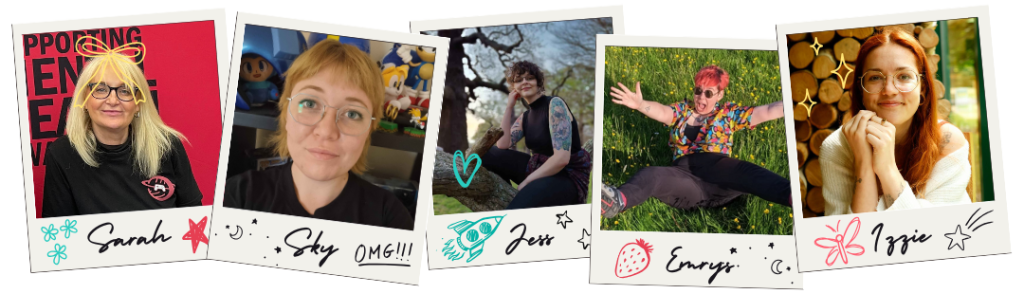
The Safe In Our World team absolutely ATE this year! Obviously, that was partly down to the excellent decision in hiring me. What a slay! – Izzie
You might have bumped into Sarah (Charity Director) at a few roundtables this year. She’s been out in the wild, waving the Safe In Our World flag, raising awareness, and securing opportunities for us to reach more devs.
Let’s not forget our part-time finance whizz, Tash (Finance Administrator). who’s given us even more of her time this year as our operation grows.
And then there’s Sky, our fantastic Partnerships & Training Manager, who has pioneered our new Mental Health Star Accreditation over the last year. They are the powerhouse behind so much of what we do as a charity. Be it toolkits, training, or new initiatives to make our industry a safer place; they’re spearheading the positive change our industry needs.
🌠 Our Mental Health Star Accreditation
Undoubtedly, the shining star of this last year at Safe In Our World has been our new Mental Health Star Accreditation – unveiled in August 2025 – bringing the first-ever evidence-based mental health accreditation to the games industry. This initiative propels us forward in our mission to introduce best practices and celebrate companies already leading the way in workplace wellbeing! 👏
💡 We’d like to thank Doug Cockle, the voice of Geralt in The Witcher video games franchise, for lending his voice to our Accreditation launch video – as a patron and friend to Safe In Our World, his support and enthusiasm means a lot to our team.
We’ve had NAUGHT but appreciation for our community. Under the pressure of all the uncertainty and change happening in the games industry, you’ve still shown up for us and supported us. We’ve been shown so much love this year, especially around the launch of our new Mental Health Star Accreditation – we’re so grateful. – Sky
If you’re thinking ahead to what you want to achieve in 2026, consider becoming a Mental Health Star. Our accreditation is designed to be accessible, flexible, and scalable – so whether you’re a two-person team or a AAA studio, an accreditation with Safe In Our World will help you take your workplace wellbeing to the next level.
🎮 Press Pause 2025
Are you ready to unravel a mystery? 👀 To celebrate our charity’s 6th anniversary, we’ve launched our annual Press Pause fundraiser – with a puzzling twist!
Inspired by the success of Blue Prince, which launched in April this year, we put our thinking hats on and came up with a fundraising challenge for those who love a good puzzle (or six)!
Dive into Press Pause: Mysteries Of The Mind, our latest campaign to get your brain whirring. Help Safe In Our World seek out a mysterious hidden truth, which has fractured into pieces and hidden itself within six puzzles. Unravel the riddles, uncover the clues, and investigate the Safe House. Who knows, you might learn something about yourself along the way.
Visit our Press Pause 2025 campaign page on Tiltify to download the Investigation Kit for free, and consider setting up a fundraiser or donating. The kit has been designed so you can play solo or with friends or colleagues. We’ve pulled together a Press Pause Creator Guide to help streamers get started with Mysteries Of The Mind, including insights to share about our charity and recommendations for playing the campaign live on stream.
🎓 Ambassador Applications
For those who missed it, this is a gentle reminder that the application process for becoming a Safe In Our World Ambassador (Class of 2026) is currently open. If you have a passion for mental health in games and feel you can volunteer your time to our mission, apply through our form.
Becoming an Ambassador:
- You sign our code of conduct and uphold our values
- You take part in at least one key activity each year (e.g. streaming, fundraising, public speaking, writing for us)
- You champion our mission in mental health in everything you do
Anyone with a passion for reducing mental health stigma and increasing awareness is welcome to apply, regardless of where you work – or whether you’ve applied before. We highly encourage people of marginalised backgrounds to apply.
New ambassadors receive a Class of 2026 merch gift, priority access to internal news and initiatives, opportunities to contribute to content, access to resources and training, a bespoke monthly newsletter, and a place among our many amazing Ambassadors on the Safe In Our World website.
Apply today – deadline for submissions is 24th October, 11:59 UK time.
Thank you for celebrating six years with us. Play safe! ✌️
Skills utilised:
News
Celebrate Our Upcoming Anniversary With The Wired & Humble Mega Bundle
Wired and Humble launch exciting bundle worth £195.25, in celebration of our Safe In Our World anniversary.
As you know, this week Safe In Our World is turning six, and we’re celebrating in style. Wired Productions and Humble have delivered a jam-packed bundle filled with fantastic games in support of our mental health charity – worth a whopping £195.25!
You’ll receive up to 13 great games (depending on how much you pay), and a portion of the proceeds go towards supporting Safe In Our World, helping us continue to deliver game-changing mental health tools, resources, and training.

Wired the same way
Did you know, Wired Productions played a crucial role in the founding of Safe In Our World. Our charity started as a direct response to real events in the lives and work of the founders.
The team behind Wired Productions (Leo, Neil, and Gareth) wanted to do something meaningful that could help others struggling with mental health challenges. That spark ignited the rocket fuel that helped Safe In Our World soar.
Since that time, our charity has grown into a fully independent organisation. But we still look back on those early days and feel thankful the conversations that needed to happen happened. Our mission has always been to empower discussion about mental health, and that’s where this all began.
We’ll always be grateful to Wired for all their support. In fact, founder Leo Zullo continues to steer our board of trustees, keeping the original vision alive as we continue to grow.
What’s in the Anniversary Bundle?
Out now, the Wired & Humble Safe In Our World Anniversary Bundle is loaded with games you will want to play immediately. Here’s the full line-up!
- Bulwark Evolution: Falconeer Chronicles | Soar through the skies and defend your world.
- Gori: Cuddly Carnage | Cute, chaotic, and gloriously unpredictable.
- Martha is Dead | Psychological horror that sticks with you.
- Deliver Us the Moon | Explore space in this atmospheric adventure.
- GRIP: Combat Racing | Fast, destructive, and totally thrilling.
- Arcade Paradise | Build and manage your very own arcade empire.
- Aaero 2 | Music, rhythm, and high-speed action.
- The Falconeer | Epic aerial battles across stunning landscapes.
- Those Who Remain | Suspenseful and eerie storytelling at its finest.
- Fractured Minds | Thought-provoking mental health experiences.
- Tin Hearts | Physics-based puzzles that bend brains and reality.
- The Last Worker | Satirical storytelling and immersive world-building.
- Tiny Troopers: Global Ops | Tiny soldiers, big missions, even bigger fun.
Support mental health, play great games
Whether you are a long-time supporter of Safe in Our World, a fan of Wired Productions, or just love a good Humble Bundle, this is your chance to play amazing games while supporting mental health.
Every bundle purchase helps us continue raising awareness, creating resources and toolkits, facilitating training, and delivering mental health initiatives across the games industry and global gaming community. It’s also a great opportunity to show some love to the talented team at Wired Productions and help support the Humble community. So, grab the bundle and dive in for mental health in games!
Skills utilised:
News
Get a head-start on World Mental Health Day with Safe In Our World
Either you’re reading this in advance of World Mental Health Day (October 10), or it’s arrived and you’re wondering how to mark the day. Don’t worry, we’re here to give you a little inspiration!
Share to your socials 👉 Click to download our free World Mental Health Day square (1:1) or Instagram (4:3) graphic to share, to let your community know you’ll be a tether if they ever feel lost in the dark.
What is World Mental Health Day, really?
What’s it for? What does it actually achieve? It might feel like we have lots of awareness days for lots of things (because we do), and you might ask the question: haven’t we achieved awareness by now? It’s a fair question, but like with most things in life, it’s never that simple.
‘Awareness’ requires upkeep. It’s something we maintain, not something we attain. So, yes, days like World Mental Health Day are still vital and still serve to raise awareness.
But one day (out of 365) isn’t enough to resolve the global crisis we’re facing in mental health. According to the World Health Organization, over a billion people are living with mental health conditions – such as anxiety and depression. Odds are you know someone who’s struggling, or maybe you’re the one struggling.
What can I do about it?
Naturally, when dealing with big problems, we’ll look for big solutions. To really tackle the root cause of mental ill health, we’d need to look at sustained investment in mental health services, social reform, and significant action to tackle inequality. It’s not something we can really summarise in one blog, and we don’t want to overwhelm you.
But neither do we want you to feel like you don’t have the power to make a difference. You don’t necessarily need to bring the big solutions! Change comes in all shapes and sizes, and we’ve got some simple, sustainable ideas to help you take action. We’re not expecting you to do all of these, but committing to one or two can help the mental health of your community, friends, and family.
🔴 I’m low energy right now, what can I do?
Before we dive into this one, it’s important we recognise those who are feeling this way, who still show up and throw their support behind our mission. That’s a big deal! We’re very aware that there are many within Safe In Our World’s community who personally struggle with their mental health, or have a dynamic disability or chronic illness, which makes it harder to keep pushing forward. But still, you keep pushing alongside us. We see you.
When you’re low on energy, you need to prioritise your own mental health. It’s not selfish, it’s survival. If you’re struggling with your mental health right now, we’d encourage you to seek out some support, because you don’t need to struggle alone. If you’re still eager to get involved, you could consider the following:
- Tell someone how you’re feeling
- Share a self-care tip that helps you
- Demonstrate how to set healthy boundaries
🟡 I want to improve mental health at work, what can I do?
Thank you! People like you help us create a safer, healthier games industry for current and future generations. You don’t need to be in a leadership position to push for change (but it helps when leaders get involved). There are many ways you can help, so we’ll list off a bunch, and you can find the one(s) that fit you best:
- Register now for our FREE mental health awareness training (Oct 9 & Nov 6)
- Promote and join our Level Up initiative (for free resources and training)
- Share notes and insights from training you attend with colleagues
- Lead by example by taking your breaks and finishing on time wherever possible
- Create your own Human Handbook for improved communication at work
- Contribute to and share stories from Safe In Our World with colleagues
- Get accredited and become a Mental Health Star
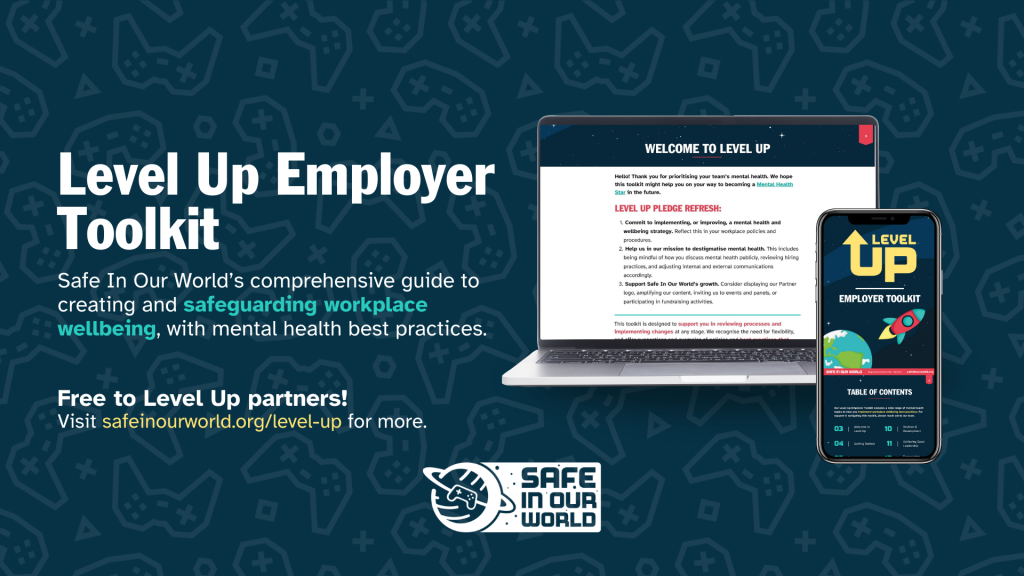
It’s a great time to become a Level Up partner! We’ve just given our Level Up Employer Toolkit a glow up (click to download a sample copy). Much like this list, we’ve included a bunch of ideas for how you can improve mental health in the workplace – only it’s way more comprehensive, and marked as either essential, an easy win, having a cost implication, or an industry best practice that’d get you a gold star in our books.
🟢 I want to help mental health in my games community, what can I do?
This is a great ambition to have, and we need more people who think like you. Friends and community are vital elements of good mental health, and provide us with so much support throughout our lives. We’ve been living through a loneliness epidemic (1 in 6 people experience loneliness) and social isolation takes a great toll on our wellbeing. Thankfully, video games can offer a haven from that darkness. Many people find connection and friendship through video games, and the communities that grow around them.
You can help nurture those communities and maintain safe online spaces where everyone feels welcome and included. Don’t underestimate the impact you can have. You might help one person that you know of, but many others then see the example you’re setting. You can help inspire more people to take an active role in increasing mental health awareness and online safety. (You’re also very welcome to attend our free Mental Health Awareness Training!)
- Volunteer as a Discord or forum moderator
- Share your mental health story and amplify other people’s stories
- Prioritise signposting in community spaces you look after
- Encourage positive interactions and reject toxicity
- Play mental health-themed games alone, with friends, or on stream
When we focus on the big solutions, we can sometimes lose sight of the small, sustainable ways to improve mental health awareness – and we hope these lists have helped you focus in on what you can do right now! Maybe you’re the kind of person with the energy, ambition and drive to lobby governments, shape policies and lead movements. That’s amazing, and we can’t wait to see you make waves in mental health!
For the rest of us, remember that some waves start as ripples. A small impact is still an impact – and even if you help just one person, that’s one person more than if you didn’t take action. So, this World Mental Health Day, commit to making a ripple.
Skills utilised:
News
Safe In Our World Ambassador Class of 2026 – Applications Are Open!
Safe In Our World is welcoming new Ambassador applications for our Class of 2026!
As we enter October, and with Safe In Our World’s anniversary just around the corner, we’re pleased to announce that Ambassador applications for the Class of 2026 are now open.
We’ve been privileged to expand our network of mental health champions over the last year, with Ambassadors from across the world helping us to raise awareness and start conversations. And now, we’re again encouraging passionate mental health advocates with big ideas to apply – and join our mission to end mental health stigma!
What is the Safe In Our World Ambassador Program?
We’ve been running our Ambassador Program for almost as long as we’ve existed as a charity. Every year, we welcome 25 new Ambassadors as representatives of Safe In Our World.
These amazing people champion our message across various platforms, at events, and within the work they do. They help us fundraise, create content, or contribute to our blog, and some even bring our mission to others through public speaking events.

Becoming a Safe In Our World Ambassador
If you want to become an official charity ambassador, you need to apply through our Ambassador application form. We select 25 new ambassadors by committee – reviewing ideas, inspiration and initiatives. People provide as much detail as possible, and assume anonymity.
As an ambassador, you would be expected to:
- Sign our Code of Conduct and uphold our values
- Take part in at least one key activity each year (e.g. fundraising, contributing to website)
- Champion our mission in mental health
Anyone who is passionate about our mission can apply, regardless of where they work. This is open to everyone, and we highly encourage people of marginalized backgrounds to apply.
What will Ambassadors receive?
As a Safe In Our World Ambassador, you’ll benefit from opportunities to attend local and virtual events, access exclusive mental health training, and receive a bespoke monthly newsletter with charity updates, initiatives and ideas for how you can support us.
- Gain priority access to internal news and initiatives
- Contribute to the Safe In Our World website
- Your profile features on our Ambassador page
- Exclusive access to Ambassador Discord channels
- Represent the charity at physical/virtual events
- Attend exclusive mental health training
- Receive Ambassador Class of 2026 Merch Gift

Applications will close at 23:59 UK time on the 24th October 2025, so please make sure to get your application in before that deadline! All applicants (whether successful or not) will be contacted in November 2025.
We can’t wait to meet our Ambassador Class of 2026 and start working together to grow Safe In Our World and prioritise mental health awareness across the global games industry. ✨
Skills utilised:
News
Safe In Our World brings FREE Mental Health Awareness Training to Community Managers
Safe In Our World is delivering free bespoke mental health awareness workshops for Community Managers, supported by Humble and facilitated by Mind Fitness.
Ready to level up your mental health awareness and learn practical tools for safeguarding yourself and your community? Humble is supporting a series of Mental Health Awareness training workshops, developed and delivered by Mind Fitness, to address the specific challenges that Community Managers face in the games industry.
Why do Community Managers need mental health awareness?
The position of Community Manager is still relatively new, but has quickly become a critical role in the games industry. Over the last decade, we’ve seen Community Management take many shapes – often evolving into one person doing many jobs!
Managing forums, creating content, scheduling social media posts, gathering and analysing player feedback, bug reporting, writing and delivering developer update videos, delving into the world of influencer marketing, the list goes on.
If you ask two Community Managers what they do, chances are their answers won’t be the same. Still, they’ll likely have experienced the pressure of trying to be everywhere at once. It’s also likely they’ll have encountered toxicity or had to moderate difficult social interactions.
The role of the Community Manager can seem limitless. Without clear frameworks and established expectations, the internal and external demands can be overwhelming. We must provide CMs with the tools to look after their own wellbeing, by giving them the knowledge and confidence to signpost players to resources, and switch off when they’re off the clock. – Andy, Mind Fitness
What skills can Community Managers learn through mental health training?
Managing online communities presents significant, unique challenges that require confidence, decisiveness, and compassion to resolve. We’re committed to establishing more mental health role models and allies across the games industry, and Community Managers are leading the way.
With our free three-hour digital workshop, CMs can enhance their understanding of mental health and learn how to apply practical and emotional skills to protect themselves and others. They’ll learn how to establish healthy boundaries online and how to signpost players towards mental health support and resources.
The course will also cover:
- Identifying and managing stress
- Understanding mental health, stigma, and discrimination
- Insights into key policies and advice from the WHO (World Health Organisation)
- A closer look at anxiety and mood disorders
- What to do in a mental health emergency
- Understanding wellbeing and safeguarding your own mental health
- Developing your emotional intelligence
It’s wild to think I started my mental health awareness journey doing this training with Mind Fitness and Safe In Our World back in 2021, when I was a Community Manager. It unlocked something in me, and now, fast-forward four years, I’m working at the mental health charity where it all began. I learned so much from Mind Fitness, including skills I’ve now put into practice time and time again, protecting the mental health of the communities I’ve been privileged to serve. But it also helped me look after myself online! I’d recommend it to any CM or anyone in a player-facing role. Or just anyone in games, really. – Em
How to sign up for free Mental Health Awareness training
If you’re a Community Manager or someone in a player-facing role, or you just want to gain a deeper insight into mental health in the context of gaming communities, you can sign up on Eventbrite.
If you are a manager or team leader and you’d like to register members of your team for this three-hour mental health awareness workshop, we’d recommend sending over the Eventbrite link so they can register themselves (just so they’ll get the email invite for the session, and reminders when it’s about to start).
Being a Community Manager involves navigating toxicity, difficult conversations, and a minefield of potential miscommunication. Give your Community Managers the toolkit to succeed (and to switch off and protect their own wellbeing), and register now.
Skills utilised:
News
Become a Mental Health Star with the Safe In Our World Accreditation
Taking your workplace wellbeing to the next level with Safe In Our World’s Mental Health Star Accreditation.
Safe In Our World’s new initiative – the Mental Health Star Accreditation – provides games industry companies the chance to shine! Demonstrate your commitment to workplace wellbeing, and be recognised for your successes. ✨🏆
The Mental Health Star Accreditation has been created by experts working in the intersection between mental health and games development, with the long-term goal of creating psychologically safer working environments. We are uniquely positioned, and able to understand the nuances of the games industry, and the unique challenges businesses within our industry are facing.
Is the Accreditation for me?
Our Accreditation is flexible and scalable. We recognise the scope of diversity within our industry, from AAA studios to two-person teams. Our key focus is bringing everyone the tools and resources needed to safeguard their team, regardless of company age or size.
We’ve spent a great deal of time developing this accreditation to be as accessible as possible for all companies in the games industry. You’ll have support throughout, with a guidebook that walks you through every stage of the process, and advice for how to deploy an employee survey to get the highest engagement in your team. And we’re always just an email away when you need something specific. – Sky (Partnerships & Training Manager)
We begin with a company-wide audit, collecting any evidence of mental health policies and processes. We also help you deploy a practical, accessible employee survey to gain actionable insights into culture and sentiment within your team. Once the audit is complete, you receive a full report that provides examples of what you’ve been doing well, and recommendations and support in ways you can improve.
If you’re wondering whether this accreditation is right for you, the short answer is “yes”. But you are more than welcome to get in touch for an informal chat, so you can ask any questions you might have before locking in. We’re actually delightful to hang out with, so even if you don’t go through with the accreditation at this time, you at least get to enjoy our company. 💚
What does Accreditation offer me?
What doesn’t it offer? For employers, becoming a Mental Health Star accredited company means accessing key insights into your own team’s sentiment, and then having a clear plan of action for what to do with those insights. It also means your achievements are recognised, with a seal of approval that potential talent can use to identify you as a trustworthy employer. Accreditation with Safe In Our World means you care enough to act – that you put your team first. It means you are a pioneer in mental health, and that you’re actively contributing to making the video games industry a safer place for everyone.
For people working (or looking for work) in games, you benefit from being able to identify employers you actually want to work with. This seal of approval means that a company has committed to a comprehensive review of their policies and processes. It shows a dedication to raising awareness and safeguarding the mental wellbeing of their whole team. And it shows a willingness to improve!
It’s also something you can feel proud of yourself, because you’re a part of the change you want to see in the games industry. You can take pride in your place of work, and play an active role in making our industry a safer place to work for current and future generations.
How do I become a Mental Health Star?
We’re so glad you asked! It’s very simple, really. You just need to get in touch with our team to book in time for a friendly, casual chat. We’ll talk you through what you can expect from start to finish, and answer any of your questions.
The key thing to remember is that this accreditation is designed to be flexible. What we mean by that is there’s no “bad time” to start, because there’s no set deadline to stick to. Our industry is challenging, fast-paced, always moving – and finding time in your schedule can be difficult. We’ll adapt to your needs and your workload.
So, let’s get something in the diary. We cannot wait to work with you. Let’s celebrate the wins, and identify the gaps – and make the games industry a healthier and happier place for all to enjoy.
Skills utilised:
Mental Health Star Accreditation, News
Intersectionality and Mental Health: Understanding your Social Identity
Why do people shun labels? And what do we gain from them? Let’s explore the theory of social identity and why it’s an important factor in our mental health.
What is social identity?
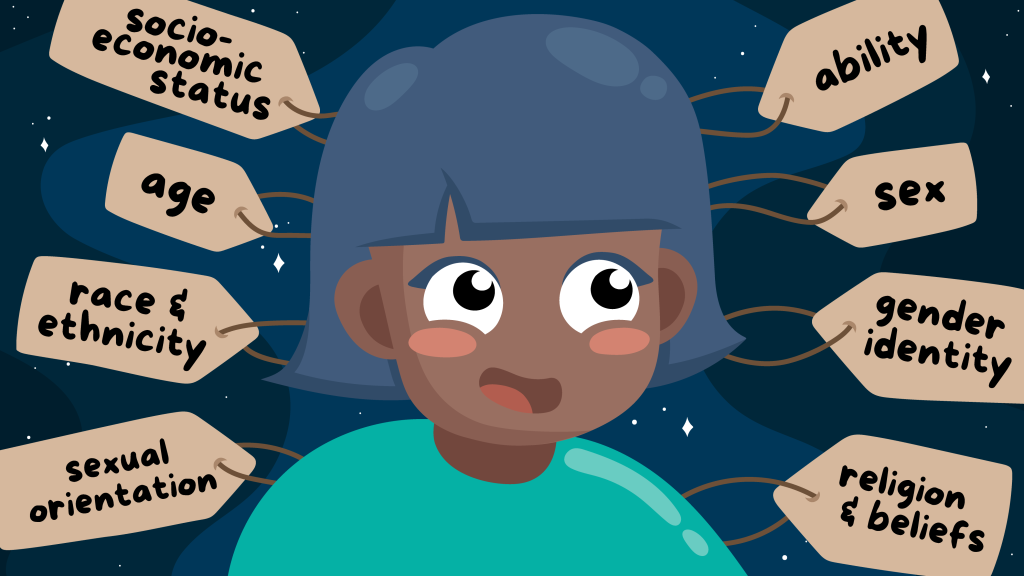
Social identity refers to a person’s sense of who they are, based on their ability, age, ethnicity, gender, race, religion, sexual orientation, and socioeconomic status (to name a few). Simply put, your social identity has helped shape who you are as a human being.
For example, you might be a woman from a working-class family. That’s two elements of your social identity: gender and socio-economic status. Your behaviours, attitudes and beliefs will likely be influenced by your experiences as a woman and your upbringing in a working-class family.
Everyone’s social identity is a unique tapestry of their lives and experiences. It tells a story – it is part of who we are, but it doesn’t define who we’ll be.
Social Identity Theory
Developed by Henri Tajfel and John Turner in 1979, Social Identity Theory sought to explain how individuals define themselves based on group memberships (e.g. religion or social class). It explored how people categorise themselves (and others) into social groups, and how this could provide a sense of belonging, purpose, self-worth and identity.
Social Identity Theory also explored how this social practice could isolate groups of people, creating issues of favouritism, stereotyping and prejudice.
A clear example of the negative implications can be found in our musical preferences, where fans of one type of music choose to mock fans of a very different type of music. But these implications can be much more severe – especially when discussing race, ethnicity, politics, or sexuality.
How is the impact of social identity felt?
Our social identities can influence how we view the world and how we behave within it. Social identity can play a big role in our mental health and sense of self. It can shape how we perceive others, how we connect with them or how we judge them.
Take for example, the working-class woman. Let’s call her Jane. Jane may have had to work really hard to get to where she is, facing down obstacle after obstacle. As a result, she might be a fiercely determined and resourceful person, with a knack for problem-solving.
At the same time, Jane might struggle with self-esteem, or anxiety that stems from a fear of making mistakes – fearing to fail and to see all her hard work unravel.
Jane is just one example of how someone can be shaped by their social identity. While these experiences can shape who we are, they do not define us. We’re not discussing the concept of fate – and it’s important to remember this.
The Rejection of Labels
Why do some people dislike labels? Many people feel comfortable with their social identity and the language used to describe themselves – while others shun labels, calling them harmful and unnecessary. This can lead to conflict, and a reduction in empathy for those who disagree.
“Labels fail to capture the complexity, diversity and wholeness of our humanity, and have the potential to reinforce stereotypes, which contribute to discrimination and oppression.” Foundation for Change
Some people choose not to label themselves because they don’t like how that label may be perceived by others. Take for example, disability – choosing to call yourself disabled. A lot of effort has been put in by people who do describe themselves as disabled, to challenge the negative perception around it.
“Disability is not a dirty word.” And while great progress has been made to shift perceptions, many people still battle internalised ableism, or worry about how others who maintain their prejudice will perceive them if they adopt that label.
Some people who don’t like labels simply don’t feel like it’s anyone else’s business how they identify – so choose not to adopt labels to help define who they are. And some simply don’t feel there are words that properly capture the complexity of their identity.
Your social identity (and the labels used to communicate it) is a very personal thing. We should never apply labels to others. And we should not allow others to dictate how we ourselves can identify.
Intersectionality and Mental Health
We, as a species, love to simplify. We love bite-sized information, neat categorisation, putting things in boxes – but it’s rarely that easy, and mental health is no exception.
Our mental health is directly influenced by our social identity. That tapestry of who we are runs through the very core of our personal experiences, influencing our emotions and the choices we make.
Understanding how our lived experiences can impact our mental health is a vital step in achieving good mental health. By considering our ability, age, ethnicity, gender, race, religion, sexual orientation, and socioeconomic status, we’re making space to explore the nuances of our experiences and personal challenges.
For instance, marginalised communities (e.g. LGBTQIA+, disabled people, Black and Minority Ethnic communities) experience disproportionate levels of hardship. LGBTQIA+ people are at higher risk of hate crimes. Black people are at higher risk of being killed by police. Disabled people have to spend considerably more money to achieve the same standard of living as non-disabled people.
These inequalities (and many more) can significantly influence the mental health of those groups, and to effectively support these groups with their mental health, we must consider these inequalities. To achieve culturally competent care that considers the nuances of our social identities, we must ensure an awareness of societal biases and risks.
Exploring your Social Identity and Mental Health
What can you do now? Well, ask yourself what you know about your social identity first. Perhaps you’re very familiar with how you’ve chosen to categorise yourself in the past. Maybe you’re comfortable with the labels you use to identify yourself.
In that case, consider this: have you ever denied yourself something because of a box you’ve put yourself in? (For example: “I can’t wear that because that’s not for my gender.”)
On the other hand, maybe you’re new to the concept of social identity. You might be one of the people we’ve mentioned who doesn’t use labels! That’s okay, and we’re not telling you to start applying labels to yourself if that’s not your thing.
But if that is you, we invite you to consider this: have you ever used the rejection of a label to justify not learning something about yourself? (For example: “This video isn’t for me because it’s about racism and I’m not Black.”)
Knowledge is power, and even if you choose not to adopt a label and build out your social identity, you can learn a lot from a little self-reflection. It can make you aware of privileges you may enjoy, or show you the challenges you’ve faced in a whole new light.
Inside or outside the box, your mental health matters – and gaining a better understanding of who you are and how you experience the world can help safeguard your wellbeing for the future.
Skills utilised:
News
Safe Break: Surviving Develop:Brighton with 7 event self-care tips
With Develop:Brighton on the horizon, here’s 7 self-care tips to help keep yourself (and others) safe this event season.
Let’s talk self-care essentials! We’re going to start with the very basics of keeping yourself healthy and happy during an event, because while these essential considerations seem obvious now, when you’re in the thick of it, it’s often these steps that get skipped.
📢 Do you want to join us at Develop:Brighton? Sign up for our Safe Break Mixer, to learn more about event best practices for good mental health and wellbeing.
💧 Staying hydrated is your top priority
Even mild dehydration can cause headaches, fatigue and negatively impact your memory – which is less than ideal when trying to remember people’s names.
🥪 Don’t skip meals
It’s easy to forgo fuelling up when you’re busy meeting new people, attending talks and roundtables, and finding your way from one meeting room to the next. Why not schedule a meeting in a cafe, and enjoy some brunch with your business contacts? If you’re really pushed for time, make sure you have some snacks in your bag.
✋ Allow yourself regular breaks
You will thank yourself in the long run. You’re going to be up on your feet a lot. People wearing fitness watches will know what we mean, you will do a lot of steps during Develop:Brighton – so give your body time to rest when you can.
🚶 Move for wellness
Why not go for a gentle walk along the seafront? Fresh air is a huge consideration at conferences – often, venues are packed with people, and the air quality suffers for it. Poor air quality increases your chances of developing a headache, or feeling tired faster. Consider stretching out your tired muscles, to feel a bit more refreshed.
💭 Make time to self regulate
What do we mean by this? Often, people think of self-regulation in regards to sensory input or feeling overwhelmed – a common experience for neurodivergent people. But making time for self-regulation benefits everyone! It’s the chance to sit with your emotions, figure out how you’re feeling, identify any needs and address them, without the pressure of doing all that on the go. Giving yourself five minutes to sit and think between meetings can help set you up for better social experiences and positive outcomes.
🙅 Set healthy boundaries for you
There is an immense pressure (especially when you’ve spent a lot of money to go to an event) to make the absolute most out of your time there. This can quickly lead into burnout territory. You are allowed to say “no” to events or activities that you feel will drain your energy. You are allowed to leave functions where you’re getting overwhelmed. You don’t have to drink alcohol, and you certainly do not need to justify that choice to others.
😴 Prioritise your sleep
A spontaneous afterparty might sound tempting, or you might feel like it’s another networking opportunity you don’t want to miss, but sleep hygiene is essential for your wellbeing. A poor night of sleep will negatively impact your memory, concentration, and overall enjoyment of the event. It can already be challenging to sleep well in a new environment, don’t make it harder!
🎒 Build your Wellbeing Toolkit
When packing your bag for an industry event, you want to prioritise essentials that help you do all of the above – hydrate, fuel up, self-regulate! But you also want to ensure you don’t overpack, because this is a bag you’re going to be carrying around all day. So, customise your own wellbeing toolkit based on your own needs (use the Develop:Brighton inspired list below for ideas).

- Refillable water bottle
- Lightweight snacks (e.g. granola/protein bar, trail mix)
- Fidget toys/stress ball etc.
- Hygiene products (e.g. deodorant, hand sanitizer)
- Skin care (sunscreen, lip balm)
- Earplugs, noise cancelling headphones, etc.
- Portable hand fan
- Decant your purse/wallet for lightweight option
- Meds/pain killers
- Portable phone charger
Choosing the right bag can help reduce stress at events too! Having a small pouch for your smaller essential items (e.g. hand sanitizer, lip balm, fidget toy) which can be transferred between bags can help avoid panic searching through your tote bag. Consider how comfortable the bag will be for use throughout the day – is it heavy on your shoulders, are the straps comfortable, is it secure?
📅 Safe Break: A Safe In Our World Mixer
Ease yourself into Develop:Brighton with Safe In Our World’s mixer, Safe Break, where we’ll be sharing best practices around event and conference self-care. Join us for some journaling activities (straight out of our Sidekick mental health journal), coffee and treats.
When: 11am – 2pm BST
Where: Project Nile House

Our whole team is coming, so it’s an ideal opportunity to meet the people behind our charity, and discuss how you can level up mental health in your workplace, achieve a healthy work life balance, and help us reduce mental health stigma across the global games industry.
Tickets are £5, which goes directly to supporting our charity. We recognise that cost of admission may be a barrier to some event goers, so please do reach out to us if this applies to you – email hello@safeinourworld.com for support.
🔗 Secure your spot – book now!
Ticket price in TicketSource is set to £5 minimum as a recommended donation, but you are welcome to donate more. All proceeds from ticket sales for this event will go towards Safe In Our World’s mission to support mental health in the games industry and wider communities. If you choose to donate more, additional donations can be used to give individuals experiencing financial difficulty the opportunity to attend this event free of charge.
Skills utilised:
News
Doomscrolling: How to protect your mental health online
To scroll, or not to scroll, that is the dilemma – and it’s impacting our mental health. So how do we manage doomscrolling to protect ourselves online?
If you’ve got a phone in your pocket, chances are you’ve caught yourself doomscrolling from time to time. But for many, this habit of scrolling through distressing content online has spiralled out of control – and left many feeling hopeless and anxious.
We’re at a point in the conversation where most of us know by now that doomscrolling is bad. That’s not a groundbreaking revelation. But we know it’s not good for us, so why do we do it? What are we getting from it (other than an overwhelming sense of impending doom)?
The science behind doomscrolling
There’s evidence to suggest doomscrolling is tied to our basic instinct to survive. Since humans lived in caves, our species has survived by assessing risk. Whether that’s the risk of being taken out by a saber-tooth tiger, or not walking in front of a bus, our brains are hard-wired to process information, identify dangers, and find ways to avoid or manage those dangers.
The act of doomscrolling triggers responses in the limbic system of our brain (the place where we process emotions, regulate behaviours and form memories). It’s the part of our brain that promotes self-preservation and drives our flight-or-fight response to danger. It’s that same part that drives our urge to keep scrolling through distressing content. By doing so, we’re assessing risk, we’re gathering data – we’re trying to survive!
But doomscrolling inevitably leads to a doom spiral. The more we do it, the more we feel we need to do it – and deeper down the rabbit hole we fall.
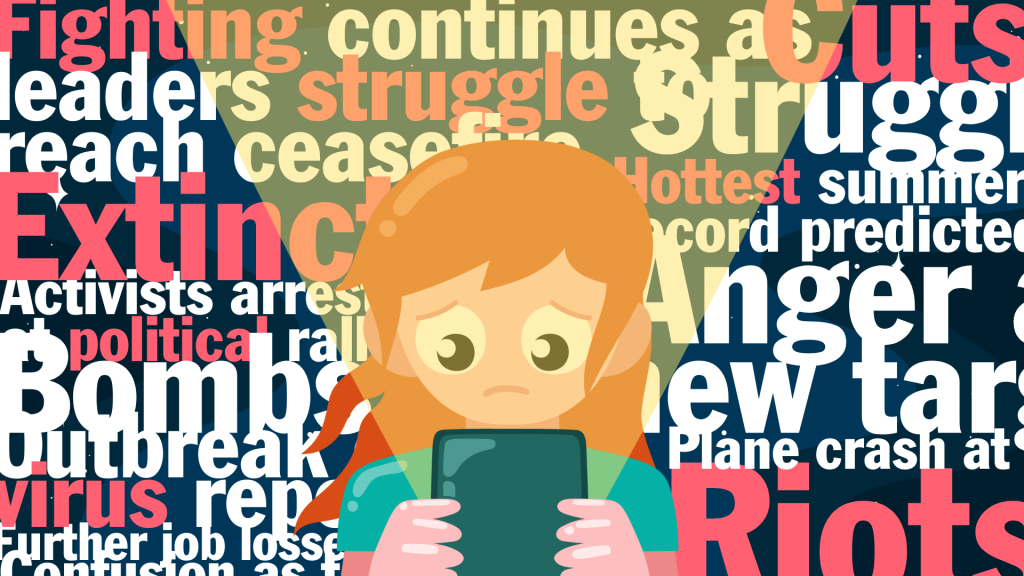
Impact of doomscrolling on our health
This repetitive behaviour can provoke emotions like fear, despair, anger and anxiety. And if that wasn’t enough of a motivator to cut back, it can lead to physical symptoms too – such as nausea, headaches, muscle tension and pain, and even elevated blood pressure.
This is because the limbic system is linked to our sympathetic nervous system, which cues the release of cortisol and stimulates the production of adrenaline to help us in those fight-flight situations. Those physical symptoms are usually manageable short-term, indeed they can help to keep us alive when we need to be on high alert. However, repeated stimulation of our nervous system and an overload of cortisol can lead to long-term, negative health implications both physical and mental (c-PTSD).
Consume, consume, consume
We’re all at a disadvantage in our quest to reduce time spent doomscrolling, because so many factors are working to keep us locked in. From social media algorithms carefully curated to hold your attention, to sensationalised news articles engineered to draw you in, everything online is constantly fighting for your attention.
And it works. We’re manipulated, rewarded, tempted and guilted into engaging and absorbing all sorts of media, be it enjoyable or terrifying!
Many of us are still learning to navigate a post-Covid world of doomscrolling content. Balance is hard to get right, and cold turkey feels impossible to achieve. Especially since so much of the content we’re seeing seeks to elicit a guilt response.
“Please don’t scroll away…”
Something you’ll often hear at the start of a TikTok video are the words “please don’t scroll”, as content creators beg for your attention. This is especially true for content related to humanitarian crises, calls for aid, for awareness, for support.
It makes sense, right? Often those videos are talking about really important topics. Many would argue there’s a need for us to be aware of what’s actually going on around the world, because if we’re not aware, how can we do anything to help? If we stay ignorant, the problems persist.
And while that’s true, there’s also the risk of being so overwhelmed by that distressing content, that we’re driven to a different kind of inaction. Instead of ignorance, we feel hopeless and powerless against the forces we’re contending with. So how do we strike a balance?

Redirecting your efforts to limit doomscrolling
First off, don’t expect to switch off the urge straight away. You’re battling your own instincts, and that’s futile. Instead of trying to stop the behaviour, we need to redirect it. How you achieve that depends on what’s motivating you to doomscroll in the first place.
Are you feeling overwhelmed by a crisis? In situations where you feel distressed about a crisis, you might feel compelled to keep watching distressing content. Being informed can help you take action. It could be you contact your local representative by letter, or sign a petition, or perhaps you get involved with fundraising efforts. Instead of getting sucked down the doom spiral of distressing content, identify what you want to achieve – and make a to do list!
Is there a systemic issue you want to help tackle? This can be tricky, because there’s a great deal of educational content out there for so many systemic issues, not to mention lived experiences that help people empathise and gain a deeper understanding of an issue they themselves might not experience. This is where you need to be vigilant and introspective. Ask yourself, are there safer ways you can be learning more about this issue? Seek out podcasts, books, video essays – and limit your exposure to sensational, triggering content where needed.
Do you have a genuine interest to learn? Distressing content can only teach you so much, and sometimes that content focuses more on eliciting a specific emotional reaction over teaching you something valuable. Again, ask if there’s a safer way to learn. It could be that you take a course, join a group or club, or watch a documentary. What won’t help is being sucked into a TikTok live debate.
Disrupting the feed
It might be that you just need to switch off! You cannot fight every battle, and you’ll struggle to fight any battle with a drained battery. If you know you’re susceptible to doomscrolling, you can put contingencies in place to help avoid getting sucked in.
Often we need a distraction to switch out of ‘doomscroll mode’. Setting boundaries for yourself, and talking about boundaries with those around you, can help in creating those distractions when you need them.
If your friend notices you’ve been looking at your phone for a while, in those instances, you could encourage them to check in with you to help pull your focus away from the screen. You can support others in this way too, asking if that’s what they want to be doing right now, or if there’s something else you could do together.
Particularly in the aftermath of a collective traumatic experience, like the pandemic, this is a great way of showing up for each other and being supportive.

Other practical suggestions on setting boundaries:
- Set a timer when discussing distressing topics, scheduling time for self care when that time is up.
- Create time and space to talk about important and heavy topics, and identify times and spaces where those talks are not appropriate (e.g. not right before getting up or going to bed).
- Enable sleep-mode and manage your social media exposure on your smartphone (limit time on a particular app or disable notifications during a certain time of day).
- Switch off unwelcome news article notifications on your phone.
- If you’re unsure what someone means when discussing a topic or outlining a boundary, ask them to explain it or direct you to the best place to learn – minimising miscommunications in the future!
Skills utilised:
News
Safe In Our World celebrates the positive, impactful voices in games industry accessibility + FREE Toolkit
For Global Accessibility Awareness Day, Safe In Our World launches a toolkit for workplace accessibility, centralising resources and insights from inclusion advocates across the games industry.
Global Accessibility Awareness Day is designed to get people talking, thinking, and learning about accessibility and inclusion. We’ve teamed up with Level Up Partner, Easy Surf, and Safe In Our World Patron, Radderss, to create a toolkit that supports games industry employers – helping them to foster greater accessibility for disabled employees in the workplace.
The International Game Development Association’s 2023 developer satisfaction survey saw 44% of respondents identify as having either a physical or mental difference.
“Our main goal in working on this toolkit is just to provide information,” says Sky Tunley-Stainton, Partnerships & Training Manager. “I know there are a lot of folks out there who want to do more but just don’t know where to start, or where to find the right information. Even for disabled people themselves, if they’ve never had accommodations before, they might not even know what to ask for. So this toolkit provides that really solid foundation of information that can be built upon.”
Change the game for workplace accessibility
We recognise that change takes time, but we also know it costs nothing to be kind. That’s why we’ve spent time creating this toolkit with a focus on social accessibility at work.
87% of disabled people have experienced negative attitudes or behaviours which impact their daily lives. Challenging ableism and changing the perception of disabled people in the workplace is something you can start immediately.
Some accessibility recommendation include:
- Offering a flexible working schedule
- Arranging training and workshops (which we can provide or recommend)
- Speak with your disabled employees (and be ready to listen to all types of feedback)
- Embrace assistive technologies
- Make sure your company events are inclusive
About the accessibility toolkit
The Workplace Accessibility Toolkit aims to provide guidance around what accessibility can look like across different organisations, as well as signposting to further information and support.
You will find vital information and advice, covering hiring, onboarding, and training; day-to-day job functions; and the social aspect of work. Discover tips on gathering valuable feedback from your employees. Review your hiring processes with expert insights on accessible candidate journeys. Identify opportunities to improve social accessibility in your workplace!
Amplifying existing accessibility resources
Accessibility resources exist, and have existed, for a while. We want to recognise all the efforts of accessibility advocates and disability rights activists on this Global Accessibility Awareness Day.
When creating this toolkit, we didn’t want to reinvent the wheel. We wanted to pull together the valuable insights of countless accessibility advocates, to centralise those tools and resources into one accessible, actionable document.
Our toolkit is not only led by experts on disability inclusion, but includes links to further resources, covering topics like inclusive language, software and communication tools, and insights on how you can implement changes at work.
Where to start
Accessibility can be overwhelming – but it’s essential not to allow this to prevent you from starting somewhere! And a good place to start is downloading our toolkit.
It’s designed to provide information and guidance suitable for companies of all sizes. If you’re just starting out, use the toolkit to build a strong foundation of accessibility at your company. If you’re an established studio, this toolkit can help you understand where you’re getting things right, and where there’s still room for improvement!
Remember, you don’t need to do everything straight away: perhaps start by looking through the toolkit and identifying the “easy wins.”
- Download the Workplace Accessibility Toolkit in PDF format.
- Download the Workplace Accessibility Toolkit in Word format.
Staying informed and connected
While we believe our toolkit will provide an excellent introduction to accessibility in the workplace, and offer valuable insights and recommendations across many aspects of inclusivity at work, the journey begins here.
One of the best ways you can support disabled people in the workplace, and be an effective ally in creating more inclusive working environments, is by becoming and staying informed. And we’ve got so many recommendations for how to do just that.
Special Effect
Our friends at Special Effect are working tirelessly, using innovative technology to bring the joy of video games to the lives of physically disabled people across the world. We hope you’ll consider following their work and supporting their mission.
Nothing Without Us
Nothing Without Us is a non-profit created by disabled gamers with the aim to increase inclusion for disabled industry professionals and content creators in games. Focusing on education and improving accessibility of gaming events, they champion disability representation in the games industry. This toolkit was co-authored by a member of their team.
AbleToPlay
AbleToPlay is a free game-changing platform that allows users to quickly find accessible games based on their personal needs, listening to your must-haves and nice-to-haves to match you with games you’ll enjoy.
IGDA Game Accessibility SIG
For those eager to learn more about accessibility in games, we’d recommend the IGDA Game Accessibility SIG. As a specialist interest group for members of the International Game Development Association, they regularly share ideas, resources and best practice. They also host GAconf EU and GAconf US – events dedicated to advancing the field of accessibility in games development.
This section could go on forever, because we’re not kidding when we tell you there are so many amazing advocates out there doing their bit for accessibility in games. Download our toolkit and look for Further Reading to discover many more resources and organisations that informed or inspired our toolkit.
Next steps to an inclusive games industry
We hope you’re feeling motivated to make positive changes to our games industry, and we don’t wanna waste that momentum. So here’s a few things you can do right now that will help drive change and shift perspectives.
- Share this toolkit in your work Slack/Teams or wherever the conversations happen
- Go follow the friends we mentioned above on social media
- Help amplify our own social media posts to bring this toolkit to more people
- Sign up to the Special Effect newsletter
- Visit the Global Accessibility Awareness Day (GAAD) website for more insights
Skills utilised:
News
Play Your Way 2025 begins MONDAY (12th May) for Mental Health Week
Play Your Way 2025 starts 12th May to raise funds for Safe In Our World.
It’s time to set up your fundraisers on Tiltify – Play Your Way is about to begin! Our annual fundraising event, Play Your Way, is all about playing what you want, when you want, with whoever you want. There are so many ways to get involved, from streams to workplace games tournaments, board game nights and more.
Get involved with Play Your Way
There’s so many reasons to join in with Play Your Way this year. We’ve introduced a new theme – home world – to encourage fundraisers to share video game worlds (or gaming communities) that feel like a home away from home. It’s a great opportunity to take a trip down memory lane, and share what video games have meant to you. Show us your safe space in the world of gaming!
We’ve partnered with Lenovo’s Legion Gaming Community to bring fundraisers some amazing incentives, including two giveaways of great Lenovo Legion tech and merch. There’s also a collectable enamel pin that donors and fundraisers can collect to celebrate their contributions to Play Your Way and mental health in games.
Why support Play Your Way?
Since Safe In Our World launched in 2019, our charity has…
- Partnered with over 200 Level Up Partners, connecting them with resources and training to better support the wellbeing of their teams
- Signposted over half a million users to life saving resources on our website
- Provided over £300,000 worth of free training to the games industry
- Facilitated workshops to help those impacted by job insecurity and redundancies
- Launched Sidekick: a mental health journal for gamers
- Delivered educational talks across the games industry
- Created mental health toolkits for devs, community managers and more
Fundraising tips and ideas
New to fundraising? No worries! Download our media kit for all the information you need. The kit also includes templates and graphics for social media, a Play Your Way overlay for streamers (and some alerts), logos and more.
Struggling for ideas to help you fundraise? Here’s some inspiration:
- Add redeems to your Tiltify to trigger events during your livestreams (e.g. £5 unlocks a beanboozle forfeit)
- Create milestones at fundraising goals (e.g. at £50, you’ll dress up for stream)
- Offer giveaways to your community (e.g. raffle for a game key)
- Create a team-based fundraiser on Tiltify (this allows you to work with friends towards a collective goal)
- Start a lunch time game tournament at work (e.g. Mario Kart play offs)
Set up your Play Your Way fundraiser!
Skills utilised:
News
Changelog 2.0 is a whopping 57-hour charity streaming event supporting Safe In Our World
We’re thrilled to amplify an amazing 57-hour charity streaming event, facilitated by one of our Ambassadors. Changelog 2.0 explores 18 different worlds and stories in support of games community mental health!
Our very own KingArgaroth (Ambassador Class of 2025) has been pulling together a fantastic charity event, featuring members of the Game Changers stream team, in a Twitch event spanning the course of the weekend (and 57 hours)!
Changelog 2.0 returns for a second year, to support Safe In Our World and bring you stories of personal challenges and growth, from an introspective and creative team of gamers, donating their time and efforts to support our mission.
Changelog 2.0 Schedule
Can you marry someone in Stardew Valley in just three hours? Shalarissa is going to give it a try as she opens the event. Watch a head-to-head Minecraft challenge event with LellybeanTV. Or if games aren’t your thing, there’s even a parody of the Eurovision Song Contest to end the event, made by HampyStrange. There’s something for everyone in Changelog 2.0 – and we can’t wait to get stuck in!
You can check the schedule and find something perfect for you, or board the raid train to see a world of wonder to inspire and entertain all weekend long.
Get Involved
With a range of donation and milestone incentives, your support can spice things up! Be it challenging one of the Game Changers to play with an upside-down controller, or unlocking rewards when fundraising goals are met (like exclusive Sidekick journal giveaways), there’s loads of reasons to get involved and donate. Check in with each creator to see their own exclusive incentives!
Challenging stigma, changing the game
KingArgaroth and the Game Changers stream team explore the positive impacts games have had on them, from reclaiming their childhood to managing depression and panic disorders. They also explore the negative impact of toxicity and sexism in online gaming, and encourage everyone to help change the game – and make gaming communities safer for all!
It’s initiatives like this that really light us up as a mental health charity. It’s community building, it’s sharing lived experiences, it’s breaking down stigma. It’s starting the conversation.
So, if you’re looking for something to do this weekend (April 25th – 27th) and you’d like to throw your support behind a stream team that’s pulling out all the stops to change the game, please consider spending some time with the Game Changers.
Skills utilised:
News
5 ways leaders benefit from polishing up their communication skills
Are you prioritising your communication skills as a leader? Let’s unpack the benefits of improved communication in management.
Managing others is a big responsibility. Some feel ready for this change in their career, while others find themselves pushed into it without much guidance. Perhaps it’s a career step you’re looking to take in the near future, or something you just want to be prepared for when it happens.
Whatever your situation, it’s always beneficial to polish up your communication skills – but how, when there’s so much to do? If you fall into the category of “so much to do, so little time”, you might find yourself putting off training and personal development. But prioritising your communication skills will save you time across the board.
Improving your communication skills to build trust
All workplace relationships are (or should be) built on trust. But how do you build trust in the first place? And how do you rebuild it if you’ve fallen into bad habits?
Start by assessing your listening skills. Do you pay full attention to what you’re being told, or do you get distracted by your emails or notifications? Are you in the moment with your report, or are you already thinking forwards to the next point you want to raise with them?
Active listening goes beyond just hearing the other person. 86% of workers report they do not feel heard. When you’re having a conversation with your report (or really anyone at work) you’ve got to be present and attentive. Ask them questions to ensure you’ve understood, acknowledge their points, respond thoughtfully and empathetically – and don’t interrupt!
To learn more about building trust in the workplace, read our piece on psychological safety.
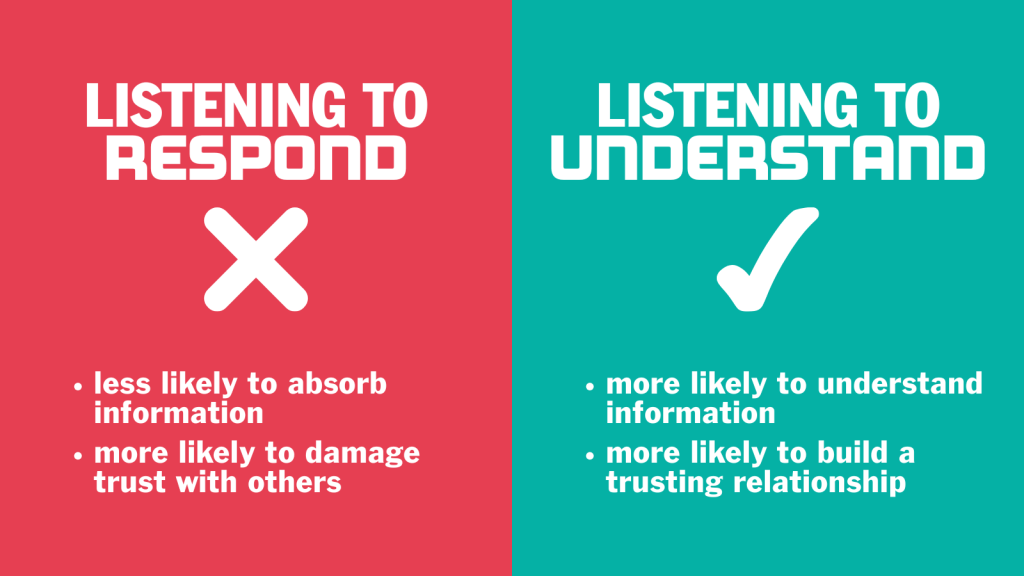
Improved communication increases productivity
This is where you’re going to save the most time! By improving your listening skills, you’re already taking the first step to increased productivity. You’ll be able to better identify if someone in your team is struggling or needs additional support.
Being attuned to the different working styles and communication needs of your team, you’ll be less likely to miss important information that might impact how you spend your day – avoiding any wasted time or effort!
And when you clearly communicate your expectations or needs for a piece of work to your report, there’s less likelihood of mistakes being made. Your reports value their time and energy as much as you do. Not only can it damage trust, but also your team’s confidence when work is having to be redone as a result of expectations being poorly communicated.
Communication is key to conflict resolution
Still, even with the best intentions, mistakes happen and frustration sets in. Communication is a key skill in conflict resolution, playing a vital role in understanding the various perspectives of those involved, making space for needs to be communicated, and leading both parties back towards common ground.
Conflict brings with it a heightened level of emotion, which makes communication more difficult for many individuals! As a facilitator in the resolution of conflict, it’s important to have the tools to communicate without adding to that heightened emotion.
Improved communication levels the playing field
We’ve already touched on how communication is as much about listening as it is talking (if not more so)! One of the most valuable things you can do as a leader is create space for underrepresented voices.
47% say that underrepresented voices are undervalued by employers. Feeling undervalued in the workplace doesn’t encourage a person to stick around. By focusing your communication skills on facilitating and amplifying underrepresented voices in your workplace, not only are you helping to increase retention of employees, you’re actively helping to improve workplace culture.
Organisations are much more likely to perform well financially when their employees feel heard, and have a sense of belonging. By holding space for underrepresented voices, you reinforce that sense of belonging – and you communicate to them that their contributions are valued!
Set the example for others
We resonate with the phrase “be the change you want to see” – but as a leader, your positive impact goes further, hits harder, does more! When people look to you for guidance and they see you prioritising communication skills, they prioritise their own.
When people see you amplifying underrepresented voices, they listen. When people see your success in navigating and resolving conflict at work, they want a piece of it. When you showcase the benefits of building trusting relationships with your direct reports, they want to achieve the same.
And when your team achieves more, collaborates effectively, and feels happier at work, you’re proving to every onlooker why they should be seeking to achieve the same. So for you we’ve coined a new phrase, “be the trend-setter you want others to see”.
The next step is free
We’ve just launched the newest installment in self-advocacy speaking training, from Lisa Marie Hall – creator of the Human Handbook.
How To Human is carefully designed to help you build a long-lasting foundation for healthy and effective communication, and it’s entirely free.
In our introductory session, you will learn and explore:
- The connection between good values and meaningful actions
- The four steps of self-advocacy speaking
- How to create your own Human Handbook and implement in your team
- How to foster accessible, inclusive communication and vocabulary
You can sign up now to our 2-part course starting in May 2025. Please consider sharing with your own networks to take your first step towards becoming a trend-setter!

Skills utilised:
News
Safe In Our World is hiring an Operations Coordinator
We’re looking for an Operations Coordinator to help us provide mental health training and resources to the games industry.
Please note: Applications are now closed for Operations Coordinator at Safe In Our World.
Key Details
We’re currently recruiting for an Operations Coordinator to join our small but mighty team here at Safe In Our World. Join our mission to eliminate mental health stigma – improving mental health awareness and acceptance across the games industry and beyond!
Hours per week: 37.5
Location: Remote / Anywhere in the UK
Salary: £27,000 per annum
Closing Date: Sunday 20th April, 23:59 GMT

The Role
We’re looking for someone able to form great relationships with our stakeholders and partners; someone with keen attention to detail, excellent administrative and organisational skills, and the drive to make a difference!
Your role at Safe In Our World will be supporting the delivery of our Level Up initiative. Level Up is a programme designed to challenge companies across the games industry to challenge mental health stigma and make positive changes in their workplace.
As our Operations Coordinator, you’ll be in close contact with our Level Up Mental Health partners, helping to deliver training and resources, gathering feedback and testimonials, and proactively working with our Partnerships & Training Manager to improve and enhance the programme’s content.
The Ideal Candidate
We’re looking for someone with demonstrable experience in building and maintaining business relationships, so communication skills are a must. Prior knowledge of the games industry is not essential, but it may help!
More than anything, we want someone who’s truly passionate about mental health. The role we get to play in the games industry is a privilege, but it can also often be challenging. We often need to adapt to the ever-evolving landscape of games, so self-motivation and workload management skills will be important.
Working From Home
Safe In Our World consists of a small team of passionate mental health advocates who all work from home. If you don’t have experience working from home, and you’re a bit concerned with what that change would be like for you, here’s a bit of inside knowledge on what a day with Safe In Our World can look like.
We primarily communicate through Discord, which allows us to be very reactive and connected as a team. Co-working sessions are common, and it’s very normal to just sit and vibe while getting a job done – but we also work collaboratively over calls!

Still, it’s not death by meetings. You’ll have full control over your own calendar, so you can be mindful of when’s a good time to take a meeting, or when you really just need to carve out some focused work time with limited distractions.
We also find time to hang out as a team, either through organised team days out, or online playing Minecraft or similar. We’ve painted pottery together, visited a video game museum, and there’s industry events we attend together too!
How To Apply
If all this sounds good to you, we’d love to hear from you. Read our full job description and apply via our form. All you’ll need is a CV and a cover letter (and no don’t worry, you won’t need to fill out all the info already in your CV in our form!)
You’ll hear back regardless of the outcome by no later than April 30th. If successful, you will be invited to a video interview (dates TBC). There is an option to include accessibility needs on the application form, but there’ll be opportunity to ask for accommodations before your interview too.
We’re so excited to hear from you! Good luck.
Skills utilised:
News
“How were you treated at work today?”: Call it! App and Psychological Safety
What if there was an app to improve workplace culture? Can technology help us build more psychological safety at work? Introducing the ‘Call it!’ app!
This month we’re focusing on the topic of psychological safety. Psychological safety plays a key role in creating a healthy workplace culture, where employees at all levels feel empowered to express themselves.
Building psychological safety allows everyone to feel confident in communicating their concerns, taking risks, and asking questions; and, crucially, being able to do so without the fear of consequences.
It can be difficult to build a culture of psychological safety: there isn’t a specific set of rules to put in place to foster it, however there are steps you can take to create safer and more supportive working environments.
We’ve been talking with Delyth Thomas from Call it!, an app designed to measure workplace culture. The app helps to track employees’ concerns around health and safety, working conditions, unacceptable behaviours, and instances of bullying, harassment and discrimination.
Tell us a bit about the ‘Call it!’ app
Safe In Our World: Why did you start developing it? What issues are you seeking to address?
Delyth: Call it! is a workplace culture app that raises industry standards by committing to safer, fairer working environments. It’s a data collection and signposting tool which compliments and amplifies a company’s existing policies and procedures – and it is 100% anonymous in-app!
Speaking out has always been risky – there are often repercussions. This could be friction between colleagues, damaging career prospects, or in a worst-case scenario, losing your job.
This is especially true for freelancers. Most freelancers will have experienced or witnessed poor behaviour. It was when I saw a tweet from a young actor with whom I’d worked, saying they didn’t feel safe speaking up about an issue that I decided to ‘do’ something.
Together with co-founders Jules Hussey and Kate Wilson, we came up with the idea of Call it! The idea was to create an anonymous app which could empower everyone in the workplace to contribute towards creating a good working environment. It’s a not-for-profit company and totally independent.
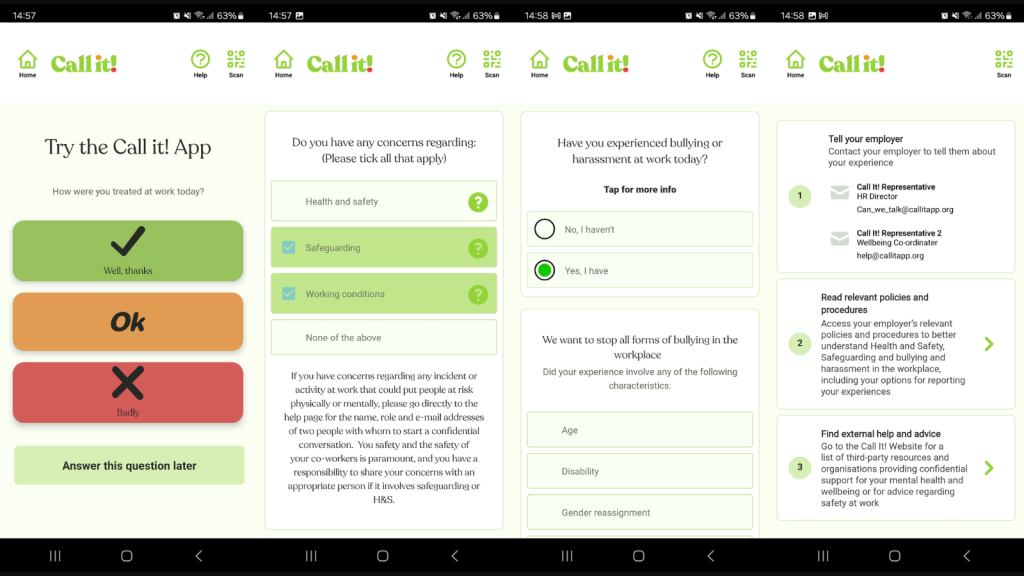
How does the ‘Call it!’ app work?
Safe In Our World: Talk us through it. How does someone get started with the ‘Call it!’ app?
Delyth: Firstly, download Call it! to a smartphone and try the in-app demo. Then scan in the unique project QR code that management or leadership will have generated for a specific project. Users can have multiple QR codes if they are working across several projects.
The user can then anonymously log:
- How they were treated at work that day via a “traffic light system” (green, amber and red buttons)
- If they had any concerns about Health and Safety, safeguarding, or working conditions
- If they experienced bullying and harassment and if it involved any of the legally protected characteristics
The final page of the app points the user to further resources and actions:
1. Tell your employer
The app signposts to two different email addresses of representatives within their organisation, giving easy access to the right person with whom to start a confidential conversation. Having two options is important as individuals might be reluctant to speak out if their only option for reporting doesn’t feel safe (or is part of the problem).
2. Read relevant policies and procedures
The user will be able to easily access policies and procedures via the app. This removes any barriers of not knowing where to find company policy, so that should they want to make a formal report, they will know how to do it and what to expect.
3. Find external help and advice
The app can also link users to the Call it! website which hosts information about third-party resources and organisations, providing confidential support for mental health and wellbeing.
How can this data help to foster greater psychological safety?
Safe In Our World: We’re keen to learn more about the impact this could have in building safer workplaces. How will ‘Call it!’ create more psychological safety in creative industries?
Delyth: Answering the question ‘How was I treated at work today?’ can be hugely cathartic.
It’s easy to get stuck ruminating over a bad day. This might lead to a person taking the issue home with them, which can have an impact on rest and recovery. Hitting the red button can help draw a line under the stress of the day.
Recognising what a good or bad day actually looks like can help start conversations before it gets to breaking point. It helps to create a culture in which everyone can thrive. It also allows the user to reflect on how they, in turn, treated people that day.
The app gives bystanders a safe way to let the management know if they’ve witnessed poor behaviours. It’s important to log these incidents, even if you’re not the recipient of poor behaviour, because it can still negatively affect working conditions. It’s also a safe way to show up for colleagues and friends.
No one wants to work in an environment that’s psychologically unsafe. By regularly answering the questions in the Call it! app, employees can feel reassured that their feedback and data is going to get through to leadership, influencing decision-making which seeks to improve the workplace for everyone.

Where does the data from ‘Call it!’ go?
Safe In Our World: So companies are gathering information from their teams: what should they then do with this data? How should it be used?
Delyth: The information the app gathers is like taking a daily temperature check across the workforce. The leadership team (whether that’s HR, line manager, etc.) has access to a dashboard which shows all the responses. This will help leadership to identify any trends in behaviour and intervene before crisis point.
They might do this by reiterating the standard of behaviour expected in the workplace, signposting to relevant training courses, or encouraging workers to have a confidential conversion.
Where is the ‘Call it!’ app being used?
Safe In Our World: Can you tell us more about how ‘Call it!’ is already being used and the positive impact it’s having on creative industries?
Delyth: The Call it! app was designed for any workplace, but it made sense to start with our own industry (Film and TV). It was first trialled on RALPH AND KATIE, an off-spin of THE A WORD made by ITV Studios for BBC One in 2022.
RALPH AND KATIE starred two actors with Down Syndrome, the first British production with two disabled leads. On-set behaviour and workplace culture were monitored by the app, enabling the producers to create as fair and equitable a production as possible.
And they were successful: RALPH AND KATIE won the inaugural Best Inclusive Practice Award at the RTS North West Awards in 2023, the judges crediting the production as “one of the most inclusive pieces of content that we’ve seen on screen for a long, long time”, and praising an inclusive workplace that “celebrated diversity and supported a range of different accessibility needs”.
The success of the RALPH AND KATIE’s use of the App catalysed a longstanding, continuing partnership between Call it! and ITV Studios and their affiliate labels.
What’s next for the ‘Call it!’ app?
Safe In Our World: What is your goal for the future of the creative industries with the ‘Call it!’ app – what comes next?
Delyth: In an ideal world this tool would be adopted in every workplace! We’re all human, and Call it! is a tool for humans.
Where trust is at a low point this app can be a tool that helps rebuild bridges, leading to safer conversations, and ultimately, a fairer and safer workplace for everyone.
Sign up via the Call it! Website or reach out to Delyth or Kate for a discount code.
To find links to download the app, scan this QR code:

Skills utilised:
Games & apps, News
Wednesdays
In Wednesdays, the player unravels Tim’s childhood memories of sexual abuse from multiple perspectives.
You begin as Tim, who decides to play his childhood game, “Orco Park”, where you manage a theme park. However, this is no regular theme park as every time you buy a new ride, a childhood memory of Tim’s becomes unravelled. With each memory you experience, you unlock and play from a different perspective of the people who make up Tim’s childhood. The trailer is available here to learn more.
Wednesdays conveys intense subjects with grace
Creators Pierre Corbinais and The Pixel Hunt consider accessibility within the narrative and game design itself. As a game that explores the traumatic effects childhood sexual abuse has on an individual, a great deal of attention was given by the development team towards safeguarding, messaging and empowering players to opt out of any uncomfortable experiences.

The developers placed a disclaimer at the beginning, going through what the game will cover, and that if the player feels uncomfortable with any specific memory, they can skip it.
Wednesdays does an amazing job of raising awareness about sensitive topics like childhood sexual abuse and making the game accessible to players while allowing them to see what they feel comfortable with seeing.
Furthermore, the game also provides great accessibility support such as an alternative font that is more readable, adjustable font sizing, and no speed or precision gameplay (or similar).
Dual Art Styles
Alongside its strong, impactful story, Wednesdays offers a lot of charm with its double art style – one based on 90s video games for Orco Park and alternative comics for the graphic novel aspect.
The dual art styles give Wednesdays a distinct pacing between different sections, and are a great indicator for the emotional tone ahead. Just like for Tim, the pixelated portions in Orco Park are a moment of respite and reflection, and the colours used in graphic novel chapters mirror the emotions the narrative conveys. 
Features
- Discover the intimate story of Tim and his relatives through his memories. With its hand-drawn visuals and comic-inspired art direction, Wednesdays encourages players to question the consequences of incest and domestic sexual violence in a honest and colourful story.
- Manage your park to unlock every memory. During these colourful pixel-art sequences, take some time to relax between two memories and reflect on Wednesdays’ characters and their bonds.
- Wednesdays is an accessible game and does not require any prior experience with video games. As a seasoned player or a gaming newbie, you will be able to adjust the settings to meet your preferences.
Wednesdays is available now on Steam

Author | Nathan Dunton
Nathan is a neurodivergent Lead QA Tester from Head Tilt Games, and a class of 2025 SIOW Ambassador
Content Warnings
This game addresses the topics of incest, sexual abuse of minors, and more specifically living on as a victim following these crimes.Though it does not depict sexual abuse in any way, some scenes do suggest consensual sexual relationships between minors of the same age. Any scene may be skipped at any time through the Pause menu by pressing the Escape or B key.Timothée’s experience is that of a victim whose family believed him and supported him, who was not traumatized, and who managed to pull through. This may be particularly troubling for victims who have had a different experience.
In addition, this game may contain:
– Mentions of incest and rape of a minor
– Non-explicit text enactments of consensual sex acts among minors of similar ages
– Explicit descriptions of sexual abuse of minors
– Mentions of traumatic amnesia
– Mentions of intrusive thoughts (in this case, the fear of an incest victim to reproduce what they have themselves experienced)
– Mentions of unwanted physiological pleasure
– Brief mentions of self-harm
– Brief mention of child pornography and child abuse material
– Internalized and normalized homophobia and biphobia
– Confrontation between a victim and their incest abuser
This game contains NO:
– Enactments of rape, incest, or sexual abuse
– Explicit visual representations of any act of a sexual nature
Skills utilised:
Games & apps, News
How workplace design can influence employee wellbeing and psychological safety
When we spend ⅓ of our entire lives at work, it’s reasonable to want to work somewhere that makes us happy. But there’s more to workplace design than scattering a few house plants, and opening the windows.
Many of us can relate to the feeling of dread when going into the office: not wanting to deal with the harsh lighting, annoying sounds, inconsistent temperatures, ‘hot desking’ situations, and so much more. This is why workplace design is so important to the ‘Inclusion Safety’ pillar of psychological safety.
What do we mean by workplace design?
Workplace design refers to the way an office space is physically arranged, and can include factors like lighting, acoustics, furniture, positioning, how different rooms are utilised, and so much more. All of these factors contribute significantly to workplace wellbeing.
We’ve been talking to Claremont, who specialise in office interior design, to shed more light on the factors that contribute to great workplace design, and why they’re so important.
The impact of poor workplace design
When we talk of workplace design, your first thought might be of ergonomic chairs, arm rests and blue light filters. But on closer inspection, you can quickly see why workplace design has become its own profession.
While it’s important to ensure your team has the appropriate back support, it’s also vital to consider everything from ventilation to natural lighting, noise levels, accessibility and more. When workplace design isn’t prioritised, it can lead to:
- Ill health and absence from work
- Poor communication and high stress levels
- Difficulty concentrating
- Issues with sleep hygiene
- Feeling isolated or undervalued
- High staff turnover
Ways to improve inclusion safety
To better understand how workplace design can be deployed to help safeguard the wellbeing of a team, Safe In Our World spoke with Claremont, who specialise in office interior design. They showed us how deep this rabbit hole can go!
To better illustrate the many ways workplace design can be used to improve productivity and happiness, we decided to look at some common recurring problems in workplaces.
Hot desking ick
Five years ago, COVID-19 changed the way we work. The pandemic saw swathes of people suddenly shifting to a WFH (work from home) situation, only coming into the office when absolutely necessary.
As many places progressed to a hybrid model, or downsized their offices to save money, we saw a spike in hot-desking – where one desk may be used by many employees at different times.
While this may have been necessary for many businesses to survive the pandemic, it does come with a host of problems for employees:
- Hygiene concerns
- Lack of privacy
- Limited personalisation
- Double booking
- Extra time spent setting up/packing down
Having a designated desk is important to me, so I find ‘hot desking’ really stressful. I like the routine and consistency of knowing where I’m going to be, knowing that my space will be clean and items where I left them, and I love being able to decorate my desk a little to make me feel more at home, like I belong.
Claremont emphasized the importance of consistency and availability of workstations throughout a workplace, including factors like having height adjustable desks, and a variety with and without screens. Ensuring spaces are kept clean, and offering additional hygiene products to maintain shared workspaces is essential.
Make space for disabled devs
The UK Games Industry Census 2022 reported that 18% of games industry professionals struggled with a physical health condition, while 38% of people in games reported anxiety and/or depression.
From ramps and reliable lifts, to wide-frame doors that allow wheelchair access, physical accessibility is a vital consideration in workplace design. Here are some further examples of physical accessibility:
- Step-free access to all buildings
- Reserved accessible parking near office building
- Wheel-chair accessible restrooms/WC
- Accessible meeting rooms (or lift access)
- Adjustable desks and work surfaces
- Braille and tactile signage
- Pods that are flush to the floor with no lip
- Accessible product choices
It’s important to also consider invisible disabilities, and how an office space can be transformed to accommodate the whole team.
The road to inaccessibility is paved with good intentions
Imagine you’re designing an office, and you make everything open-plan. There’s lots of space between desks, and those desks can be accessed from all sides. Sounds great for manoeuvrability, right?
But have you considered how that open space is now going to have a serious echo problem? Nothing to dampen the sound of desk chair wheels rolling, people typing on a hundred different keyboards, impromptu meetings in the centre of the room, the dreaded phone calls that you can only hear one side of…
Deaf or Hard of Hearing employees might struggle with an environment like this, as loud spaces could interfere with a hearing loop or other hearing technology. Meanwhile, the UKIE Census 2022 also reported that 15% of games industry professionals struggle with anxiety, and 10% have conditions affecting concentration (e.g. ADHD).
Is a wide open space going to provide those people with a space to be comfortable and productive? Or are they going to feel exposed, vulnerable and have their attention diverted every time someone walks behind them?
These are the kinds of considerations that go into good workplace design. These are the questions that Claremont sought to answer, and share in their thought leadership series, “The Inclusion Equation” The Inclusion Equation | Claremont.
A diversity of workspaces
There is no one-size-fits-all solution to what makes a great workplace, but introducing options can help everyone feel more comfortable and productive!
Some workstations can be designed to promote focus, by creating quiet, snug spaces to really zone in on a task. Others could be more open, encouraging collaboration and creativity.
Nobody likes hearing half a conversation, especially when it pulls you out of your focus. Providing a designated space for taking calls can help the rest of the team focus, while taking some of the pressure off the person taking the call too!
Meeting rooms should be varied too! Some meetings may be more sensitive in nature and need absolute privacy. But that shouldn’t compromise comfort. You can create a more formal setting without resorting to corporate imagery, dampening the mood of everyone in that boardroom.
We love the example that our friends at Special Effect set, with their remote robots, designed to let team members who work from home feel more connected and included.
Earlier this year, @aeyvi.bsky.social and I met up at the @specialeffect.bsky.social offices via remote robot!
Keep an eye out on SE’s socials as we’re going to be doing a livestreamed tour of the office using this tech!
— Paige Harvey (@paigehharvey.bsky.social) December 5, 2024 at 4:01 PM
A diversity of spaces to choose from can allow people to choose a space that fits their needs at that moment. So, whether that’s taking a phone call away from your focused team-mates, having an informal catch up by the window seat, or taking a timeout in a wellbeing space after a stressful conversation – an adaptable work environment can make all the difference!

Asking for adjustments
Adjustments in the workplace can and do often involve workplace design, and can go on to benefit more than just the person who requested the change. Adjustments are there to remove or reduce a disadvantage related to a disability. This could look like:
- Providing more ergonomic furniture
- Changing the lighting in an area of the office
- Installing noise dampening panels
- Providing an adjustable desk
Adjustments could also refer to finding a new way to do something, a change to someone’s work arrangements, or providing specific equipment, services or support. To request an adjustment, you usually need to talk to your manager or employer, to explain the situation and discuss potential solutions.
You don’t necessarily need to come with a solution in mind, but it can help to have ideas on what might reduce or remove the disadvantage. For example, if you’re struggling with migraine and the panel lighting above your desk is too harsh, and you suspect it’s a trigger, you could ask for a different, softer light to be installed.
You can make the request in writing (e.g. an email or letter), or in a meeting, or there may be an existing formal process for adjustments – it entirely depends on where you work and what their process is.
Skills utilised:
News
Misinformation and mental health: the road to bias and barriers
Safe In Our World discusses the consequences of misinformation around mental health and what we can do to get back on track.
Ending the stigma surrounding conversations of mental health and mental illness has always been firmly on our agenda as a charity supporting gamers and games professionals with their emotional wellbeing – and we feel there’s been progress! So it’s been frustrating to see signs of regression lately, with the spread of misinformation and intolerance across social media spaces and in mainstream media.
Today we wanted to tackle one emerging piece of misinformation that’s circulating, which could have a significant and detrimental impact on the progress we’ve already made as an industry, and as a society, towards better understanding and navigating our mental health.
Is mental illness over-diagnosed?
Firstly, mental health is not mental illness. It’s an important distinction, because everyone has mental health, in the same way as everyone has physical health.
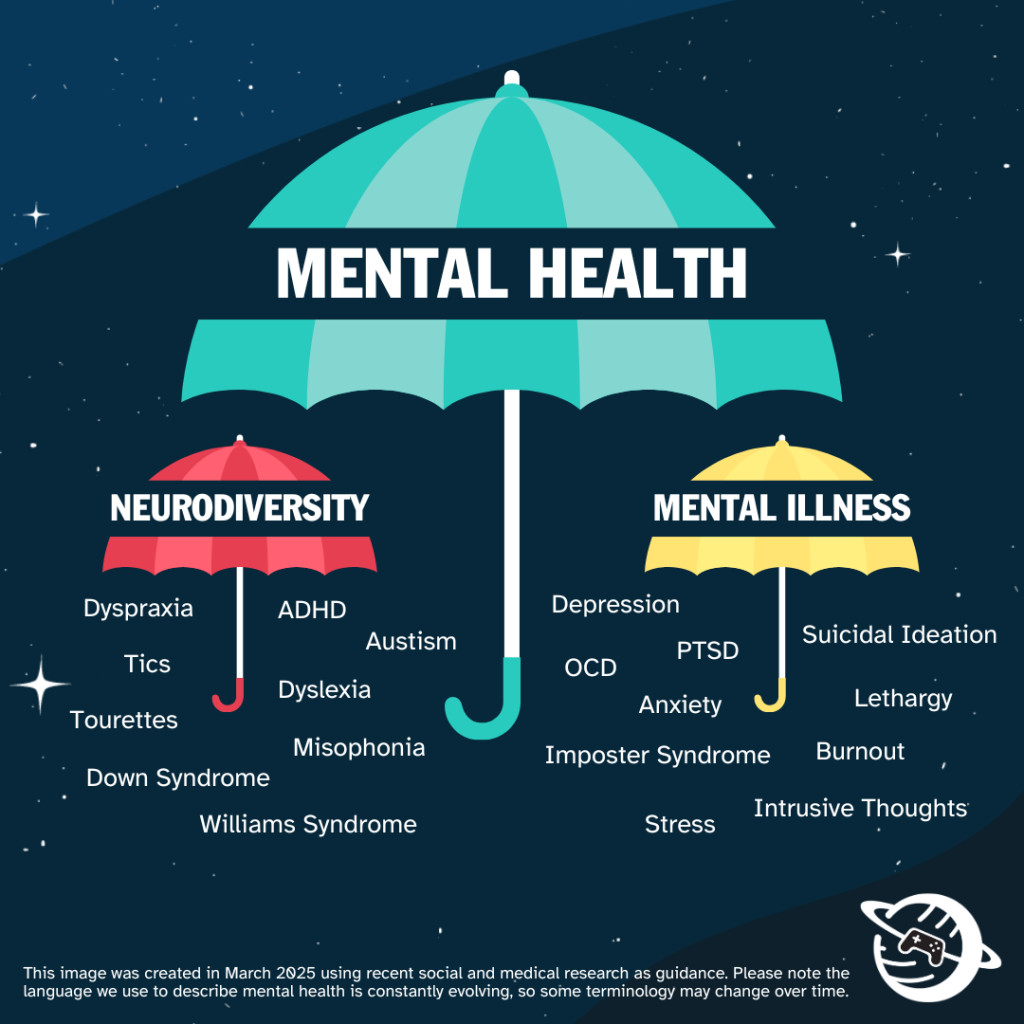
Anyone can experience mental ill health. In fact, 1 in 4 people will experience a mental health problem of some kind each year. It’s likely that you’ve experienced some struggle with your mental health, or you know someone in your family or circle of friends who has experienced some level of mental ill health.
Does that mean too many people are struggling with their mental health? Well, yeah. We would like to see a world where mental illness is drastically reduced, and those who do face said challenges can access fast and effective care. But is there an “overdiagnosis” of mental illness? No. There is no evidence to support any claims of an overdiagnosis in mental illness.

What do we know about mental illness?
To better understand why we categorically reject this idea of “overdiagnosis”, we first need to understand what we already know about mental health – and what we don’t!
Our understanding of mental health has come on in leaps and bounds over the last century, though we still have a long way to go. Mental health wasn’t even referenced as a field or discipline of study before 1946, and even today our appreciation for what mental health is is constantly evolving and changing. This context is essential to consider (and remind others of) whenever we see mental health being discussed in the news, in the workplace, or among friends and family.
There is a tendency to see rising numbers of diagnosis as a sign of “overdiagnosis”. But correlation does not imply causation, and this rise could just as easily be explained by an increased understanding of mental illness – or literally any other sources of mutual stress (e.g. climate crisis, political unrest, loss of financial security).
![Image depicts 4 circles with 4 statistics around what external factors can affect our mental health. '1 in 6 people in post-conflict situations struggle with mental health disorders.' 'Over 45% of young people feel like climate change affects their daily life.' '~60% of young people feel “very” or “extremely” worried about climate change.' 'of people experiencing financial instability [related to the impact of Covid-19] report high levels of psychological stress.'](https://safeinourworld.org/wp-content/uploads/2025/03/Mental-health-external-factors-stats.png)
The impact of misinformation
People who experience mental ill health at some point in their life report that their symptoms worsen if their experience is challenged. Current research suggests that misinformation leads to systemic bias, which creates barriers in accessing care. This is particularly true for marginalised communities!
Sometimes this is referred to as Medical Gaslighting – an act that ‘invalidates a patient’s genuine clinical concern without proper medical evaluation, because of physician ignorance, implicit bias, or medical paternalism’ (The American Journal of Medicine).
Lived experience is our greatest source of information. There’s still so much to learn in the field of mental health, and listening to individual stories and perspectives provides crucial context, empathy and understanding. This also plays a vital part in developing an individual’s personalised recovery plan.
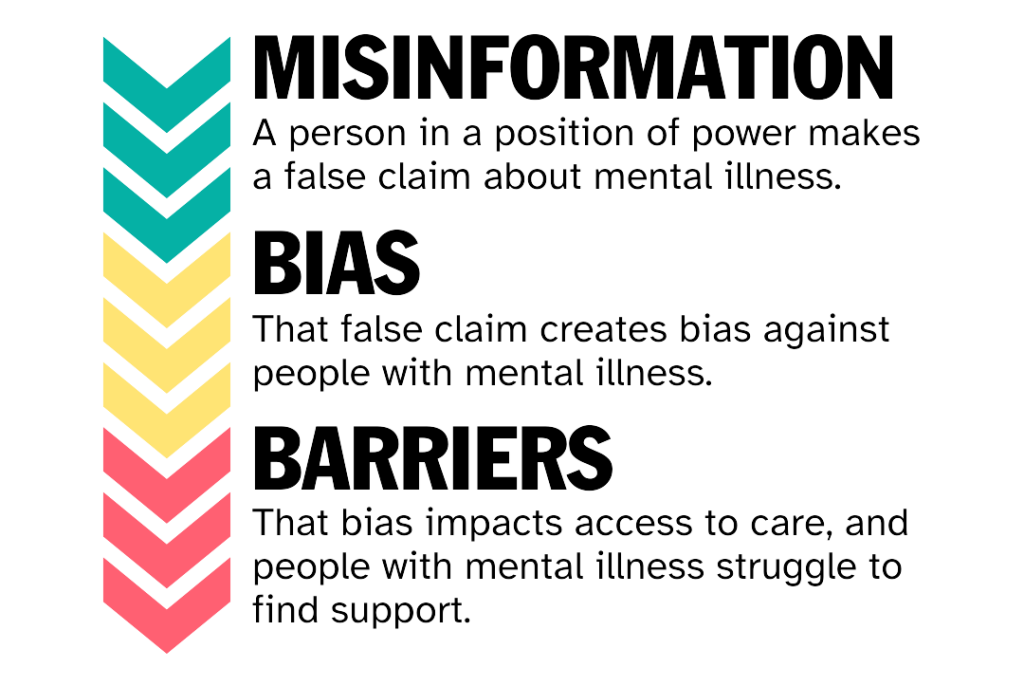
Punishing people who are struggling with their mental health, by questioning the validity of their diagnosis, will not help them recover. We believe that stigma around mental health is one of the biggest barriers to improving mental health. So let’s take a look at what we can do, collectively, to help challenge misinformation, improve awareness, and encourage empathy.
Breaking down stigma helps to encourage conversations, and conversations help to break down stigma. This is why we prioritised lived experiences! Talking about mental health can encourage people to take that final step towards seeking care.
Learning about these topics empowers us to better support each other through difficult times, and there’s no shortage of those. Mental health support should be preventative as well as reactive – not only to catalyse more efficient care, but to mitigate causes of mental illness wherever we can.
Next steps to better mental health
Causes of mental illness are numerous and complex, so much so that we couldn’t hope to cover every angle in one article. Zooming in on our small corner of mental health in the games industry, there are areas we can pinpoint as sources of stress, anxiety and burnout.
Many people in games, and in the wider tech industry, experience overworking (crunch), a lack of psychological safety or support in the workplace, job insecurity, and systemic discrimination. These can feel overwhelming, but there are resources you can access, and support you can find to help navigate these challenges.
Here are some resources we have on our website that we would like to share that may empower you on your own mental health journey:
- To find local mental health support in your country and area, please see our helpline database. Ranging from suicide crisis phonelines, to domestic abuse support, to LGBTQ+ mental health community groups, we can signpost to individual support in over 100 countries worldwide.
- Learn the language to help you advocate for yourself – watch our Free Self Advocacy Speaking Course! Being able to identify and share how you are feeling with those around you can help you set healthy boundaries, and avoid miscommunication.
- Learn more about Psychological Safety, and how it can be built, to help encourage positive change in your workplace (and even in your personal life)!
- Listen to our Interview with Elitsa Dermendzhiyska on Betwixt to learn more about Emotional Literacy.
We also recommend you check out resources and stories shared by other UK Charities that can take this conversation and your knowledge beyond the games industry: Papyrus, MindOut, Andy’s Man Club, akt, R.S.V.P, and Mind.
References:
The Roots of the Concept of Mental Health
Defining and Evaluating Overdiagnosis in Mental Health: A Meta-Research Review
NHS Publication: Adult Psychiatric Morbidity in England
Understanding Correlation VS Causation
Statistics on Climate Crisis and Anxiety
Data on Mental Health Disorders in Post-Conflict Situations
Statistics on Financial Instability and Psychological Stress
Information on Recovery and Mental Illness
Skills utilised:
News
What Psychological Safety Means (And What It Doesn’t Mean!)
What does psychological safety mean? It’s time to bust some myths around psychological safety in the workplace, and stop good intentions becoming bad habits!
Creating psychological safety means removing barriers to open, candid communication in the workplace. There are so many ways in which a lack of psychological safety can make a person feel too vulnerable to share something important:
- “I’ve made a mistake and need some help.”
- “I have a better idea of how we could do this.”
- “Can you explain that to me in a different way?”
- “I don’t feel like part of the team right now and it’s affecting my emotional wellbeing.”
All these would be difficult to express in a work environment or culture that doesn’t make space for the four types of psychological safety: inclusion, learner, contributor and challenger.
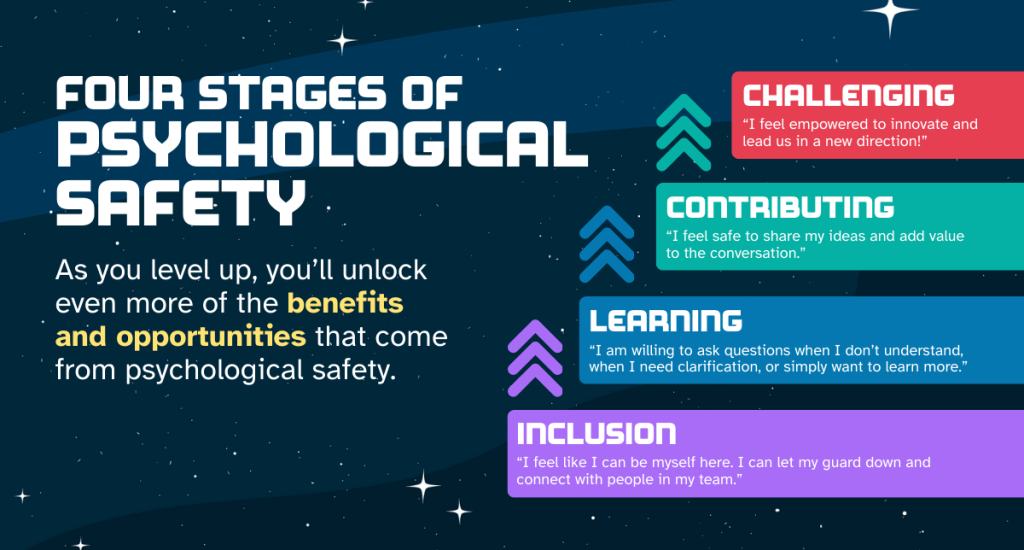
Inclusion Safety
This is where Psychological Safety truly begins. “Inclusion Safety” serves as a cornerstone to any positive workplace culture. By embracing the diversity of your team, and making colleagues or employees feel respected, included and valued, they are more likely to feel safe.
That safety allows people to feel confident in expressing themselves, their views and their vision. This leads to better communication, collaboration and even staff retention. When people feel safe to share, everyone benefits.
Learner Safety
Having space to fail is a key part of the learning process. Yet so often in the workplace, we find the pressure to improve mounts, while the safety to make mistakes is absent. Failure doesn’t have to be such a negative thing!
When you have the space to fail without fear of judgement or retribution, you’re more likely to try something new, to push your limits, and develop your skillset. And when you add in effective mentoring, setting goals and skill sharing, people can thrive, and teams can learn from each other’s successes (and mistakes)!
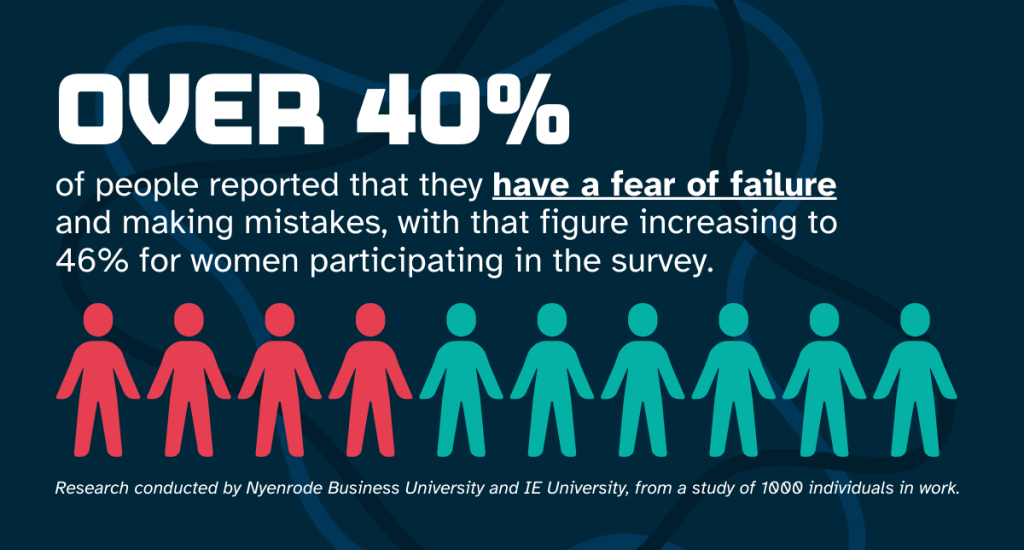
Contributor Safety
When a team doesn’t feel safe to contribute, we miss out on some of the best ideas! Confidence is something we build on through positive experiences, where speaking up has been met with genuine curiosity or excitement.
But so many of us have also had our confidence torn down, through negative feedback or even ridicule in the workplace. It’s vital that we show people it’s safe to contribute through our actions rather than just words.
Challenger Safety
One of the most daunting things to do at work, if you don’t have psychological safety, is to raise concerns or make suggestions. Many of us are told to avoid “rocking the boat”, and a fear is instilled in us from early on that challenging the status quo can put our job security at risk.
Diversity is a strength, and diversity of perspective is a superpower. By not fostering a workplace culture that encourages healthy discussion and debate, you dismiss opportunities for growth and innovation.

Myth-busting Psychological Safety
We’re not going to tell you that creating a culture and work environment of psychological safety is going to be easy. We can’t tell you where you are on that journey, or how far you’ve yet to go. What we can tell you is what psychological safety is, and what it is not.
- It is not avoiding conflict or avoiding giving criticism for fear of upsetting others.
- It is not running with ineffective or irrelevant ideas simply because you don’t want to dismiss someone’s contributions.
- It is not removing responsibility or accountability in place of freedom to fail.
- It is not solely the responsibility of people in leadership positions to put the effort in to create psychological safety.
Like with most things in life, you’re not going to get it right first time. Building psychological safety is a process, and one where you’re likely going to make mistakes before you find a happy equilibrium.
- Psychological Safety DOES mean navigating conflict respectfully and productively, recognising when something can be better and finding ways to improve together.
- Psychological Safety DOES mean delivering constructive feedback and actionable criticisms, taking into consideration how a person best receives feedback and adapting to that individual’s needs.
- Psychological Safety DOES mean trying to find common ground on ideas and adopting a “yes and” approach to ideation.
- Psychological Safety DOES mean creating an environment where you set contingencies for failure, where failing isn’t punished, and mistakes can become learning opportunities.
- Psychological Safety IS everyone’s responsibility.
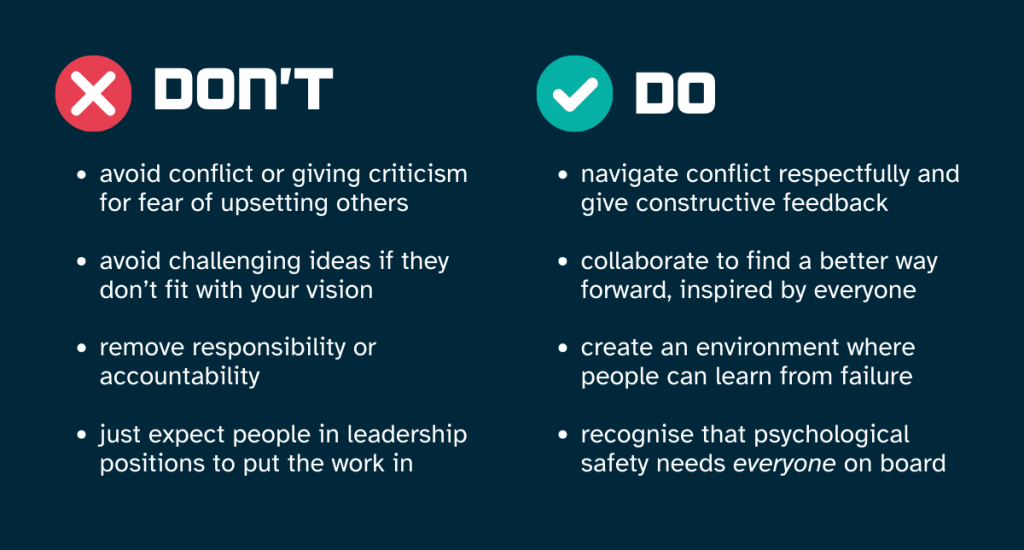
Implementing Psychological Safety
What comes next? It depends on where you’re at right now. The best way to evaluate that is by listening to your team – your whole team.
Encourage the quieter voices to contribute and give feedback, by making space for them to share in safety and privacy. Consider running an anonymous poll to gage how the team feels about the workplace culture, and whether they feel safe to be, learn, contribute and challenge.
And be ready to take responsibility for your own failures. Like we said before, failure doesn’t have to be such a negative thing! It is an opportunity to grow.
Level Up Mental Health
Safe In Our World is a mental health charity dedicated to ending mental health stigma and supporting the wellbeing of gamers and games industry professionals.

Our Level Up initiative exists to support companies with a wealth of knowledge, resources and toolkits – plus regular training and workshops to develop leadership skills, self-advocacy and so much more.
If you’d like to find out more about how Safe In Our World can support you in creating Psychological Safety in your workplace, please get in touch with us at hello@safeinourworld.com.
Skills utilised:
News
Safe In Our World goes to RuneFest 2025
Don your party hats, Safe In Our World partnered with Jagex to put mental health on the agenda at RuneFest 2025.
RuneFest 2025 may be over, but the memories will last forever. The team at Safe In Our World are back from their adventures at RuneFest, the world’s biggest and best real-world celebration of RuneScape.
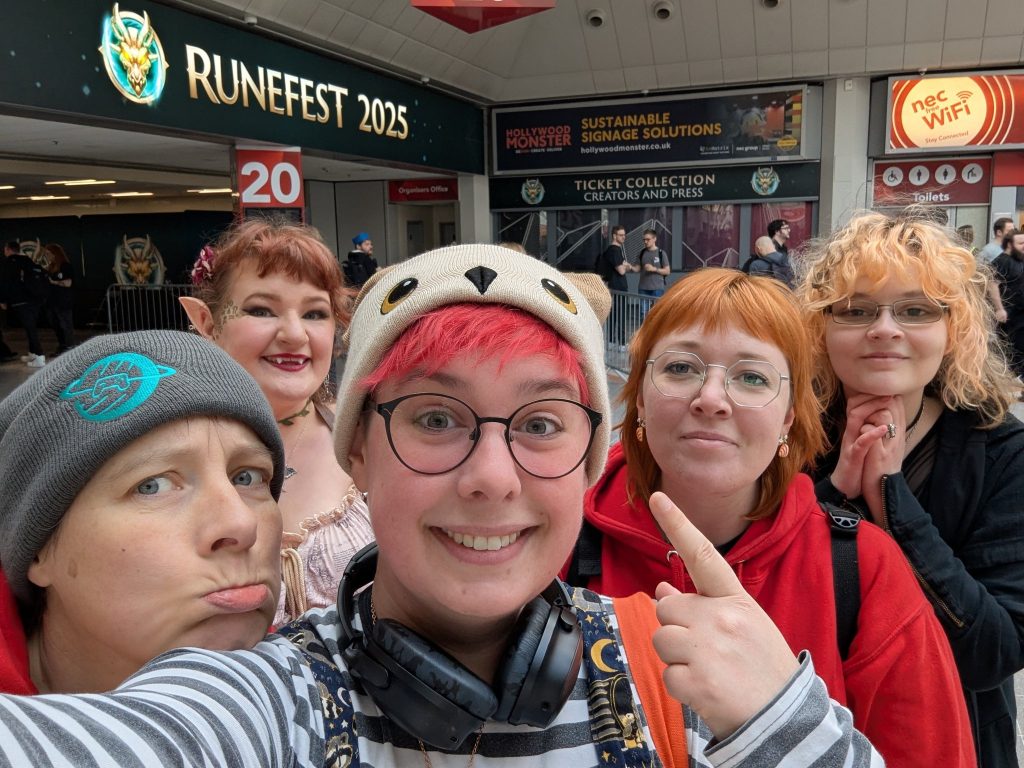
RuneFest brings RuneScape to life
For those who don’t know, RuneScape is a hugely popular fantasy MMORPG developed and published by Jagex in 2001. Set in the vast fantasy world of Gielinor, rich in lore and possibilities, players complete quests, level up their skills, and share special moments with friends – which is exactly what we did at RuneFest this year!
On arrival at the event, the team were blown away by the attention to detail in set dressing. We entered through a giant castle gate and found ourselves in an atmospheric RuneScape village, bathed in dappled light and swirling mist.
After getting our bearings (and our coffee), we made a loop of the hall to discover all the fantastical activities that Jagex had created this year, to let players level up their skills IRL!
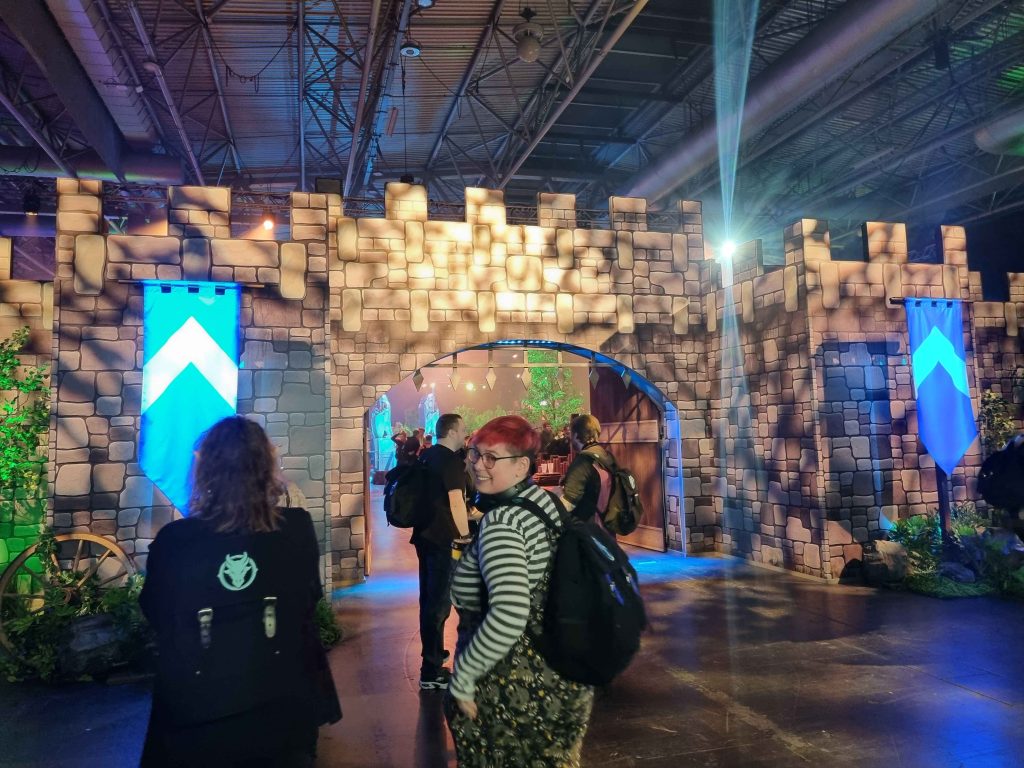
Your quest? Make friends!
We collected our welcome bags – backpacks brimming with RuneScape goodies, including a high-quality faux leather-bound notebook, and set of trading cards. These cards were the best icebreaker to meet and befriend other eventgoers!
All you had to do to strike up a conversation is have your cards to hand, and fellow adventurers would be drawn in by the promise of trade. This activity is a great example of social and mental health accessibility.
Going to an event like this can be daunting, especially if you’re going alone, or if you struggle with meeting new people. Being given a tangible goal from the get-go, and a way to start up a conversation to get past that awkwardness, is such an ingenious way to connect people at events, and we hope to see more of this in the future.
Collecting a set of four cards of one type (e.g. ore, gems, fish, logs or runes) would earn you a skill token. We took our trading cards to the Grand Exchange and gained our first token.
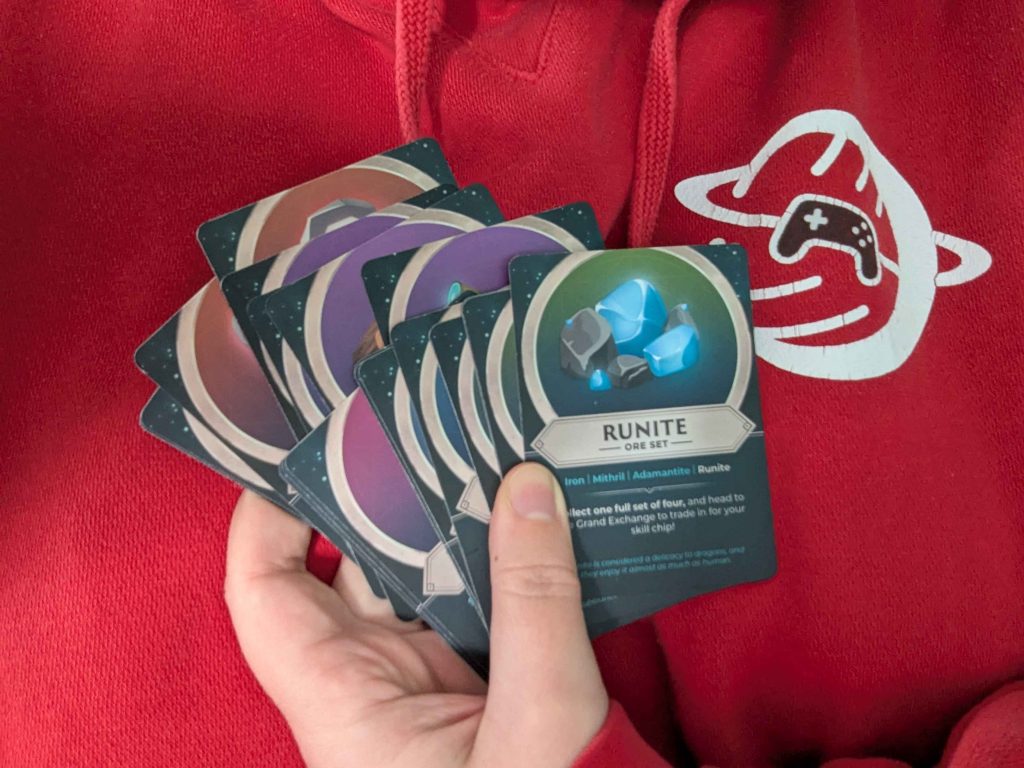
An Army Of WOM
Then it was time to build a WOM (Wise Old Man). We grabbed a table and got creative with a fun little activity included in our welcome packs. The goal was simple, pop out and stick layers of printed card together to make an iconic 3D RuneScape character.
Once we’d finished, we had the choice to take the mighty WOM with us (which of course we did) or leave him to the army (or graveyard) of Wise Old Men, forming at the end of the tables.
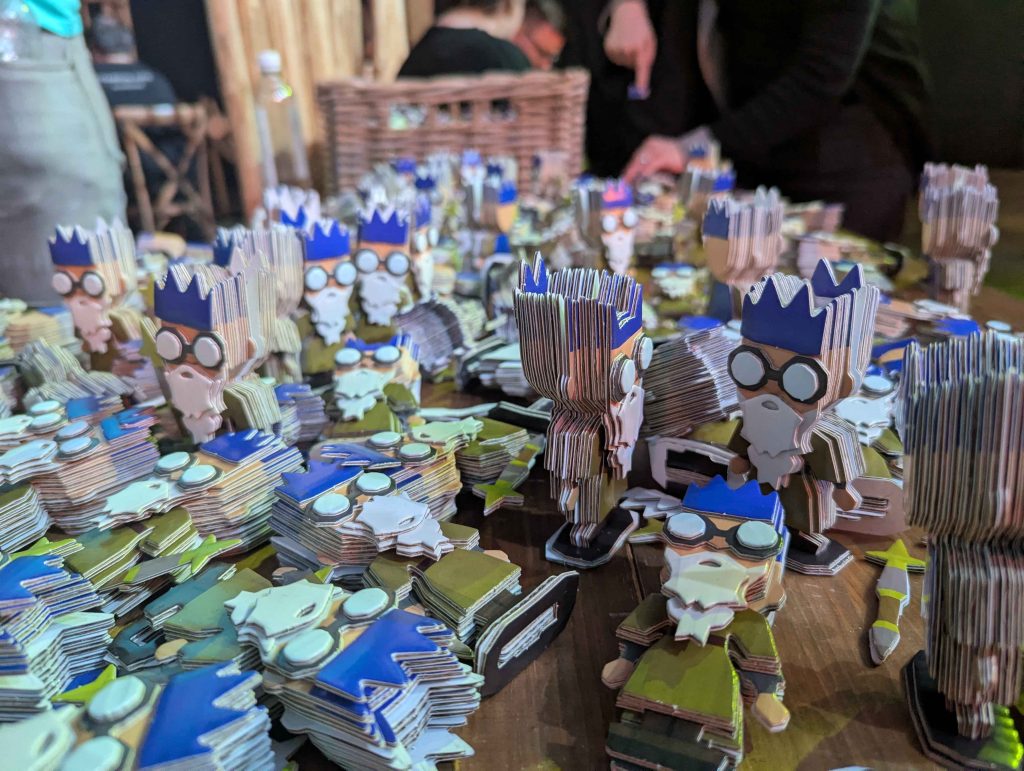
We’re the Eggsperts
Following some time at the main stage, learning about all RuneScape has to offer, and exciting updates for the future, we decided to go for the Hunting skill token – which involved diving into a huge crate of hay to hunt for eggs.
Two things we excel at as a team: 1. improving the mental health and wellbeing of the games industry and gaming communities, 2. finding rubber eggs.
We absolutely smashed that activity and had a basket of eggs so full that it almost instantly tipped the weighing scales. So, that’s another skill chip in the bag!

Say “Cheese”!
Of course, the day would not be complete without some Goblin Diplomacy, though we’re not sure what dispute we were resolving (other than whether or not we look absolutely amazing)! But since we got a skill token for our photoshoot, I think we were pretty convincing.

And so, we went for a long rest at the nearby hotel, to ready up for a full day staffing the Charity Marketplace with our friends at Special Effect and Blueprint For All. Little did we know how amazing Day 2 was going to be!
A Thoughtful Quest
It was an early start as we had to get the market stalls all dressed up around the Well of Goodwill. Our shared activity as one of the three charities was to ask three questions:
“What advice would you give to your younger self?”
– Blueprint For All
“What are you thankful for in this moment, and what are you learning from this adventure?”
– Safe In Our World
“What are your hopes for the future of accessibility?”
– Special Effect
Answering these three questions would earn players a special Party Hat Charity Pin Badge, but it also gave players a moment to reflect on their journey. They could take their answers away with them, or pin them to the giant board, which quickly filled with thoughtful and introspective answers that had us all feeling so thankful for the community.
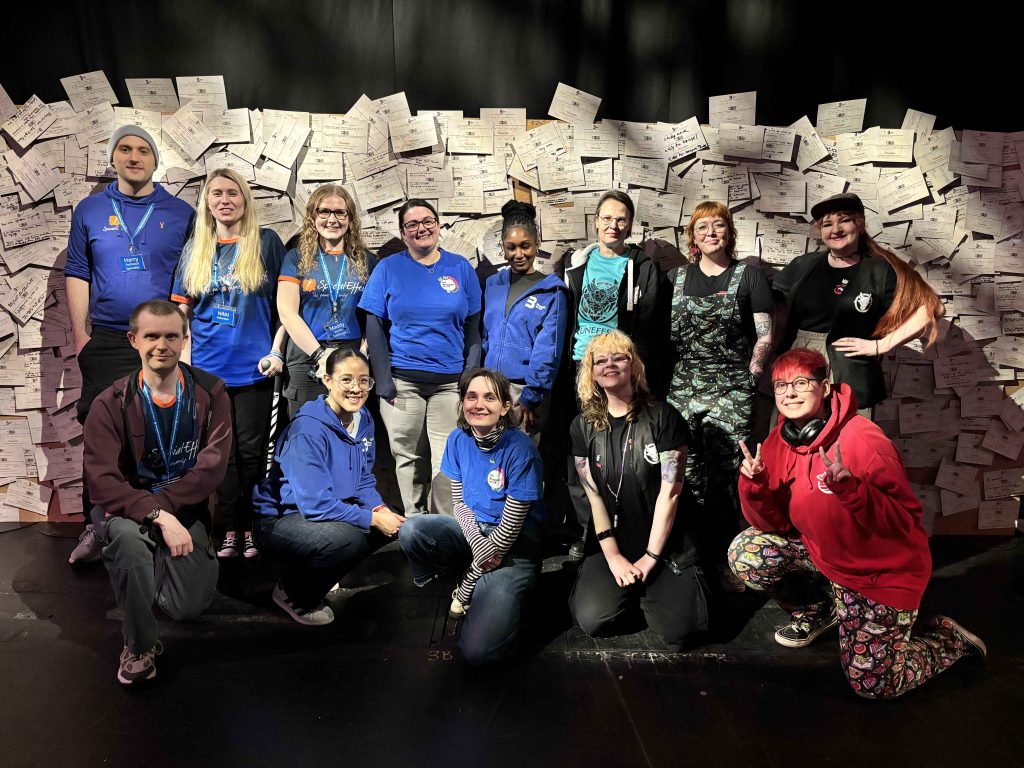
Reading the wall, and listening to the stories of players, we came to appreciate what makes the RuneScape community so special. It’s a community of creativity and kindness.
Reflections on the RuneScape community
Everyone is on their own journey, but there’s always space to help others. There’s a comradery among players, and a willingness to listen and learn and teach.
Sharing a passion for RuneScape creates bonds of friendship and even partnership. People came as couples, as families, as friends who’d known each other for decades.
We are so thankful to have been part of what felt like a very special event for so many, and to witness the positivity and compassion of a community like no other. The event ended, visitors exited, and we got to packing up… but even then, we weren’t ready for what would come next.
staying behind after @RuneFest 2025 closes to clap and cheer the event organisers and volunteers
is the BIGGEST green flag we ever did see from a games community 💚 pic.twitter.com/SJ88UrjLpe
— Safe In Our World (@SafeInOurWorld) March 5, 2025
After a round of applause for all the volunteers and the Jagex team, we all headed to the exit, to be met by a crowd of players and eventgoers. They’d stayed in the NEC, waiting at the entrance, to clap and cheer the event organisers, the team and the volunteers for hosting such a great event.
The Safe In Our World team walked through a corridor of cosplayers and RuneScape fans, whooping and clapping and celebrating what had been the best two days, and two very special days that our team will never forget.
Skills utilised:
News