Stress
If you’ve ever played Dark Souls, you know something about stress: the tightening chest before a boss fight, the spike of alertness when reading an attack. That response is real and biological. It’s not a flaw; it’s the system working as intended.
What is stress?
A stressor is whatever triggers the response: a deadline, a difficult conversation, a pattern of worried thinking. Stress is the body and mind’s reaction to it. The same stressor can produce very different reactions in different people, depending on how they read the situation. (See the Yerkes-Dodson curve.*)
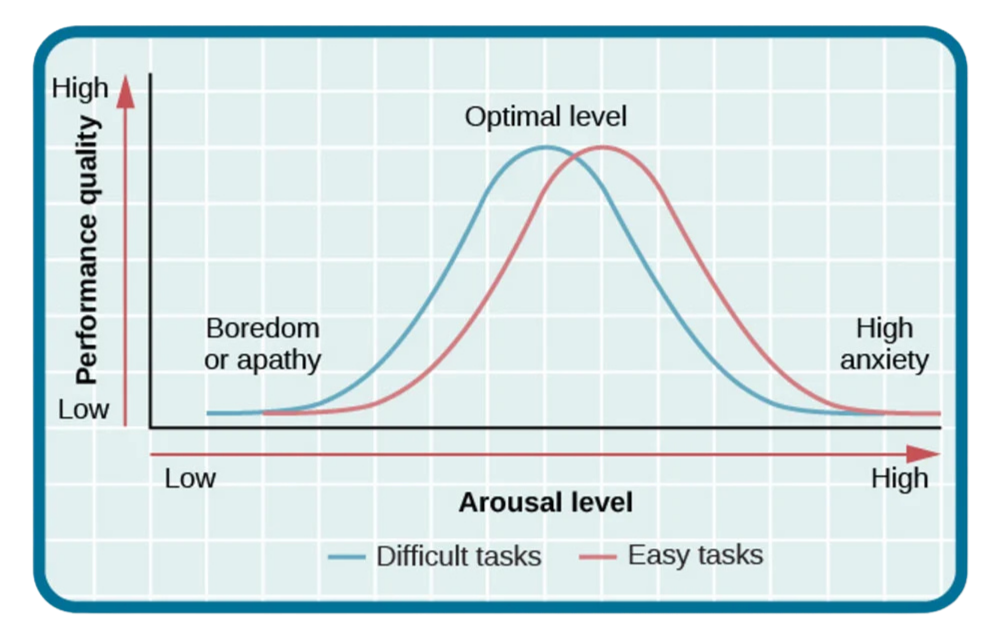
*In discussing the Yerkes-Dodson law, the word “arousal” relates to stress and motivation.
Some stress is necessary. We need a certain level of activation to perform well. (Yerkes-Dodson, 1908)
When a challenge feels meaningful and just within reach, we tend to do our best work, what athletes and gamers call being “in the zone.” Too little pressure and we disengage. Too much and performance falls apart. The goal isn’t to eliminate stress; it’s to recognise when your response is working for you.
Built for bursts, not marathons
When the brain judges something as dangerous, it triggers the fight, flight, freeze, or fawn response: increased adrenaline, a faster heart rate and breathing, and narrowed attention. This evolved for temporary threats, with recovery once the threat passed.
Modern stressors – a difficult work environment, financial pressure, a relentless stream of toxic gaming lobby messages – don’t resolve in seconds. They persist, and the nervous system, unchanged for millennia, struggles to tell a predator from a project deadline.
Interpersonal stress deserves a specific mention. Difficult relationships, conflict, or power imbalances at work activate the same threat system as physical danger. For many people, their most consistent source of chronic stress is the quality of their relationships, personal and professional, not workload.
When stress becomes chronic
Chronic stress is the alarm staying on for weeks or months with no real recovery. The first thing to suffer is usually thinking: judgement and problem-solving weaken. Sleep deteriorates, feeding back into next-day stress.
Physically, sustained stress is linked to raised blood pressure, weakened immunity, and chronic headaches. Psychologically, when nothing seems to make a difference, people can develop learned helplessness, one pathway through which prolonged stress becomes anxiety or depression.
Signs stress is building: racing heart, tight breathing, muscle tension, disrupted sleep, irritability, difficulty concentrating, feeling overwhelmed, losing enjoyment in things you usually like.
Internal stressors
Some of the most persistent stress triggers are internal. Rumination, turning a problem over and over, feels like problem-solving but prolongs distress.
Ask yourself: is this thinking helping me, or going in circles? Is it moving me toward action? Is it within my control?
Self-criticism activates the same threat response as external danger, and doesn’t improve performance, it undermines it. Catastrophising and perfectionism both keep the stress response running without a real, resolving event.
Stress and sleep
Stress and sleep affect each other in both directions: stress disrupts sleep, and poor sleep worsens next-day stress reactivity. Worrying about not sleeping is itself a source of arousal that keeps sleep away, sleep tends to respond better to reducing arousal than to trying harder.
We have a sleep hygiene resource available on our Partner Portal for members of our Level Up programme, and you can find more resources and information about sleep from The Sleep Charity.
What can help to reduce stress?
- Recognising and naming what you’re feeling reduces its intensity.
- Slowed, lengthened breathing (in for four, hold for two, out for six) calms the body.
- Physical exercise addresses both physical and psychological stress.
- Deliberate rest, not scrolling, allows genuine recovery.
- Talking to someone is one of the strongest buffers against chronic stress.
- Cognitive Behavioural Therapy (or CBT) is the most evidenced treatment where stress has developed alongside anxiety or depression.
Stress, gaming, and the games industry
A 2023 survey found around 78% of UK gamers play games to feel less stressed, and casual gaming can produce physiological stress reduction comparable to mindfulness.
Open-world games have been linked to meaningful wellbeing improvements through exploration and mastery. Gaming works best as one coping tool among several; when it becomes the only way to escape distress, the underlying stressor tends to remain unaddressed.
The games industry carries its own pressures. HSE statistics show 964,000 UK workers experienced work-related stress in 2024/25, the highest on record.
Crunch, job insecurity from large-scale layoffs, and a culture that treats passion as its own reward all add up. Different roles carry distinct pressures, from QA testers’ repetitive deadline-driven work to community managers’ frontline toxicity exposure.
Support with stress
We have daily and weekly self-guided check-ins to help you decompress and manage stress and anxiety – you can download these for free from our Wellbeing Hub.

Further reading
- Read about anxiety, burnout and mental health at work
- Learn more about the Yerkes-Dodson curve (and how anxiety impacts performance)
- Discover more information on stress from Mind